Key Takeaways
- Ethereum led institutional adoption, stablecoin settlements, and DeFi TVL.
- Solana excelled in user growth, trading volume, app revenue, and low fees, driving retail usage.
- Overall, Ethereum edged ahead in 2025 due to deeper financial integration, while Solana rapidly closed the gap through scale and activity.
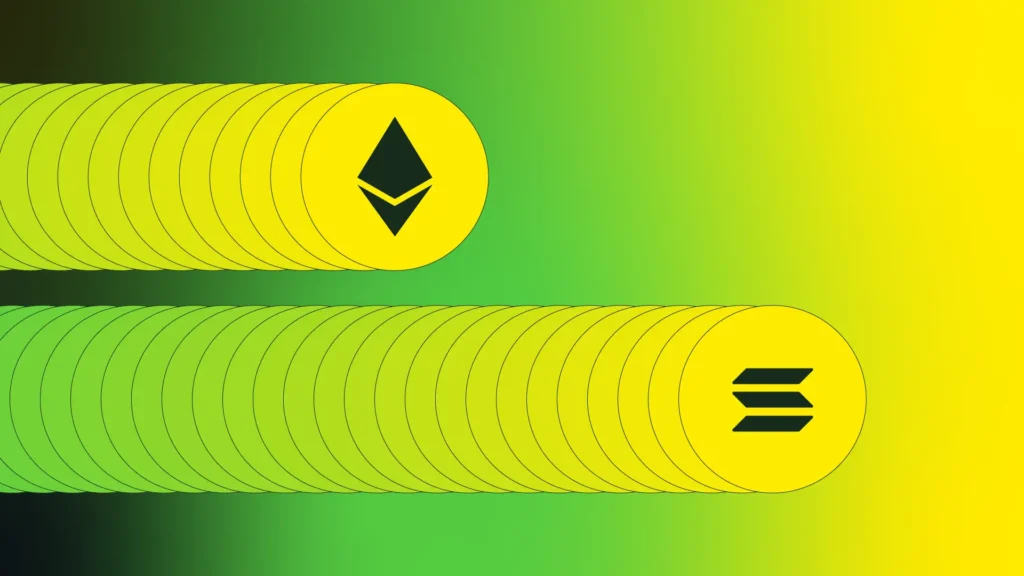
Ethereum (ETH) and Solana (SOL) both posted strong numbers in 2025, but they told very different stories.
One leaned into institutional adoption and financial infrastructure, the other into scale, speed, and retail-driven activity.
Together, their year-in-review data reveals how blockchain usage is diverging—and why the Ethereum vs. Solana debate looks very different heading into 2026.
Network Performance and Transactions
Ethereum continued to improve throughput and efficiency through its expanding Layer 2 (L2) ecosystem.
Rollups processed an average of more than 5,600 transactions per second (TPS), with daily peaks reaching 1.74 million transactions.
These gains significantly reduced congestion and costs compared to prior years.
Solana, meanwhile, reported roughly 33 billion non-vote transactions in 2025 (116 billion including votes), averaging 1,054 non-vote TPS.
The network added 725 million new wallets with at least one transaction and averaged 3.2 million daily active wallets—about 50% higher than the previous year.
In raw volume and user growth, Solana clearly led.
Ethereum’s effective TPS surpassed Solana’s when L2 activity is included, but Solana handled high throughput directly on its base layer.
As a result, Solana appeared better suited for high-frequency, everyday use, while Ethereum excelled through scalable, layered infrastructure.
Fee reductions reinforced these trends. Ethereum’s L2 transaction fees dropped below $0.01, making complex applications more affordable.
Solana’s average fee stood at $0.017, with a median of just $0.0011, meaning most transactions were nearly free.
Both networks remained inexpensive, with Solana slightly favored for simple, frequent transactions.
DeFi and Stablecoins
Ethereum retained its dominance in DeFi, with total value locked (TVL) climbing to nearly $99 billion.
This reflected strong confidence in the network’s security and long-term reliability.
Solana focused less on TVL and more on activity.
Its decentralized exchanges (DEX) processed $1.5 trillion in volume—up 57% year over year—while application revenue reached $2.39 billion, a 46% increase.
Seven Solana-based apps generated more than $100 million each.
The contrast is clear: Ethereum led in capital parked on-chain, while Solana excelled in trading volume and real revenue generation.
Stablecoin usage followed a similar pattern.
Ethereum settled $18.8 trillion in stablecoin transactions, reinforcing its role as the backbone for crypto payments and transfers.
Solana’s stablecoin supply doubled year over year to $14.8 billion, with transfer volume reaching $11.7 trillion—a sevenfold increase over two years.
Solana also diversified into new asset classes, including $1 billion in tokenized equities, $33 billion in Bitcoin volume, and smaller integrations of assets like Zcash, Monad, and NEAR.
Ethereum remained the leader in stablecoin settlement, but Solana’s growth rate and asset experimentation stood out.
Institutional Adoption and Ecosystem Growth
Institutional demand remained Ethereum’s strongest advantage.
Ethereum exchange-traded funds (ETFs) and strategic reserves held more than $35 billion in ETH, while on-chain real-world asset issuance exceeded $12 billion.
When looking at the institutional side of things, Ethereum’s ETFs and strategic reserves held over $35 billion in ETH.
On-chain RWA (real-world assets) issuance exceeded $12 billion, indicating that it remains among the top holdings of choice for institutions.
Solana entered the ETF market later, launching its first products in the third quarter of 2025.
Despite the late start, Solana ETFs attracted $1.02 billion in net inflows and maintained momentum even as Bitcoin and Ethereum ETFs faced sustained outflows.
Staked SOL has reached 421 million tokens, representing an 8% year-over-year increase.
While Ethereum continued to dominate in absolute institutional scale, Solana showed early signs of growing institutional interest.
Developer and ecosystem metrics further highlighted the divide.
Ethereum reported over 88 million smart contracts deployed and roughly 32,000 active developers, reflecting a large and mature builder base.
Solana, by contrast, emphasized economic activity. Network revenue reached $1.4 billion—up 48 times in two years—driven by memecoins ($482 billion in volume), launchpads (11.6 million tokens created), and AI-agent activity ($31 billion in volume).
Ethereum appeared more established for long-term development, while Solana thrived in fast-moving, high-engagement segments.
Who Came Out Ahead?
Both networks delivered strong performances in 2025, but their strengths diverged.
Ethereum deepened its role in institutional finance through ETFs, real-world assets, and DeFi, supported by a large developer community and improved L2 scalability.
Solana, meanwhile, surged in user activity, transaction volume, and app revenue, pairing accessibility with rapid experimentation.
While it still trails Ethereum in locked value and institutional depth, its pace of growth suggests the gap continues to narrow.
In short, Ethereum retained its edge in financial integration, while Solana proved itself to be a high-speed, high-activity network, gaining ground rapidly.

Prashant Jha is a seasoned crypto journalist based in Delhi, India, with a Bachelor’s Degree in Computer Science Engineering. Passionate about the evolving world of blockchain and cryptocurrencies, he has been a dedicated voice in the industry since 2018. Prashant’s expertise lies in regulatory reporting, where he unravels complex legal and financial developments with clarity and precision. Before joining CCN in 2024, he honed his craft at Cointelegraph, establishing himself as a trusted name in crypto journalism.
His coverage spans major industry events, including the high-profile collapses of FTX, Three Arrows Capital (3AC), and LUNA, offering readers insightful analyses of their regulatory and market implications. Prashant’s technical background enables him to bridge the gap between intricate blockchain technology and its real-world applications, making his work accessible to novices and experts.
Beyond his professional pursuits, Prashant is an avid music enthusiast, often exploring diverse genres to unwind. A sports lover, he has a particular passion for cricket and frequently engages in discussions about the game. His multifaceted interests and sharp journalistic instincts make him a valuable contributor to CCN, where he continues shaping the crypto landscape's narrative.