Key Takeaways
The European Central Bank may succeed in building a secure and resilient digital euro, but its adoption could ultimately depend on something far simpler: whether people find it easier to use than their existing payment methods.
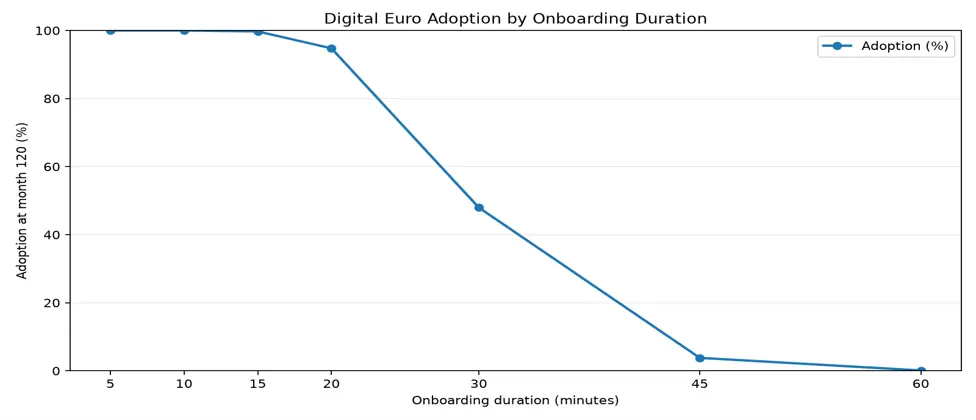
Research from OMFIF and Imperial College London’s Centre for Financial Technology suggests that small frictions in onboarding and payments could sharply reduce usage.
Their agent-based model simulated how consumers might adopt the digital euro across retail, online and person-to-person channels.
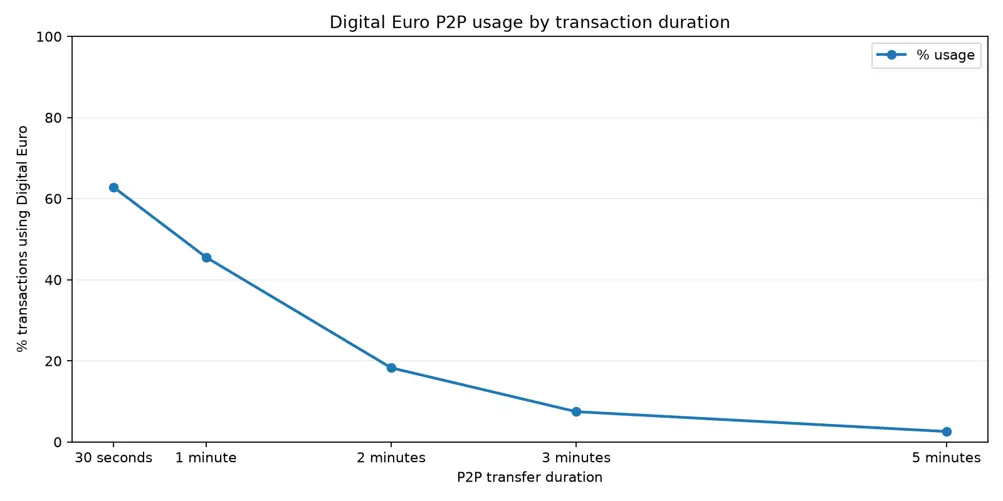
The findings set clear benchmarks. Registration should take no longer than 20 minutes, peer-to-peer transfers should take 60 seconds or less, and in-store payments should match the roughly 12 seconds required for a conventional card transaction.
Without that level of convenience, the digital euro risks becoming a wallet that Europeans open once but rarely use again.
+53
Bitcoin
Bitcoin Cash
Dogecoin
Ethereum
Litecoin
TRON
Tether
Ripple
Build'N'Build
Cardano
Toncoin
1inch Network
Aave
Algorand
Aptos
Arbitrum
Cosmos
Avalanche
Axie Infinity
Basic Attention Token
Chiliz
Compound
Curve DAO Token
Dai
Polkadot
Ethereum Name Service
Frax
The Graph
Immutable
Injective Protocol
Kava.io
Lido DAO Token
Chainlink
Decentraland
Polygon Matic
Maker
Mantle
NEAR Protocol
Optimism
PAX Gold
Pepe
Quant
Render Token
The Sandbox
Shiba Inu
Solana
Sui
SushiSwap
Uniswap
USD Coin
Wrapped Bitcoin
Wrapped Ethereum
Worldcoin
Tether Gold
Stellar
Monero
Tezos
Zcash
+8
Bitcoin Cash
Bitcoin
Ethereum
Litecoin
Tether
Ripple
Dogecoin
Cardano
Build'N'Build
TRON
USD Coin
Solana
Dai
+7
Tether
Bitcoin
Ethereum
USD Coin
TRON
Litecoin
Dogecoin
Ripple
Bitcoin Cash
Solana
Polygon Matic
Build'N'Build
The model identifies onboarding as an early obstacle. If users face a lengthy registration process, many may abandon it before activating their digital euro wallets.
Access through existing banking apps could reduce this problem because banks already possess the information required for know-your-customer and anti-money-laundering checks.
However, those apps may not offer the frictionless person-to-person experience that helped Sweden’s Swish payment service grow.

Swish allows users to send money by selecting a contact or entering a phone number, completing transfers in around 30 seconds.
A digital euro payment requiring a QR code or copied wallet details could take approximately 60 seconds. If users must retrieve multiple bank-account numbers, the process could stretch to two minutes and become less competitive.
Separate ECB research reinforces the challenge. A working paper involving approximately 19,000 households found that explaining the digital euro through a short video temporarily increased willingness to adopt it, but most of the effect disappeared after three months.
Many respondents preferred their established payment methods and showed little interest in learning more. ECB working paper
The ECB has already proposed two features that could improve the product’s prospects: automated wallet funding and co-badging.
Under the waterfall mechanism, digital euros exceeding a user’s holding limit would automatically move into a nominated bank account.
The reverse waterfall would draw money from that account whenever the wallet lacks enough funds to complete a payment.

This would prevent users from having to monitor and manually top up their wallets, an inconvenience the OMFIF model suggests could prove fatal to regular use.
Co-badging would allow consumers to spend digital euros using a physical card or its mobile-wallet equivalent. That could make retail payments as fast as existing card transactions while allowing merchants to accept the digital euro through familiar infrastructure.
Nevertheless, the research suggests peer-to-peer transfers offer the strongest route to adoption.
To succeed, the ECB’s standalone app would need to make sending digital euros as easy as choosing a phone contact.
The political argument for the digital euro rests heavily on European payment sovereignty. More than 60 economists, including Thomas Piketty, warned that Europe risks becoming increasingly dependent on American companies such as Visa, Mastercard and PayPal without a public digital alternative.
They described the project as an essential safeguard for European resilience.
Financial-sector professionals remain less convinced. A Center for Financial Studies survey reported that 62.3% considered the digital euro unnecessary given the payment methods already available, while roughly two-thirds expected low or very low consumer adoption.
LATEST: 🏦 The European Central Bank says the Eurosystem will not be able to identify digital euro users, with offline transactions visible only to the payer and payee. pic.twitter.com/KphCw96evQ
— CoinMarketCap (@CoinMarketCap) August 24, 2026
Respondents also raised concerns about costs, cybersecurity and potential deposit outflows from commercial banks.
The ECB therefore faces a product challenge as much as a monetary one. Strategic autonomy may justify creating the digital euro, but it will not persuade consumers to abandon faster or more familiar options.
For everyday users, success may come down to three questions: Can they register quickly, send money in seconds and pay without thinking about which wallet holds their funds?
If not, Europe’s public digital currency could be technically impressive but commercially irrelevant.
Giuseppe Ciccomascolo began his career as an investigative journalist in Italy, where he contributed to both local and national newspapers, focusing on various financial sectors.
Upon relocating to London, he worked as an analyst for Fitch's CapitalStructure and later as a Senior Reporter for Alliance News. In 2017, Giuseppe transitioned to covering cryptocurrency-related news, producing documentaries and articles on Bitcoin and other emerging digital currencies. He also played a pivotal role in establishing the academy for a cryptocurrency exchange website. Crypto remained his primary area of interest throughout his tenure as a writer for ThirdFloor.
You’re All Set!
Thanks for signing up. We’ll be in touch soon with the latest insights.