Cardano Payments Arrive at 137 Swiss SPAR Stores — Can ADA Become Everyday Money?
Share
Key Takeaways
Customers can now pay with ADA at 137 SPAR supermarkets in Switzerland, in one of the first large-scale in-store retail integrations for the Cardano blockchain.
The payment system runs on DFX.swiss’s Open Crypto Pay, allowing shoppers to pay directly from native ADA wallets without using centralized exchanges.
Payments are processed instantly at checkout, making the experience similar to using a card or mobile wallet.
Other solutions, such as Bitcoin Lightning payments, crypto debit cards, and stablecoin payment systems, are also pushing crypto adoption in retail environments.
Cryptocurrency adoption has long promised to move beyond trading screens and into everyday life. In Switzerland, that vision has taken a major step forward, as Cardano (ADA) can now be used to pay for groceries at 137 SPAR supermarkets.
The development follows a new integration between the Cardano Foundation and the Swiss crypto-financial platform DFX.swiss, enabling ADA payments via the Open Crypto Pay system. The initiative marks one of the most visible examples of blockchain technology entering brick-and-mortar retail.
For years, crypto enthusiasts have discussed the potential for digital assets to replace or complement traditional payment systems. Now, Swiss shoppers can walk into a supermarket and pay for everyday items using ADA directly from their crypto wallets.
The question many investors are asking, however, is whether this real-world adoption could eventually translate into price momentum for Cardano’s native token.
How Cardano (ADA) Payments Work at Swiss SPAR Supermarkets
At the center of the rollout is Open Crypto Pay, a payment infrastructure developed by DFX.swiss that allows customers to pay with cryptocurrency in physical retail stores.
Through this system, customers can now pay directly with ADA at checkout counters in 137 SPAR locations across Switzerland. Transactions are processed in real time and do not rely on centralized exchanges, a design that aims to simplify crypto payments while maintaining the decentralized nature of blockchain transactions.
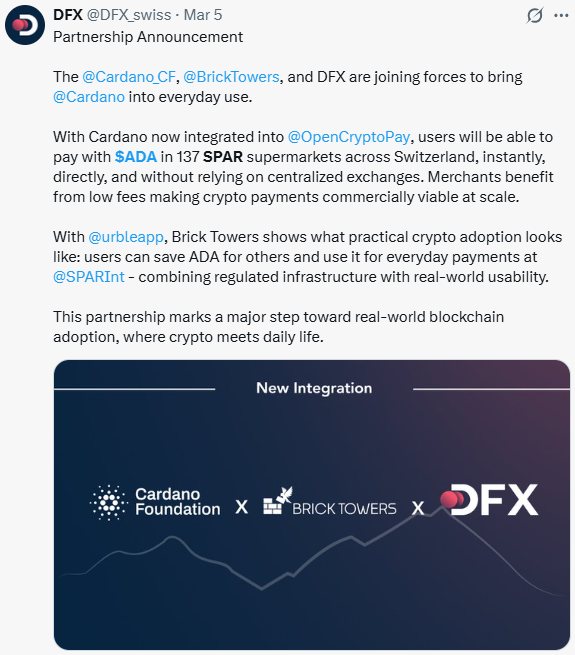
DFX announced the partnership with Cardano and Brick Towers. | Credit: DFX.swiss X profile
Unlike many crypto payment solutions that require converting digital assets through third-party platforms, Open Crypto Pay allows native ADA wallets to interact directly with the payment system. Customers simply scan a payment code at checkout, and the transaction is settled on-chain.
Key features of the system include:
Direct wallet payments: Customers can pay using ADA from their personal Cardano wallets without converting to fiat first.
Real-time settlement: Transactions are processed almost instantly at the checkout counter.
No centralized exchange required: Payments occur directly on-chain, reducing reliance on intermediaries.
Lower merchant fees: Retailers can reduce transaction costs compared to traditional card payment systems.
Seamless checkout experience: The payment process feels like using a debit card or a mobile payment app.
This type of integration is significant because it addresses one of the biggest barriers to crypto adoption: usability. By embedding crypto payments into existing retail infrastructure, the experience can become similar to paying with a debit card or mobile wallet.
Frederik Gregaard, CEO of the Cardano Foundation, described the development as part of a broader shift in financial infrastructure. He noted that blockchain technology becomes truly impactful when it operates invisibly in everyday financial activities, allowing users to transact without needing to think about the underlying technology.
Why Retailers May Benefit From Accepting Crypto Payments
One of the strongest incentives for retailers to adopt crypto payments lies in lower transaction fees.
Traditional payment methods, particularly credit cards, often involve several intermediaries, each charging a processing fee. For retailers operating on thin margins, especially in grocery retail, these fees can accumulate quickly.
According to DFX.swiss, transaction fees with Open Crypto Pay are roughly two-thirds lower than those with conventional payment providers.
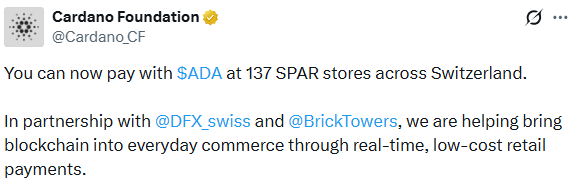
Cardano says users can now pay with ADA at 137 SPAR stores across Switzerland. | Credit: Cardano Foundation X profile
This fee reduction could represent a meaningful advantage for merchants.
Lower transaction costs also make blockchain payments attractive in countries with advanced retail systems, such as Switzerland, where payment infrastructure is already highly digitalized but still expensive for merchants.
Beyond cost savings, blockchain payments also provide instant settlement, reducing delays associated with card processing systems.
Cyrill Thommen, CEO of DFX.swiss, said the partnership demonstrates how blockchain technology can move beyond experimental use cases and deliver practical benefits for businesses and consumers.
How DFX.swiss Connects Crypto Payments With Traditional Banking
While paying with crypto may seem simple, one of the biggest challenges to adoption is connecting blockchain assets to the traditional financial system.
To address this issue, the integration relies heavily on DFX.swiss’s on- and off-ramp infrastructure.
These services allow users to convert ADA into fiat currencies, such as Swiss francs, or to purchase ADA directly through their DFX accounts. By enabling seamless conversions, the platform removes much of the friction typically associated with crypto payments.
Key functions of the DFX.swiss infrastructure include:
Fiat-to-crypto purchases: Users can buy ADA directly with traditional currencies such as Swiss francs.
Crypto-to-fiat conversion: ADA can be exchanged back into fiat quickly when needed.
Direct bank integration: Funds can be transferred between bank accounts and blockchain wallets without intermediaries.
Simplified user experience: Fewer steps are required compared to using multiple crypto exchanges.
Improved accessibility: Makes crypto payments more practical for everyday users and businesses.
Instead of requiring multiple exchanges or intermediaries, the system allows funds to move directly between bank accounts and blockchain wallets.
This type of infrastructure is essential if cryptocurrencies are to function as practical payment tools rather than purely speculative assets. Without reliable on-ramps and off-ramps, users would struggle to move between traditional money and digital assets.
Cardano Savings Ecosystem Expands With urble App
The ecosystem around this integration goes beyond payments alone.
Swiss fintech company Brick Towers has developed a financial application called urble, which integrates with the DFX.swiss infrastructure and the Cardano blockchain.
The app focuses on digital savings goals, allowing users to allocate ADA toward long-term financial planning.
Key features of the urble app include:
Goal-based crypto savings: Users can set specific savings targets using ADA.
Family-focused planning: Separate savings goals can be created for children, partners, or other family members.
Integration with Cardano: Savings are built around ADA, linking personal finance tools with the Cardano ecosystem.
Connection to payment infrastructure: Through its integration with DFX.swiss, users can both save and spend ADA within the same ecosystem.
User-friendly wealth management: Designed to make digital assets easier to use for everyday financial planning.
Users can create separate savings goals for children, partners, or family members, blending traditional savings accounts with blockchain-based assets.
By combining spending and saving tools within the same ecosystem, the developers aim to create a closed financial loop where users can earn, save, and spend cryptocurrency without leaving the platform.
This approach reflects a broader trend in fintech: integrating crypto into everyday financial services rather than treating it solely as a speculative investment category.
Other Companies Offering Crypto Payments in Retail
While Cardano’s entry into Swiss supermarkets is notable, it is not the first attempt to bring cryptocurrency into physical retail.
Several companies have experimented with crypto payment infrastructure over the past decade.
The Lightning Network allows Bitcoin transactions to be processed almost instantly with minimal fees, making it suitable for small purchases such as coffee or groceries.
Retail adoption of Lightning payments has expanded in regions such as El Salvador, where Bitcoin is legal tender, and in parts of Europe where merchants accept Lightning payments through specialized point-of-sale systems.
Crypto Debit Cards
Another widely used method for spending cryptocurrency involves crypto debit cards.
Companies such as Crypto.com, Coinbase, and Binance have launched payment cards that convert cryptocurrency into fiat at the point of sale.
These cards allow users to spend crypto anywhere traditional card networks like Visa or Mastercard are accepted.
However, unlike direct blockchain payments, crypto cards rely on centralized intermediaries that convert assets into fiat before the transaction reaches the merchant.
Stablecoin Payment Systems
Stablecoins have also become a popular option for crypto payments because their value is pegged to traditional currencies.
Platforms such as Strike, BitPay, and various fintech startups have explored using stablecoins for retail transactions, particularly in cross-border payments.
Stablecoins offer price stability, which can make them more appealing to merchants than volatile assets like Bitcoin or ADA.
The country’s Crypto Valley, centered around the city of Zug, has become a hub for blockchain startups, foundations, and research organizations.
Major blockchain projects, including Ethereum, Cardano, and Tezos, have established strong presences in Switzerland due to the country’s supportive regulatory framework.
Switzerland has become one of the most crypto-friendly jurisdictions in the world. | Credit: CrysYost.icp X profile
Swiss regulators have generally taken a balanced approach to cryptocurrency, allowing innovation while maintaining financial oversight.
This environment has made Switzerland an ideal testing ground for real-world blockchain use cases, including retail payments.
The SPAR integration reflects how crypto companies are increasingly experimenting with everyday commerce rather than purely financial trading.
Will Real-World Adoption Drive Cardano (ADA) Price Growth?
For investors, the most pressing question is whether developments such as retail adoption can influence a cryptocurrency’s market price.
Historically, crypto prices have been driven more by speculation and market cycles than by direct usage. However, long-term adoption can still influence a network’s perceived value.
Key factors that could affect ADA’s price include:
Real-world utility: Wider use of ADA for payments could increase demand for the token.
Network activity: More transactions on the Cardano blockchain may strengthen the ecosystem.
Merchant adoption: If more retailers accept ADA, its practical use case could expand.
User growth: Increased wallet activity and payment usage could signal stronger adoption.
Institutional interest: Partnerships and integrations may attract more investment into the network.
If cryptocurrencies become widely used for payments, demand for the underlying tokens may increase, particularly if those tokens are required to power the payment infrastructure.
In Cardano’s case, ADA functions as the native asset used for transaction fees and network operations. Greater network usage could, in theory, lead to higher demand for the token.
However, price movements also depend on broader market factors such as:
Overall crypto market trends.
Investor sentiment and speculation.
Macroeconomic conditions and liquidity.
Regulatory developments.
Technological progress within the Cardano ecosystem.
Because of these variables, real-world adoption alone does not guarantee price appreciation, but it can strengthen a blockchain network’s long-term fundamentals.
Cardano Retail Payments Signal a New Phase of Crypto Adoption
For years, cryptocurrency advocates have argued that digital assets would eventually become part of everyday financial life.
The launch of ADA payments at Swiss SPAR stores offers a tangible example of that vision.
Instead of remaining confined to exchanges and trading platforms, blockchain technology is beginning to appear in places where consumers interact with money daily.
While it remains to be seen whether shoppers will widely adopt crypto payments, the integration represents a step toward normalizing blockchain transactions in everyday commerce.
If successful, similar models could expand to other retailers, regions, and cryptocurrencies.
For now, Swiss shoppers may find themselves participating in a small but notable experiment: buying groceries with Cardano.
Can you really pay with Cardano (ADA) at supermarkets in Switzerland?
Yes. Through a new integration between the Cardano Foundation and DFX.swiss, customers can now pay with ADA at 137 SPAR supermarkets in Switzerland. Payments are processed using the Open Crypto Pay system, allowing users to pay directly from their ADA wallets at checkout.
How do Cardano payments work at SPAR stores?
Customers use Open Crypto Pay, a crypto payment system developed by DFX.swiss. At checkout, shoppers scan a payment code and confirm the transaction using their ADA wallet. The payment is then processed in real time on the Cardano blockchain.
Do customers need to convert ADA to cash before paying?
No. One of the key features of the system is that users can pay directly with ADA from their native wallets. However, DFX.swiss also provides on- and off-ramp services that allow users to convert ADA to fiat currencies like Swiss francs if needed.
Why are retailers interested in accepting Cardano payments?
Retailers may benefit from significantly lower transaction fees. According to DFX.swiss, payment fees through Open Crypto Pay can be around two-thirds lower than traditional card payment systems, which can help merchants reduce costs.
Disclaimer:
The information provided in this article is for informational purposes only. It is not intended to be, nor should it be construed as, financial advice. We do not make any warranties regarding the completeness, reliability, or accuracy of this information. All investments involve risk, and past performance does not guarantee future results. We recommend consulting a financial advisor before making any investment decisions.
Giuseppe Ciccomascolo began his career as an investigative journalist in Italy, where he contributed to both local and national newspapers, focusing on various financial sectors.
Upon relocating to London, he worked as an analyst for Fitch's CapitalStructure and later as a Senior Reporter for Alliance News. In 2017, Giuseppe transitioned to covering cryptocurrency-related news, producing documentaries and articles on Bitcoin and other emerging digital currencies. He also played a pivotal role in establishing the academy for a cryptocurrency exchange website. Crypto remained his primary area of interest throughout his tenure as a writer for ThirdFloor.


 Easy
Easy