82 crypto project shutdowns happened in 2026 as weak demand, funding shortages, and security breaches expose unsustainable businesses. | Credit: CCN.com
Share
Key Takeaways
Stacy Muur identified 82 crypto projects that reportedly shut down in 2026 across DeFi, infrastructure, and Web3 gaming.
DeFiLlama separately recorded 100 wind-down announcements by August; the counts use different criteria and should not be combined.
Weak demand, depleted funding, insufficient revenue, and security breaches are driving closures.
Crypto’s survival problem is spreading beyond falling token prices. Researcher Stacy Muur has identified 82 projects and protocols that reportedly shut down in 2026, highlighting the pressure on businesses across decentralized finance, blockchain infrastructure, and Web3 gaming.
The list includes Balancer, Radiant Capital, Neon EVM, and Step Finance. Their reported exits reflect different combinations of security failures, exhausted funding, and businesses unable to generate enough income.
Yet the headline count needs context. Separate research from DeFiLlama had already recorded 100 shutdown announcements by August, using a methodology that includes wind-downs and strategic transitions.
New Trending Crypto Wallet Offers
Sponsored
Disclosure
We sometimes use affiliate links in our content, when clicking on those we might receive a commission at no extra cost to you. By using this website you agree to our terms and conditions and privacy policy.
Shutdown Count Is Bigger and More Complicated Than 82
Muur’s list offers a snapshot of the shakeout, rather than a definitive industry census.
DeFiLlama’s analysis counted projects that announced wind-downs during 2026. It excluded those that announced closures in 2025 but stopped operating this year. Forty announcements came in the preceding 90 days.
The two figures should therefore neither be added together nor treated as directly comparable totals.
Compiled a list of protocols that have shut down in 2026.
A shutdown can also mean different things. A development company can close while contracts remain deployed; a network can migrate to another chain; a product can disappear while its parent organization continues.
DeFiLlama explicitly included strategic pivots, identifying Fantom’s transition toward Sonic as one example. Its research also distinguished a development team’s departure from the confirmed death of an underlying network.
For tokenholders, those distinctions matter. Continued trading does not establish that a project still has developers, sustainable operations, or a viable product.
The broader concern is business continuity: whether anyone remains responsible for maintaining the service users originally funded.
Blast Shows Why Billions in Deposits Cannot Guarantee Survival
Blast provides a prominent example of economic failure following rapid initial growth.
The Ethereum layer-2 network announced its wind-down on Oct. 2 after operating costs exceeded revenue. The team said it saw no credible route to making the chain sustainable,.
Blast had attracted more than $2 billion in deposits before its February 2024 mainnet launch, helped by native yield and a points program linked to an anticipated airdrop. Its DeFi deposits subsequently fell sharply.
Blast will be shutting down.
We launched Blast with the goal of building a self-sustaining chain for users and developers. Unfortunately, the economics of operating the chain no longer make sense: the ongoing costs of maintaining Blast exceed the revenue generated by the L2, and…
The practical consequences extend beyond the BLAST token. Users have until October 26 to withdraw through the normal interface. Afterward, accessing assets will require direct interaction with bridge contracts on Ethereum.
Other closures followed security shocks. Step Finance stopped operating after a treasury breach, while Radiant Capital announced a wind-down after failing to recover from its 2024 exploit.
These cases illustrate separate vulnerabilities: attracting deposits without sufficient operating income, and losing the resources or confidence needed to rebuild after an attack.
Funding Cannot Substitute for Customers and Cash Flow
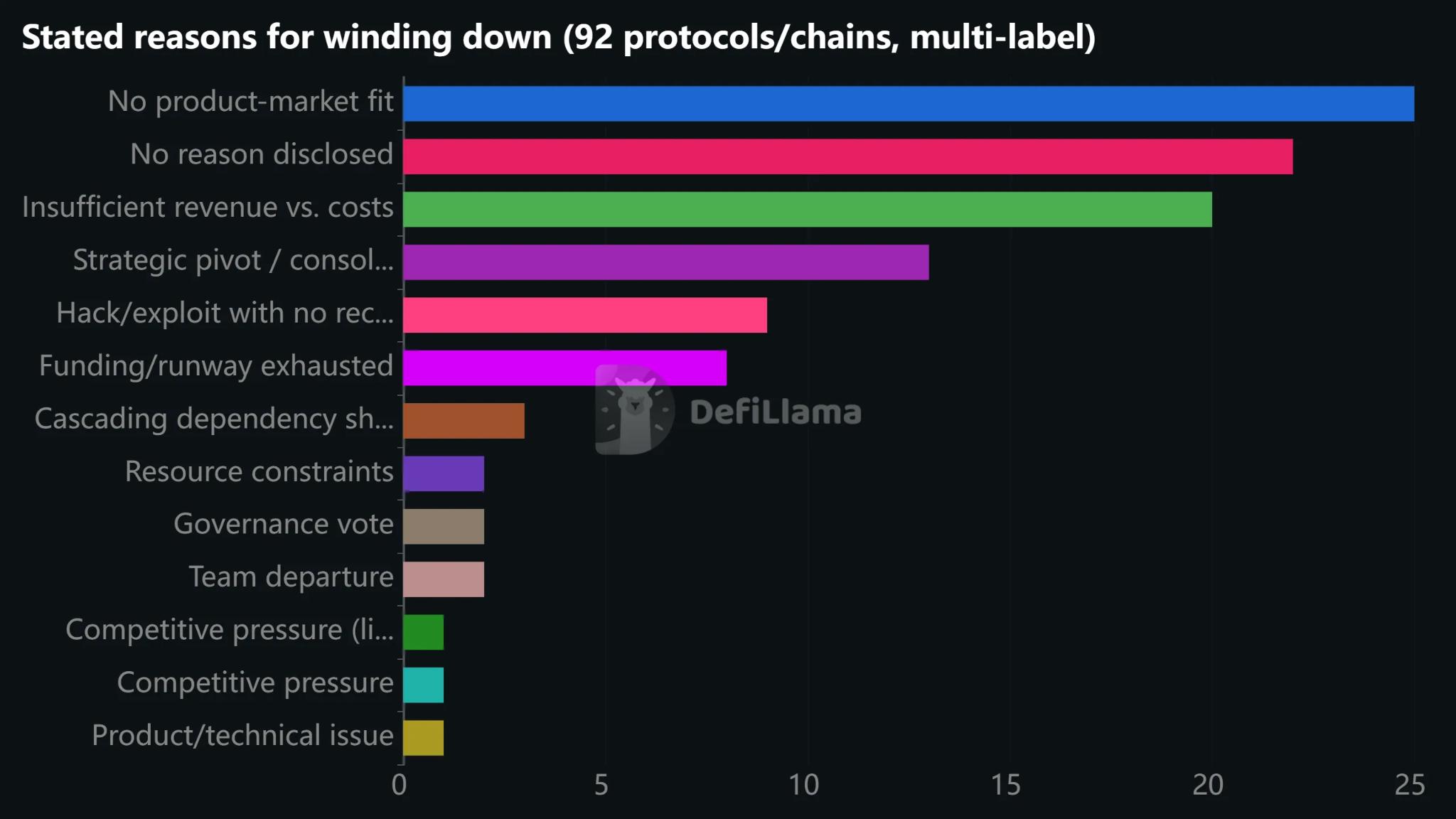
DeFiLlama identified weak product-market fit as the most common stated shutdown reason, followed by depleted runway, insufficient revenue, and product pivots.
The projects collectively raised approximately $1 billion and generated $250 million in lifetime fees. Nine individually raised more than $50 million.
Reasons behind crypto project shutdowns in 2026. | Credit: DeFiLlama
Those fees should not be mistaken for expenses or profits. DeFiLlama defines fees as total user payments; protocol revenue represents the portion retained rather than distributed to participants such as liquidity providers.
Capital is also concentrating. DeFiLlama reported higher venture investment in the first half of 2026 despite an 80% decline in deal count, alongside 87 mergers and acquisitions by August.
The implication is a tougher funding environment for marginal projects. Without repeat users and retained income, another financing round may postpone closure without fixing the business.
Disclaimer:
The information provided in this article is for informational purposes only. It is not intended to be, nor should it be construed as, financial advice. We do not make any warranties regarding the completeness, reliability, or accuracy of this information. All investments involve risk, and past performance does not guarantee future results. We recommend consulting a financial advisor before making any investment decisions.
Giuseppe Ciccomascolo began his career as an investigative journalist in Italy, where he contributed to both local and national newspapers, focusing on various financial sectors.
Upon relocating to London, he worked as an analyst for Fitch's CapitalStructure and later as a Senior Reporter for Alliance News. In 2017, Giuseppe transitioned to covering cryptocurrency-related news, producing documentaries and articles on Bitcoin and other emerging digital currencies. He also played a pivotal role in establishing the academy for a cryptocurrency exchange website. Crypto remained his primary area of interest throughout his tenure as a writer for ThirdFloor.