Key Takeaways
- Over half of all cryptocurrencies launched since 2021 have failed, yet many remain tradable.
- Once-prominent projects continue moving within the market despite halted development or failed missions.
- Fueled by speculation and nostalgia, CCN dives into how the crypto industry has a strange resistance to death.
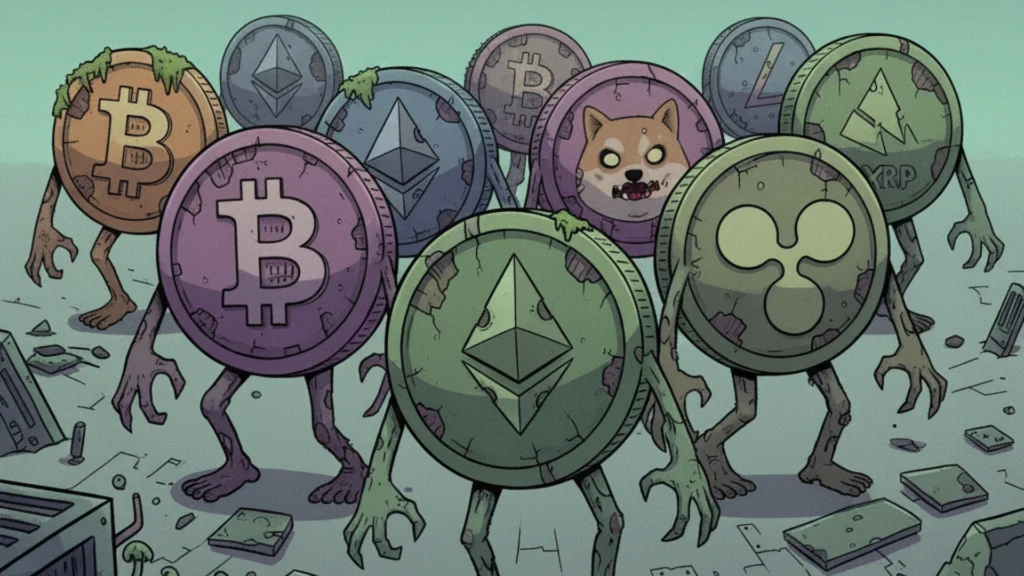
With so many cryptocurrency projects collapsing in recent years, it’s hardly surprising that some still shuffle along like the walking dead.
Despite being abandoned by their creators, millions of so-called “dead tokens” continue to exist, and some even trade, as the industry refuses to let go of the deceased.
With Halloween upon us, CCN dives into the strange world of dead projects that refuse to disappear.
What Are Dead Tokens and Why Are They Still Trading?
A “dead token” typically refers to a crypto project where most or all development has ceased, the websites and social channels have been abandoned, and there is no practical use case anymore.
Many of these tokens, although “dead,” still exist on-chain and can technically be traded because their smart contracts remain active.
Once a token is issued on a blockchain and liquidity pools are created, there is no easy mechanism to remove it entirely.
Trading activity on these projects is usually driven by speculators rather than investors betting on genuine project value.
In some cases, tokens are delisted from major exchanges but remain accessible via smaller decentralized exchanges (DEXs).
How Many Dead Tokens Are There?
According to data from GeckoTerminal, over half of all cryptocurrencies listed since 2021 have failed to gain traction.
Of the nearly seven million projects launched between 2021 and the present, roughly 3.7 million have ceased trading and are considered failures.
| Year of Launch |
Number of Dead Coins |
| 2021 |
2,584 |
| 2022 |
213,075 |
| 2023 |
245,049 |
| 2024 |
1,382,010 |
| 2025 (April) |
1,821,549 |
| 2026 |
N/A |
Much of that wave of collapse occurred in 2024 and early 2025, with around 1.4 million failures in 2024 and 1.8 million so far in 2025.
The explosion of new tokens, especially those generated through platforms like pump.fun, has flooded the market with low-effort projects that quickly disappear.
As a result, a huge portion of the crypto universe now consists of tokens that are essentially lifeless, though many remain publicly tradable.
Tokens That Should Be Dead but Still Trade
LUNA
The collapse of TerraUSD and its sister token, LUNA, in May 2022 wiped out tens of billions of dollars in market value and triggered one of the largest crashes in cryptocurrency history.
The stablecoin lost its dollar peg, and LUNA’s value fell by more than 99.99%.
Although the original Terra network effectively collapsed, it was rebranded as Terra Classic (LUNC), while a new iteration of the platform adopted the LUNA ticker symbol.
In the second half of 2023, the revamped LUNA showed signs of a comeback, achieving a billion-dollar market capitalization and briefly returning to the top 10 cryptocurrencies.
However, in August 2023, the platform was hacked, causing its value to drop to a new all-time low.
Terra’s founder, Do Kwon, was arrested in Montenegro in March 2023 and later charged by U.S. prosecutors with eight offenses, including securities fraud and wire fraud.
His company, Terraform Labs, filed for bankruptcy in January 2024, marking the formal end of one of crypto’s most notorious ventures.
Despite several partial recoveries throughout 2023 and 2024, LUNA’s value dropped again to an all-time low and has not regained its former top-tier position.
Both LUNA Classic (LUNC) and LUNA still trade actively on several exchanges.
Kadena (KDA)
The Kadena Foundation announced in October 2025 that it would cease operations, citing an inability to continue supporting the blockchain network’s development.
In an official statement, the organization confirmed it would end all business activity and maintenance of the blockchain.
The news sent the KDA token tumbling more than 60% in a single day to a new all-time low.
Despite the shutdown, the Kadena blockchain remains online, sustained by independent miners and community operators.
Major exchanges, however, have begun distancing themselves from the asset.
Binance.US announced it would delist Kadena on Nov. 12, citing low trading volume and insufficient project development.
The exchange said it periodically removes tokens that no longer meet its quality or compliance standards.
“With no demand in sight, KDA’s price might reach a new all-time low below $0.045,” CCN analyst Victor Olanrewaju said.
“However, this trend might reverse if many other exchanges drum up support for Kadena. In that scenario, the altcoin might rise toward $0.20,” he added.
Ethereum Classic (ETC)
Ethereum Classic (ETC) remains one of the crypto market’s most persistent survivors, a blockchain born from controversy and sustained more by legacy than innovation.
ETC was created in 2016 following the infamous DAO hack, which split the Ethereum network in two.
The majority of users voted to roll back the stolen funds and continue as Ethereum (ETH), while a minority maintained the original chain under the principle that “code is law.”
That chain became Ethereum Classic.
Today, ETC continues to operate using a Proof-of-Work (PoW) mechanism, even after Ethereum’s 2022 transition to Proof-of-Stake (PoS).
It records tens of millions of dollars in daily trading volume, though developer activity and adoption remain limited.
As of January 27, 2025, ETC was trading at around $25.10, according to CCN, which then reported in March that ETC had suffered a 40% correction within the last 90 days.
At the time of reporting, the token is trading at $15.70.
“Ethereum Classic has been a somewhat solid, if unspectacular, performer,” a CCN analyst previously wrote. “While the coin benefits from Ethereum’s brand and its adherence to Proof-of-Work, it continues to operate in its predecessor’s shadow.”
Analysts concluded that without meaningful developer engagement or ecosystem growth, ETC will remain a zombie.
Ripple Labs (XRP)
Perhaps the most controversial on this list, Ripple Labs, once billed as a challenger to the global payments network SWIFT, now operates as what analysts have called a “crypto zombie.”
The company’s original goal was to modernize international money transfers through its XRP-based ledger, offering banks a faster, cheaper way to move funds.
But that ambition seems increasingly distant, especially as SWIFT explores its own blockchain implementations.
As Forbes reported: “In terms of global money flows, not much is going on at Ripple Labs today, and few expect it ever to disrupt the Belgian banking cooperative known as SWIFT,” which processes around $5 trillion in interbank transfers daily.
Despite failing to achieve its primary mission, Ripple’s blockchain still operates, recording transactions of its native token XRP, albeit with limited real-world utility.
The token continues to trade heavily, around $5.36 billion worth each day, and maintains a market capitalization of roughly $36 billion, ranking as the sixth-largest cryptocurrency by value.
“But don’t expect XRP or any of these crypto creations to shutter operations anytime soon. With billions sitting in their coffers, Ripple and others can continue to exist for years,” Forbes wrote.

Kurt Robson is a London-based reporter at CCN, specialising in the fast-moving worlds of crypto and emerging technology. He began his career covering local news in Cornwall after graduating from Falmouth University with First Class Honours in Journalism. There, he cut his teeth on everything from council meetings to missing swans.
He quickly rose through the ranks to become a frontline journalist at several of the UK’s leading national newspapers. Over the years, he has interviewed musicians and celebrities, reported from courtrooms and crime scenes, and secured multiple front-page exclusives.
Following the upheaval of the COVID-19 pandemic, Kurt shifted his focus to technology journalism—just ahead of the AI boom. With a natural curiosity and a trained eye for emerging trends, he has found a new rhythm in reporting on innovation.
At CCN, Kurt's work focuses on the cutting edge of crypto, blockchain, AI, and the evolving digital world. Drawing on his background in people-first reporting and his deep interest in disruptive tech, Kurt delivers stories that are insightful, entertaining, and human-centric.