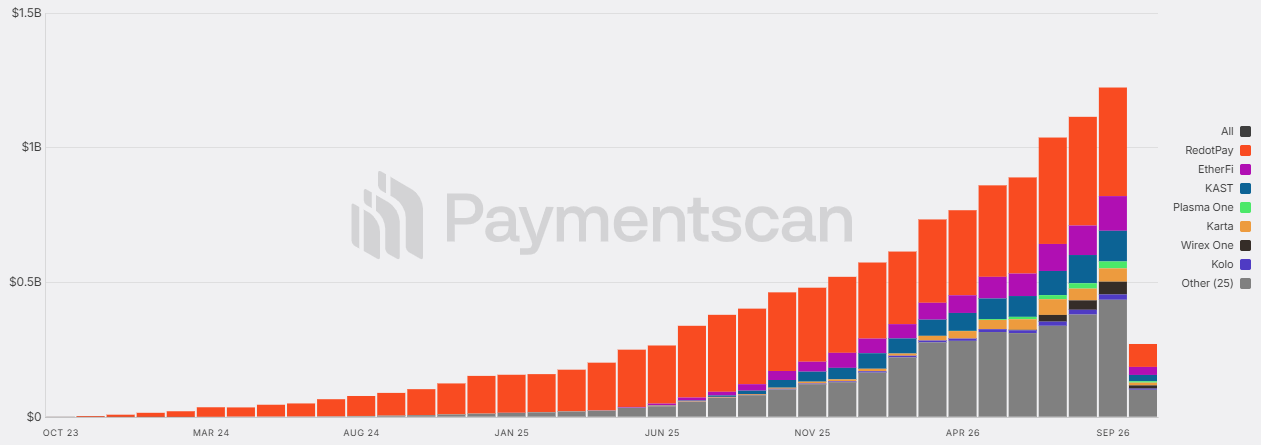
Crypto card volume reaches $12.5 billion, up 140% this year, as stablecoin adoption and QR payments fuel growth. | Credit: CCN.com
Share
Key Takeaways
Crypto card volume hit a reported $12.5 billion, up 140% year-to-date and 247% compared with October 2025.
Jupiter Spend’s activated cards rose 55% quarter-over-quarter, with QR payment demand cited as a key driver.
QR payments connect crypto-funded accounts to local merchants, allowing retailers to receive money through existing payment systems.
Crypto card payment volume has reached a reported record of $12.5 billion, with stablecoins and QR payments helping digital assets move from trading accounts into everyday spending.
The figure represents a 140% year-to-date growth and a 247% increase compared with October 2025, according to Paymentscan data. It also showed that activated cards on Jupiter Spend increased by 55% quarter-over-quarter, driven primarily by demand for QR payments.
The expansion points to a growing intersection between blockchain balances and familiar checkout systems.
Users can fund an account with stablecoins and then pay through existing card networks or by scanning a merchant’s QR code, without requiring the retailer to adopt crypto infrastructure.
Try Our Recommended Crypto Exchanges
Sponsored
Disclosure
We sometimes use affiliate links in our content, when clicking on those we might receive a commission at no extra cost to you. By using this website you agree to our terms and conditions and privacy policy.
The growth rates suggest substantial expansion: a 140% increase means volume is 2.4 times its starting level, while a 247% annual increase means it is approximately 3.47 times the previous year’s figure.
The Kobeissi Letter attributed the surge to broader stablecoin adoption and demand for more efficient cross-border transactions.
However, the headline numbers require context. Paymentscan says it primarily indexes blockchain transactions, supplementing them with issuer-provided off-chain data for a small number of cards.
BREAKING: The total volume of payments processed on crypto cards has reached a record $12.5 billion, up +140% year-to-date.
This also marks +247% growth compared to levels seen in October 2025.
Continued adoption of stablecoins as a payment rail and the push toward cross-border… pic.twitter.com/8AMiahkD0F
Its methodology distinguishes actual spending from account top-ups. Where an issuer uses centralized or batched settlement, the platform may only be able to track deposits, which do not necessarily translate into purchases.
Deposited money can also be withdrawn or transferred through banking channels.
The cited report does not clearly identify the measurement window behind the $12.5 billion total. It should therefore not be described as monthly spending or as an annualized run rate.
Similarly, Jupiter’s reported 55% growth measures the number of activated cards. It does not establish an equivalent increase in transaction volume or repeat spending.
QR Payments Connect Stablecoins to Local Checkouts
Jupiter’s documentation shows how QR payments can extend a crypto-funded account beyond conventional card terminals.
Its QR Pay service lets eligible users scan merchant codes and pay from their Spend account. Payments are processed locally, with recipients receiving funds through domestic payment rails. Merchants do not need to register with Jupiter or install a dedicated integration.
Supported networks include Indonesia’s QRIS, Malaysia’s DuitNow, the Philippines’ QR Ph and Vietnam’s VietQR.
just look at how spending across some crypto cards and onchain neobanks has changed in just one year
Jupiter says the service charges neither the payer nor the recipient, including for foreign-exchange conversion. Transactions are capped at $500 each and $5,000 daily. Availability depends on the card issuer, country, and activation date; its documentation currently lists Singapore’s and Thailand’s QR networks as temporarily unavailable.
QR purchases also do not earn the cashback available on eligible Jupiter Card transactions.
These details show that QR spending and card purchases are distinct payment routes within the same product. Their appeal lies in connecting a crypto-funded balance to checkout methods merchants already use.
Visa’s Expansion Shows a Broader Payments Shift
Separate figures from Visa support the broader growth story.
In a September update, Visa reported more than 160 stablecoin-linked card programs globally during its fiscal second quarter of 2026, with payment volume increasing nearly 200% year-over-year. It also said stablecoin settlement volume had exceeded a $20 billion annualized run rate.
That settlement figure measures a different activity from consumer card spending and should not be added to the reported $12.5 billion total.
Crypto cards were just the wedge.
Stablecoins are now moving into business payments, bank settlement and merchant checkout at the same time.
Three launches this week make that pretty obvious.
Jupiter’s card illustrates the connection: users fund their accounts with supported stablecoins, while purchases travel through Visa and settle in fiat.
Spending is limited to deposited funds rather than a borrowing allowance.
Together, the developments suggest crypto payments are gaining traction by fitting into existing commerce. The next test is whether rapid card activation translates into sustained everyday use.
Disclaimer:
The information provided in this article is for informational purposes only. It is not intended to be, nor should it be construed as, financial advice. We do not make any warranties regarding the completeness, reliability, or accuracy of this information. All investments involve risk, and past performance does not guarantee future results. We recommend consulting a financial advisor before making any investment decisions.
Giuseppe Ciccomascolo began his career as an investigative journalist in Italy, where he contributed to both local and national newspapers, focusing on various financial sectors.
Upon relocating to London, he worked as an analyst for Fitch's CapitalStructure and later as a Senior Reporter for Alliance News. In 2017, Giuseppe transitioned to covering cryptocurrency-related news, producing documentaries and articles on Bitcoin and other emerging digital currencies. He also played a pivotal role in establishing the academy for a cryptocurrency exchange website. Crypto remained his primary area of interest throughout his tenure as a writer for ThirdFloor.