Hyperliquid generated $429 million in 2026 revenue through Sept. 15, outperforming the next two ranked crypto projects combined. | Credit: CCN.com
Share
Key Takeaways
Hyperliquid generated $429.04 million in 2026 revenue through Sept. 15, more than the next two ranked projects combined.
Hyperliquid and Pump.fun captured 22.10% of the $3.40 billion tracked across non-stablecoin projects.
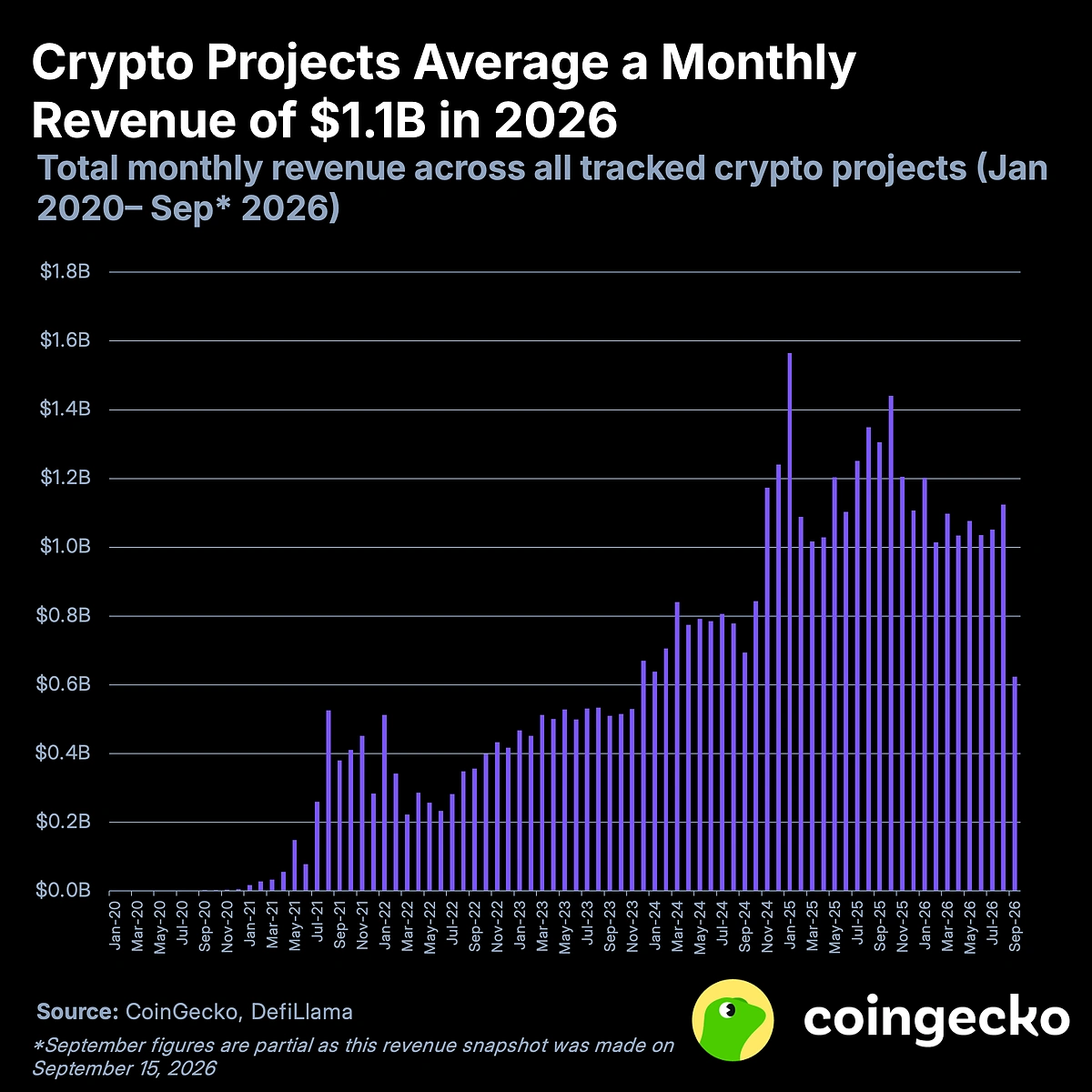
Crypto revenue averaged $1.08 billion per month through August, remaining resilient despite Bitcoin’s nearly 40% decline.
Hyperliquid has emerged as crypto’s largest non-stablecoin revenue generator of 2026, bringing in $429.04 million between Jan. 1 and Sept. 15, according to new CoinGecko research.
The decentralized perpetual futures platform captured 13% of the $3.40 billion generated by the projects included in the study. Its revenue also exceeded the combined $454.30 million earned by Axiom Pro and Sky, the third- and fourth-ranked projects.
Pump.fun finished second with $322.21 million, giving it a 9.5% share. Together, Hyperliquid and the Solana-based memecoin launchpad generated $751.25 million, equivalent to 22% of the tracked total.
The figures underline the strength of speculative trading platforms during a difficult year for the wider crypto market.
Bitcoin fell by almost 40% over the period examined, but demand for perpetual futures, memecoin launches, and on-chain trading tools continued to generate substantial fees.
Try Our Recommended Crypto Exchanges
Sponsored
Disclosure
We sometimes use affiliate links in our content, when clicking on those we might receive a commission at no extra cost to you. By using this website you agree to our terms and conditions and privacy policy.
Hyperliquid’s lead reflects the continued popularity of perpetual futures, or “perps,” which allow traders to take leveraged long or short positions without an expiry date.
The platform operates an on-chain order book through HyperCore, combining features associated with centralized exchanges, such as rapid execution and deep liquidity, with blockchain-based settlement.
Its model generates revenue from trading activity regardless of whether cryptocurrency prices rise or fall. Volatile and declining markets can therefore remain profitable for the platform as traders reposition portfolios, hedge exposure or speculate with leverage.
Hyperliquid’s wider ecosystem also creates revenue opportunities for external applications. Its builder program allows wallets, bots, and trading interfaces to route transactions into HyperCore while charging additional fees.
Axiom Pro, ranked third on CoinGecko’s revenue table with $132.09 million, is one example of a trading terminal that provides access to perpetual futures and integrates Hyperliquid for that functionality.
Hyperliquid’s revenue performance has coincided with substantial gains for its native HYPE token. HYPE reportedly reached an all-time high of $92 on Sept. 18 and had risen approximately 260% since the beginning of the year, even as Bitcoin remained well below its October 2025 record.
However, growing competition could test that momentum. Centralized and regulated platforms are increasingly expanding into perpetual futures, potentially challenging Hyperliquid’s early advantage.
Trading Platforms Dominate the Upper Rankings
CoinGecko’s rankings show that infrastructure surrounding speculative activity can generate as much revenue as the underlying protocols.
Pump.fun earned almost all of its $322.21 million from token creation and trading fees associated with its Solana memecoin launchpad. Axiom Pro followed with $132.09 million, while stablecoin issuer Sky ranked fourth at $129.87 million.
GMGN, another trading terminal focused primarily on Solana memecoins, generated $126.03 million and secured fifth place. Its performance mirrors Pump.fun’s success because both platforms benefit from the same demand for rapid token launches and speculative trading.
HYPERLIQUID TRADER UP $16.3M TRADING CRYPTO AND STOCKS
MRVL Long OG is running $61.8M in perp positions, currently up +$1.46M unrealized.
The book includes a $25.21M $BTC short alongside tokenized stock longs:
Polymarket ranked sixth with $115.48 million in revenue, followed by World Liberty Financial at $95.37 million and Paxos at $87.93 million. Perpetual futures platform edgeX and MEV infrastructure provider Titan Builder completed the top 10 with $84.37 million and $83.47 million, respectively.
The remaining positions went to Collector Crypt, Phantom, Aave, payments project fomo, and decentralized exchange Aerodrome.
Collectively, the top 15 projects captured 56% of the $3.40 billion tracked by CoinGecko. However, no single sector dominated the entire ranking. The list included perpetual futures platforms, trading terminals, stablecoin issuers, a launchpad, a prediction market, a wallet, a lending protocol, an RWA business and a decentralized exchange.
That diversity suggests crypto’s revenue base is expanding beyond conventional DeFi products, even though trading and speculation remain its strongest engines.
Crypto Revenue Holds Up During the Bear Market
Across all tracked projects, including Tether and Circle, crypto generated an average of $1.08 billion in monthly revenue during the first eight months of 2026.
That represented a 12% decline from the $1.22 billion monthly average recorded throughout 2025. Compared with the first eight months of last year, when projects averaged $1.20 billion per month, revenue declined by 10.14%.
The drop was relatively modest compared with Bitcoin’s nearly 40% decline, suggesting that established crypto platforms can maintain activity and fee generation during market downturns.
Crypto revenues remain consistent despite the current bear market. | Credit: CoinGecko
CoinGecko excluded Tether and Circle from its primary top-15 ranking because their scale would obscure differences among other projects.
It also excluded Grayscale, which would otherwise have ranked third with $154.14 million, because its sponsor fees depend on assets under management rather than protocol usage.
The methodology also includes an important distinction: not every dollar classified as crypto revenue came directly from on-chain fees. Stablecoin businesses such as Paxos and World Liberty Financial derive much of their income from off-chain reserves.
Even with those qualifications, Hyperliquid’s lead remains significant. Its $429 million in total revenue shows that demand for decentralized leveraged trading has created one of the sector’s strongest revenue machines, even as the broader market remains under pressure.
Disclaimer:
The information provided in this article is for informational purposes only. It is not intended to be, nor should it be construed as, financial advice. We do not make any warranties regarding the completeness, reliability, or accuracy of this information. All investments involve risk, and past performance does not guarantee future results. We recommend consulting a financial advisor before making any investment decisions.
Giuseppe Ciccomascolo began his career as an investigative journalist in Italy, where he contributed to both local and national newspapers, focusing on various financial sectors.
Upon relocating to London, he worked as an analyst for Fitch's CapitalStructure and later as a Senior Reporter for Alliance News. In 2017, Giuseppe transitioned to covering cryptocurrency-related news, producing documentaries and articles on Bitcoin and other emerging digital currencies. He also played a pivotal role in establishing the academy for a cryptocurrency exchange website. Crypto remained his primary area of interest throughout his tenure as a writer for ThirdFloor.