Bloomberg’s Mike McGlone says crypto has lagged the Nasdaq-100 since 2017 despite far higher volatility, raising doubts about its next major rally. | Credit: CCN.com
Share
Key Takeaways
Bloomberg Intelligence’s Mike McGlone says a broad crypto index has been roughly flat since 2017 while the Nasdaq-100 has risen.
McGlone sees Bitcoin futures, US spot Bitcoin ETFs, and a friendlier political climate as major catalysts that may already have played out.
The verdict depends on the starting date and the assets measured: the broad index’s performance does not describe every Bitcoin investment.
Crypto has delivered spectacular rallies since 2017. But measured against the Nasdaq-100, a broad basket of digital assets has offered a less compelling deal for investors, according to Bloomberg Intelligence strategist Mike McGlone: substantially more volatility without a sustained performance advantage.
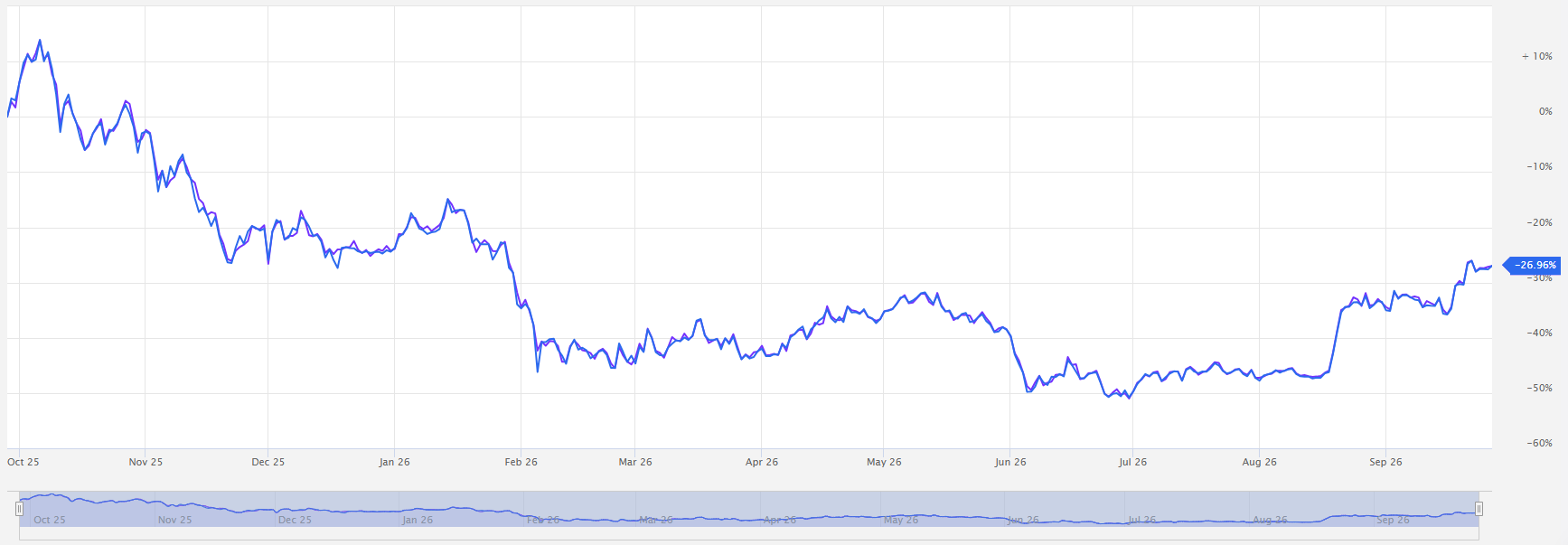
McGlone said the MarketVector Digital Assets 100 Index, or MVDA, has been roughly flat over his comparison period while the Nasdaq-100 has climbed.
He estimates the crypto index experienced about three times as much volatility. For a portfolio manager, that combination raises a harder question than whether Bitcoin can rally again: what additional risk has it delivered?
His answer is pessimistic. McGlone argues that the arrival of regulated Bitcoin futures, US spot Bitcoin exchange-traded products, and a friendlier political climate may have already provided crypto with its strongest catalysts.
Try Our Recommended Crypto Exchanges
Sponsored
Disclosure
We sometimes use affiliate links in our content, when clicking on those we might receive a commission at no extra cost to you. By using this website you agree to our terms and conditions and privacy policy.
A Broad Crypto Bet Has Struggled to Justify Its Risk
The MVDA tracks 100 digital assets weighted by market capitalization. Bitcoin accounts for roughly two-thirds of it, so the index reflects the wider market without giving every small token equal influence.
MarketVector identifies it as a price-return index and lists October 2017 as its launch date.
McGlone’s criticism has two parts. First, he says an investor who held the basket from his 2017 starting point would have endured far larger swings than an investor in the Nasdaq-100 without receiving superior returns.
Second, he argues that crypto’s positive correlation with growth stocks has limited its value as a diversifier.
Crypto Duds vs. Nasdaq for Almost a Decade
The rules of risk and portfolio management may classify Bitcoin and cryptos as duds for almost 10 years. My graphic features the Market Vector Digital Assets 100 index (MVDA) flatlined since 2017 vs. the Nasdaq-100 Index (NDX), despite… pic.twitter.com/yfmY1qYfP2
An asset can earn a place in a portfolio despite modest returns if it tends to rise when other holdings fall. That case becomes harder to make when it tends to move in the same direction as stocks.
The comparison does have limits. Its result depends on the starting date, and an index of 100 changing assets is different from holding Bitcoin alone.
MarketVector digital assets 100 index. | Credit: MVDA
MarketVector’s figures illustrate how much the chosen window matters: its published five-year return for MVDA is negative, while its three-year return is strongly positive. Neither figure, on its own, settles the case for every crypto investor.
Still, McGlone’s test speaks to a practical investment decision. Anyone taking on crypto’s drawdowns in hopes of beating conventional growth stocks has to measure the return against both the magnitude of those drawdowns and the available alternatives.
Mainstream Adoption May Have Changed the Trade
McGlone places the turning point around the launch of Bitcoin futures in 2017. CME Group launched its contract on Dec. 18 that year, giving institutional traders a regulated way to gain exposure to, or hedge against, Bitcoin price moves.
The timing alone does not establish that futures caused crypto’s relative performance to weaken, but it marks a shift toward a more accessible market.
The next major access milestone came in January 2024, when the US Securities and Exchange Commission approved the listing and trading of spot Bitcoin exchange-traded products.
Investors could then buy Bitcoin exposure through familiar brokerage accounts. sec.gov
Crypto lost $2.1T in market value and onchain activity barely moved.
Probably the most interesting number in Chainalysis’ 2026 adoption data.
Global activity fell just 1.6% to ~$9.4T, despite what they describe as the worst crypto bear market since 2022.
McGlone suggests those products, followed by Donald Trump’s pro-crypto pivot ahead of the 2024 election, may represent “as good as it gets” for the asset class.
That is a forecast, not a conclusion established by the historical chart. Easier access can bring in buyers over time; it does not guarantee that future demand has already peaked.
It also leaves a distinction between adoption and investment returns.
More regulated products and more institutional participation could make crypto easier to own while reducing the chance of repeating the outsized gains seen when the market was smaller.
Next Rally Faces a Higher Bar
McGlone’s argument does not require Bitcoin to stop rising. Crypto could post another sharp advance and still disappoint investors if the gains come with much greater volatility than competing assets, or if technology stocks rise alongside it.
That makes the Nasdaq comparison especially consequential. Both markets can benefit when investors seek growth and are willing to accept risk.
If crypto largely shares that exposure, its case as a separate portfolio holding rests more heavily on its ability to deliver returns that compensate for its additional swings.
There are reasons the verdict could change. New demand, broader use of digital assets, or a sustained period in which crypto outperforms stocks could challenge McGlone’s view.
A different start date or a Bitcoin-only comparison could also produce a different historical result.
For now, his warning is narrower and more useful than the headline claim that crypto has permanently peaked.
After nearly nine years since the index’s 2017 launch, investors can ask whether a broad crypto allocation has earned the risk it demanded.
McGlone believes the answer is no and that the milestones once expected to transform its prospects may already be behind it.
Disclaimer:
The information provided in this article is for informational purposes only. It is not intended to be, nor should it be construed as, financial advice. We do not make any warranties regarding the completeness, reliability, or accuracy of this information. All investments involve risk, and past performance does not guarantee future results. We recommend consulting a financial advisor before making any investment decisions.
Giuseppe Ciccomascolo began his career as an investigative journalist in Italy, where he contributed to both local and national newspapers, focusing on various financial sectors.
Upon relocating to London, he worked as an analyst for Fitch's CapitalStructure and later as a Senior Reporter for Alliance News. In 2017, Giuseppe transitioned to covering cryptocurrency-related news, producing documentaries and articles on Bitcoin and other emerging digital currencies. He also played a pivotal role in establishing the academy for a cryptocurrency exchange website. Crypto remained his primary area of interest throughout his tenure as a writer for ThirdFloor.