Bitcoin and Crypto Face a “Lose Lose” Fed Trap as Stocks Reach Historic Extremes, Mike McGlone Warns
Share
Key Takeaways
Bloomberg Intelligence strategist Mike McGlone says crypto faces a “lose-lose” setup as the Federal Reserve tightens policy while US equity valuations remain near historic extremes.
Bitcoin has recovered to around $82,000, but Glassnode says new demand remains weak across ETF flows, stablecoins, corporate buying, and onchain capital inflows.
The S&P 500’s Shiller CAPE is around 41, approaching the dot-com era’s 44.2 peak, while the US 10-year Treasury yield remains close to 5%.
Bitcoin’s recovery toward $82,000 may look like resilience after last week’s Federal Reserve rate hike, but Bloomberg Intelligence strategist Mike McGlone sees something more dangerous building underneath crypto markets.
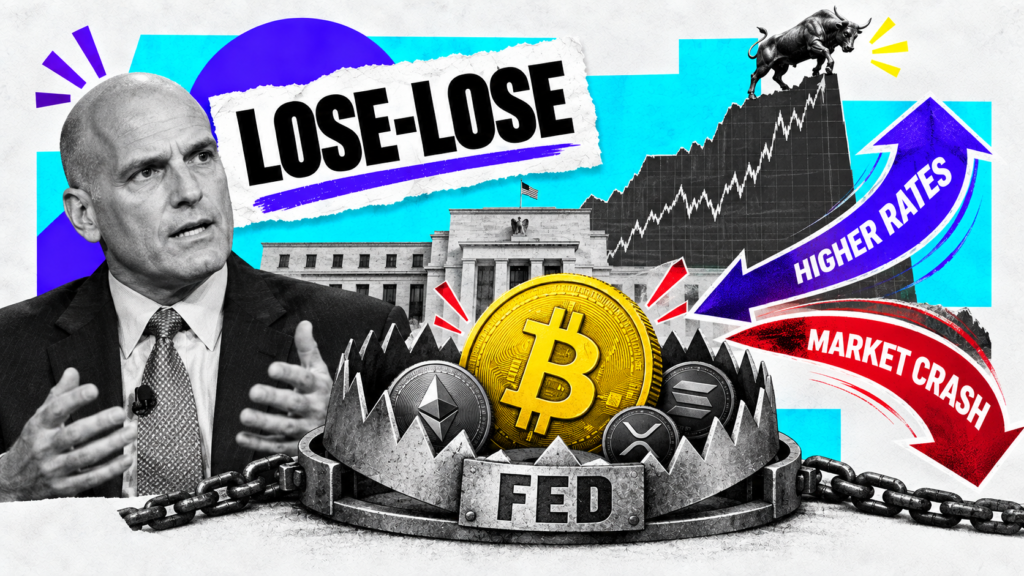
McGlone argues digital assets are caught in a “lose-lose” environment created by restrictive monetary policy on one side and historically stretched US equities on the other.
Cryptos May Face a Lose-Lose vs. Fed, Stocks
The Bloomberg Galaxy Crypto Index (BGCI) has performed poorly since 2017, flatlining vs. beta despite trading with about 4x the volatility. Will that change? Stocks could be the driver. My graphic highlights BGCI's glory days in 2021… pic.twitter.com/iAyVGsHByS
His argument starts with crypto’s risk-adjusted performance. McGlone noted that the Bloomberg Galaxy Crypto Index has delivered weak performance relative to broader markets since 2017 while exhibiting roughly four times the volatility, questioning whether investors are being adequately compensated for that additional risk.
The problem becomes more acute if stocks finally correct.
Try Our Recommended Crypto Exchanges
Sponsored
Disclosure
We sometimes use affiliate links in our content, when clicking on those we might receive a commission at no extra cost to you. By using this website you agree to our terms and conditions and privacy policy.
The Federal Reserve last week unanimously raised its benchmark rate by 25 basis points to 3.75%–4.00%, its first increase in more than three years.
More importantly for risk assets, policymakers’ median projections put the federal funds rate at 4.1% at the end of both 2026 and 2027. That points to another potential hike this year and no median rate cuts next year.
Bitcoin initially traded around $75,000–$76,500 after the decision but has since recovered, approaching $82,000 on Monday as oil prices eased and global risk markets strengthened. The 10-year Treasury yield, however, remains around 4.97%, leaving investors with unusually high returns available outside speculative assets.
McGlone’s concern is that crypto loses under either macro outcome.
If inflation remains persistent, the Fed can keep rates elevated or tighten further, restricting the liquidity that historically benefited Bitcoin and other speculative assets.
If tighter policy eventually breaks the equity rally, crypto could lose on the other side of the equation: a broad risk-off move.
McGlone has previously argued that a sustained 20% S&P 500 correction could create conditions that could drive Bitcoin sharply lower, even to $10,000 in an extreme downside scenario. That remains his forecast rather than an established relationship between a specific stock decline and BTC price.
Stocks Are Entering Rare Valuation Territory
The equity side of McGlone’s warning is increasingly difficult to ignore.
The S&P 500’s Shiller CAPE ratio is around 41, compared with a long-term median of roughly 16.1. The December 1999 dot-com peak reached 44.2, meaning current valuations are approaching territory rarely seen in modern US market history.
The Shiller CAPE ratio, short for Cyclically Adjusted Price-to-Earnings ratio (also known as the Shiller P/E or P/E 10), is a financial metric used to evaluate whether the US stock market is overvalued, undervalued, or fairly priced.Created by Nobel Prize-winning Yale economist Robert Shiller, it improves upon the standard Price-to-Earnings (P/E) ratio by smoothing out short-term economic swings.
It is true that Robert Shiller's CAPE is was up above 40. But some understanding of the math is helpful. CAPE averages monthly earnings going back 10 years. So when there is a big recent surge in earnings, and prices, CAPE does not keep up very well.
Bank of America (BofA) reached a similarly cautious conclusion using its own valuation framework. Its normalized S&P 500 P/E recently stood at 32, a level that historically corresponds to an average annual return of around-3% over the following decade.
Six of the bank’s other valuation indicators also imply negative long-term returns, although BofA acknowledged that today’s stronger corporate fundamentals could make historical comparisons overly pessimistic.
High valuations do not, by themselves, predict an imminent crash. They do mean the market has less room for disappointing earnings, persistent inflation, or higher bond yields.
Glassnode Finds Bitcoin’s Demand Engine Stalling
Bitcoin’s own market structure provides another reason for caution.
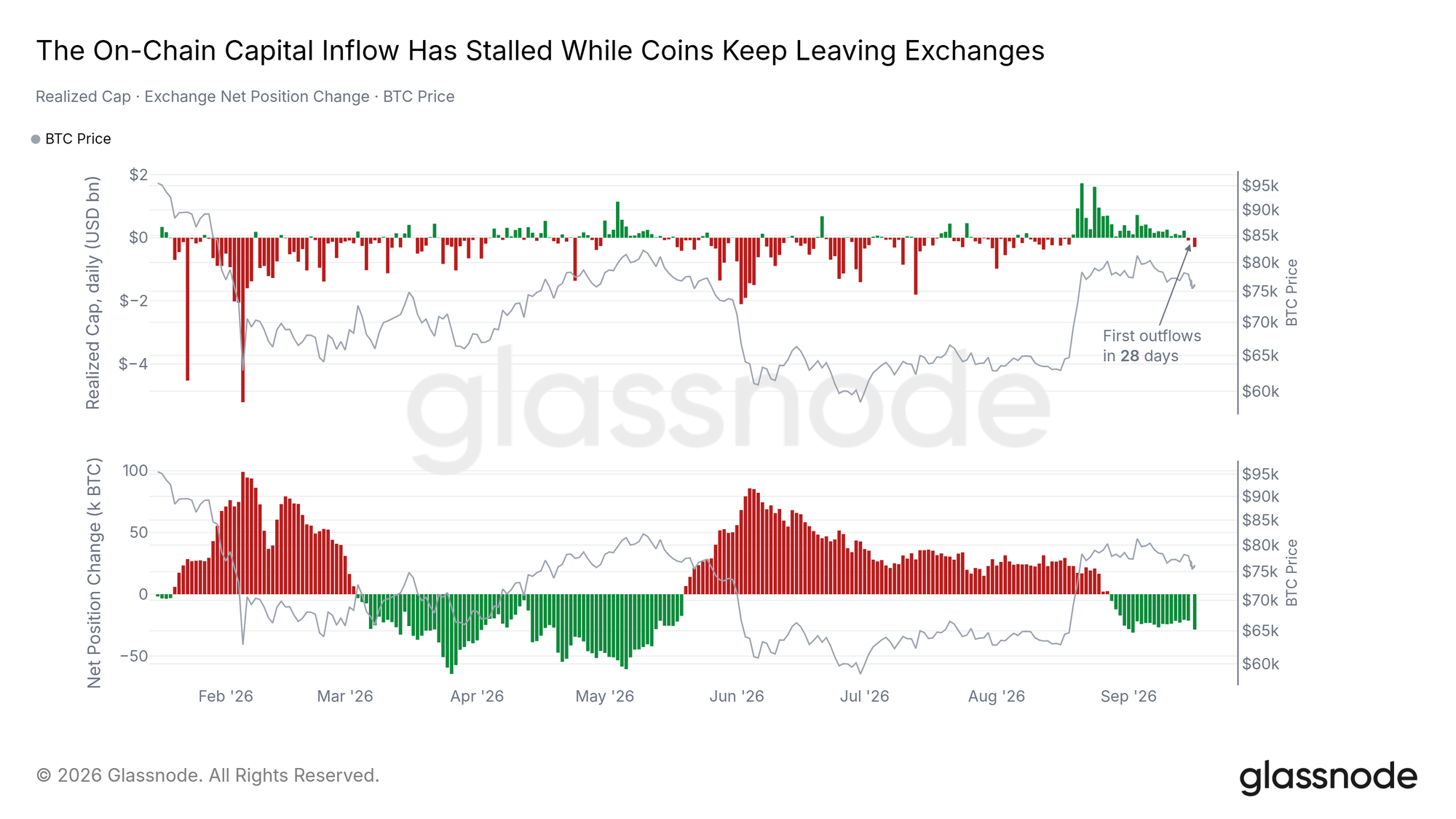
Glassnode reported this week that BTC recently fell below its True Market Mean, with demand weakening across several major channels simultaneously.
Onchain capital inflows have slowed, ETF flows have stalled, stablecoin growth has weakened, and corporate Bitcoin purchases have cooled. Glassnode described the market as moving into an area of “thin support,” meaning there are fewer recently established cost-basis levels beneath the price.
Its previous weekly data showed Bitcoin at around $76,800, down 4.4%, while the spot cumulative volume delta deteriorated from-$29.7 million to-$142.7 million, signaling stronger net selling on centralized exchanges.
30-day exchange balance remains in net outflow, down month-over-month. | Source: Glassnode
Futures open interest remained elevated at $36.4 billion, above Glassnode’s statistical upper band of $36 billion, suggesting leverage had not completely disappeared even as prices weakened.
There are counterarguments. Bitcoin survived the Fed hike, has returned toward $82,000, and has recently shown periods of weaker correlation with the S&P 500. CoinMarketCap Research found Bitcoin’s short-window S&P 500 correlation had fallen to 0.43 from 0.75 during last week’s crypto-specific selloff.
That makes McGlone’s “lose-lose” scenario a warning rather than an inevitability.
But with Bitcoin facing weak underlying demand, Treasury yields near 5%, another Fed hike potentially on the way, and US stock valuations approaching dot-com-era extremes, the next test may be whether crypto can continue climbing without the easy liquidity and booming risk appetite that powered earlier cycles.
Disclaimer:
The information provided in this article is for informational purposes only. It is not intended to be, nor should it be construed as, financial advice. We do not make any warranties regarding the completeness, reliability, or accuracy of this information. All investments involve risk, and past performance does not guarantee future results. We recommend consulting a financial advisor before making any investment decisions.
Dr. Guneet Kaur is a senior editor at CCN.com and a Science Fellow at Exponential Science. She is a fintech and blockchain expert with extensive experience in digital finance education, blockchain ecosystems, and cryptocurrency markets. She has worked with global media such as Cointelegraph, as well as education and blockchain platforms, to design and lead strategic content and learning initiatives. As an educator and assessor for top-tier executive programs, she bridges real-world fintech trends with academic insight.
Dr. Kaur is also a published researcher and peer reviewer across fintech and data science journals, including Financial Innovation Journal and International Journal of Big Data Intelligence and Applications. Her work spans data-driven analysis, Web3 innovation, and technical content development. With a strong foundation in both industry and academia, she translates complex financial technologies into practical applications, empowering learners, professionals, and institutions across the rapidly evolving digital finance landscape.