Meet the Top 101 in Crypto
News
5 min read

Solana Just Beat the NYSE in Weekly Trades  — and Is Closing In on Nasdaq

Published 24 September 2026
Giuseppe Ciccomascolo
Authors

Key Takeaways

  • Solana DEXs recorded about 208 million spot trades in the week ending Sept. 13, compared with roughly 190 million on the NYSE.
  • Solana trailed Nasdaq by about 47 million trades, its smallest reported gap.
  • Jupiter processed more than 80 million trades month to date, but trade counts alone do not show how much money changed hands.

Solana’s decentralized exchanges recorded more spot trades than the New York Stock Exchange for the first time in the week ending Sept. 13, according to figures shared by The Kobeissi Letter.

The network processed about 208 million individual token swaps during the week, compared with roughly 190 million trades on the NYSE. Solana also came within approximately 47 million trades of Nasdaq, its narrowest reported gap yet.

The milestone shows the scale of activity on Solana. It does not mean its exchanges handled more money than the NYSE, or that a token swap carries the same economic weight as a stock trade.

The comparison measures the number of executions, and that distinction matters.

Try Our Recommended Crypto Exchanges
Sponsored
Disclosure
Opened in 2011
Promotions
Get $10 in Bitcoin when you register through a referral link from an existing member.
Coins
Bitcoin Ethereum Tether Build'N'Build USD Coin +81
Promotions
Receive up to $100,000 worth of exclusive gifts for newcomers upon registration.
Coins
Bitcoin Ethereum Tether USD Coin Solana +76
Opened in 2017
Promotions
Unlock 1,500+ cryptocurrencies and seamless instant swaps in the all-in-one crypto super app ChangeNOW
Coins
Bitcoin Ethereum Tether Build'N'Build USD Coin +217

Solana’s Weekly Trade Count Overtakes the NYSE

The 208 million swaps put Solana roughly 18 million trades ahead of the NYSE for the week. Based on the same figures, the network recorded about 30 million swaps a day on average.

The Kobeissi Letter said Solana’s weekly spot DEX activity has risen 185% from its July low.

If sustained, that increase would suggest the latest result reflects a broader rebound in trading rather than a single unusually busy day. The Sept. 13 week alone, however, cannot establish how long the pace will last.

In this comparison, a DEX trade is an onchain token swap executed on a decentralized exchange on Solana. It is a narrower measure than the total volume of transactions on the blockchain, which also includes transfers and other activity unrelated to spot trading.

The reported Nasdaq gap implies roughly 255 million trades for that exchange in the same week. That leaves Solana behind Nasdaq on the metric, even after passing the NYSE.

It also makes the next comparison clear: Solana would need another substantial rise in weekly swaps or a decline in Nasdaq trading to close the remaining 47 million-trade gap.

The figures should be read with care. An equity trade and a token swap involve different assets, participants, and order execution methods. The raw count does not reveal the typical trade size, the total value changing hands or how many distinct people placed the trades.

Jupiter Helps Drive the Surge

Jupiter has been a major contributor to the rise. The Solana trading platform processed more than 80 million trades so far this month, up 38% month over month.

Jupiter lets users swap tokens while routing orders across multiple liquidity sources. Its documentation says that its default Ultra trading mode searches Solana’s leading automated market makers and other liquidity providers to find trade routes.

That helps explain why activity through a single interface can span much of the network’s trading ecosystem.

The month-to-date Jupiter figure and Solana’s weekly total cover different periods, so they cannot be divided to calculate Jupiter’s precise share of the Sept. 13 week. Still, the platform’s growth points to one source of the network-wide acceleration.

Trading conditions also affect how readily users can place small swaps. Solana’s fee guide describes a low base transaction fee, while Jupiter offers features such as automated routing and, for eligible trades, execution without requiring users to hold SOL to pay the network fee directly.

Those features can make frequent trading practical, though the reported counts alone do not show what prompted each trade.

Trade Counts Tell Only Part of the Story

The NYSE comparison is striking precisely because stock exchanges remain central to markets with vastly different assets and trading conventions. Yet a higher count does not, by itself, demonstrate greater liquidity or economic activity.

NYSE’s own market-data specification records trade count, share volume and dollar value as separate measures. A market can lead on one and trail on another. The same principle applies when comparing a network of crypto exchanges with a stock exchange.

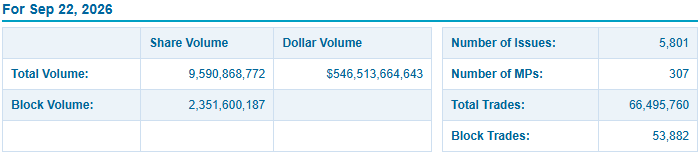
Counting methods warrant attention too. NYSE trades executed on its venue differ from trades in NYSE-listed shares across all US venues. Nasdaq’s daily market summary, for example, says it covers Nasdaq-listed securities traded across all venues.

Nasdaq daily market summary
Daily market summary represents volume from all trading venues on which Nasdaq Issues are traded. | Credit: Nasdaq

The figures establish the reported comparison, but readers need the underlying datasets and matching definitions to assess it fully.

For Solana, the next test is whether activity remains high after the current trading burst. Continued strength in both trade count and dollar volume would provide firmer evidence of lasting DEX demand. A retreat in swaps would make the NYSE crossover look more like a peak week.

Either way, 208 million swaps represent a notable level of onchain use. Solana has passed the NYSE in reported weekly trade count and narrowed its gap with Nasdaq. What that means for the relative size of those markets requires more than counting trades.

Disclaimer: The information provided in this article is for informational purposes only. It is not intended to be, nor should it be construed as, financial advice. We do not make any warranties regarding the completeness, reliability, or accuracy of this information. All investments involve risk, and past performance does not guarantee future results. We recommend consulting a financial advisor before making any investment decisions.
Giuseppe Ciccomascolo

Giuseppe Ciccomascolo began his career as an investigative journalist in Italy, where he contributed to both local and national newspapers, focusing on various financial sectors.

Upon relocating to London, he worked as an analyst for Fitch's CapitalStructure and later as a Senior Reporter for Alliance News. In 2017, Giuseppe transitioned to covering cryptocurrency-related news, producing documentaries and articles on Bitcoin and other emerging digital currencies. He also played a pivotal role in establishing the academy for a cryptocurrency exchange website. Crypto remained his primary area of interest throughout his tenure as a writer for ThirdFloor.

Related

Survey Icon
Help us improve
1 of 4
Is this your first time here?
What brought you here today?
What are you most interested in?
Would you be interested in:
Thank you icon
Thank you for your feedback!
DMCA.com Protection Status