Coinbase users can now borrow USDC against PAX Gold through Morpho on Base, accessing liquidity without selling their tokenized gold holdings. | Credit: CCN.com
Share
Key Takeaways
Eligible Coinbase users in the US, excluding New York, can now borrow USDC against PAX Gold without selling their holdings.
The loans run through Morpho on Base, making tokenized gold Coinbase Borrow’s first physical commodity-backed collateral.
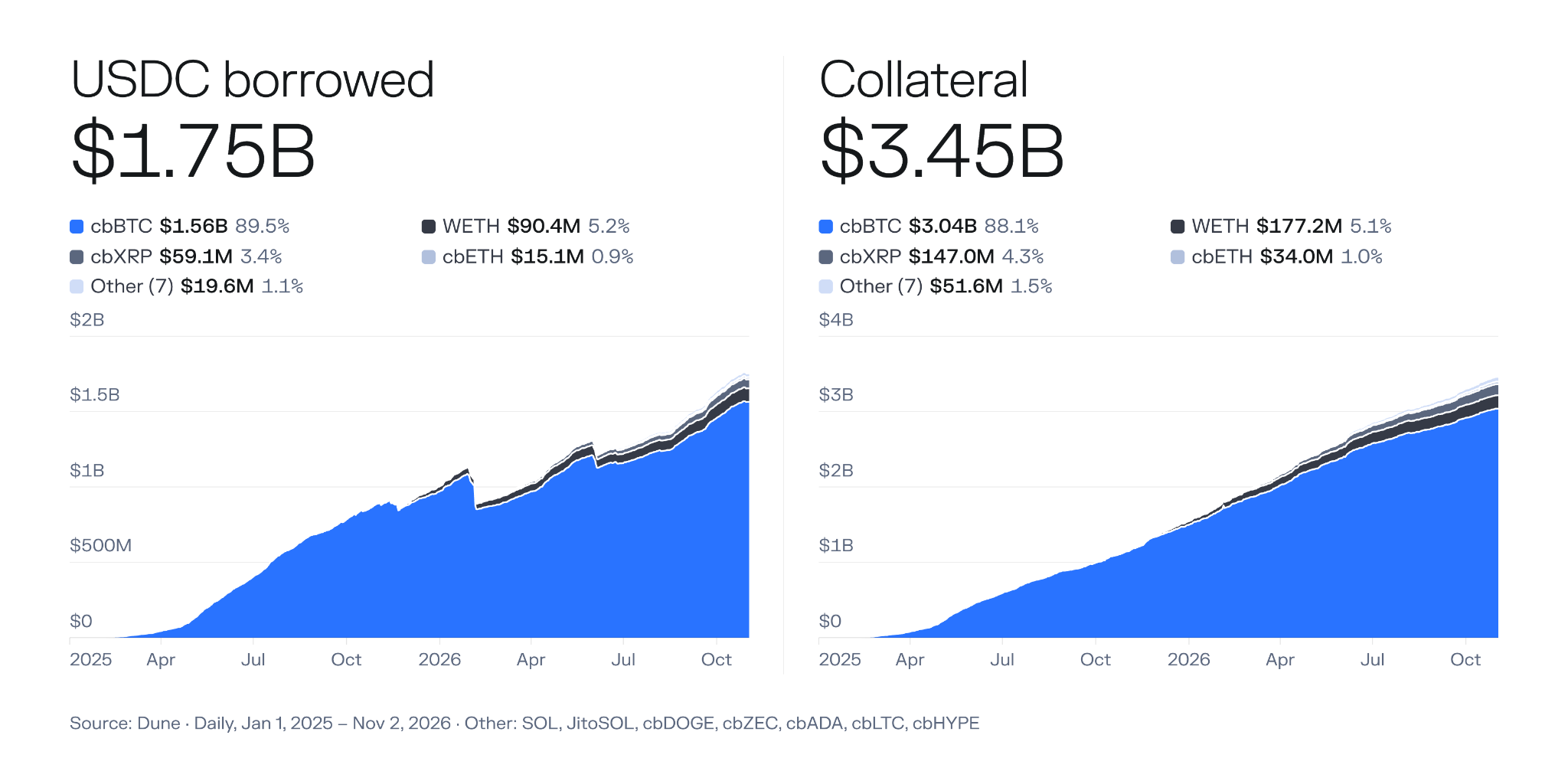
Morpho’s broader Coinbase integration supports $3.4 billion in collateral and more than $1.7 billion in active loans.
Coinbase has added tokenized gold to its borrowing service, allowing eligible customers to access USDC without selling their PAX Gold holdings.
The feature, announced November 6, uses Morpho’s lending infrastructure on Base, the Ethereum layer-2 network incubated by Coinbase.
PAX Gold, or PAXG, becomes Coinbase Borrow’s first collateral asset backed by a physical commodity, extending a product previously centered on cryptocurrencies such as Bitcoin, Ether, XRP, and Solana.
The launch gives gold holders another route to liquidity while introducing borrowing costs and liquidation risks to their positions.
Try Our Recommended Crypto Exchanges
Sponsored
Disclosure
We sometimes use affiliate links in our content, when clicking on those we might receive a commission at no extra cost to you. By using this website you agree to our terms and conditions and privacy policy.
Customers pledge PAXG as collateral and receive USDC, a stablecoin designed to track the US dollar.
The announced offering is available to eligible US customers outside New York, with borrowing limits determined by the asset and displayed within the product.
Each PAXG token represents one fine troy ounce of London Good Delivery gold held in custody by Paxos Trust Company, N.A. Paxos publishes monthly reserve attestations and provides a lookup tool showing information about allocated gold bars.
USDC borrowed and used as collateral. | Credit: Dune
The issuer places PAXG’s approximate circulating value at $2 billion. Its backing distinguishes the token from cryptocurrencies whose prices depend primarily on market demand rather than ownership of a physical reserve asset.
Coinbase provides the customer interface, while Morpho supplies the underlying on-chain lending infrastructure. The arrangement requires no credit check because collateral secures the debt, and Coinbase sponsors blockchain network fees.
Customers cannot use loan proceeds to trade on Coinbase, according to the platform’s terms.
Variable Rates and Liquidation Remain Key Risks
The gold-backed market runs through Morpho Blue, where borrowing costs respond to lending-market conditions. Rates can change as demand for loans and available liquidity shift.
Under Coinbase’s variable-rate structure, borrowers face no monthly minimum payments or fixed repayment deadline. They can repay part or all of their balance at any time, provided their position remains adequately collateralized.
However, flexible repayment does not eliminate the obligation to maintain the loan’s health. Falling collateral prices or accumulating interest can increase the loan-to-value ratio and expose a position to automatic liquidation.
Gold in a vault. Liquidity in your account.
You can now instantly borrow USDC against PAX Gold (PAXG) on Coinbase. Tokenized gold, backed by the real thing.
From crypto to commodities like gold, get instant liquidity without selling.
Coinbase also charges a processing fee each time customers borrow, including when increasing an existing loan. The fee is added to the principal, and interest accrues on the combined balance.
The distinction matters for gold investors seeking liquidity: retaining exposure through a collateralized loan creates an ongoing liability, even when the underlying asset is physically backed.
Coinbase offers fixed-rate borrowing separately, but collateral eligibility and terms vary. Borrowers therefore need the terms shown for their specific PAXG market, rather than assuming conditions advertised for Bitcoin-backed loans apply universally.
Tokenized Gold Gains a Role in Onchain Credit
Morpho says its Coinbase integration now supports roughly $3.4 billion in collateral and more than $1.7 billion in active loans. Those figures cover the wider integration, rather than gold-backed borrowing alone.
The new PAXG-USDC market expands the existing infrastructure rather than requiring Coinbase to build a separate lending system.
The launch also accompanies PAXG’s arrival on Base.
Paxos says the token carries the same reserves, oversight, and reporting across its supported blockchain networks.
Only 2.7% of global financial assets are in gold while debt and money supply keep expanding.
That’s the setup. Most people still don’t own the Gold. Tokenized gold is one way to hold it without needing a vault, as long as the token is actually tied to a bar. https://t.co/ZfLpwRrXUi
Disclaimer:
The information provided in this article is for informational purposes only. It is not intended to be, nor should it be construed as, financial advice. We do not make any warranties regarding the completeness, reliability, or accuracy of this information. All investments involve risk, and past performance does not guarantee future results. We recommend consulting a financial advisor before making any investment decisions.
Giuseppe Ciccomascolo began his career as an investigative journalist in Italy, where he contributed to both local and national newspapers, focusing on various financial sectors.
Upon relocating to London, he worked as an analyst for Fitch's CapitalStructure and later as a Senior Reporter for Alliance News. In 2017, Giuseppe transitioned to covering cryptocurrency-related news, producing documentaries and articles on Bitcoin and other emerging digital currencies. He also played a pivotal role in establishing the academy for a cryptocurrency exchange website. Crypto remained his primary area of interest throughout his tenure as a writer for ThirdFloor.