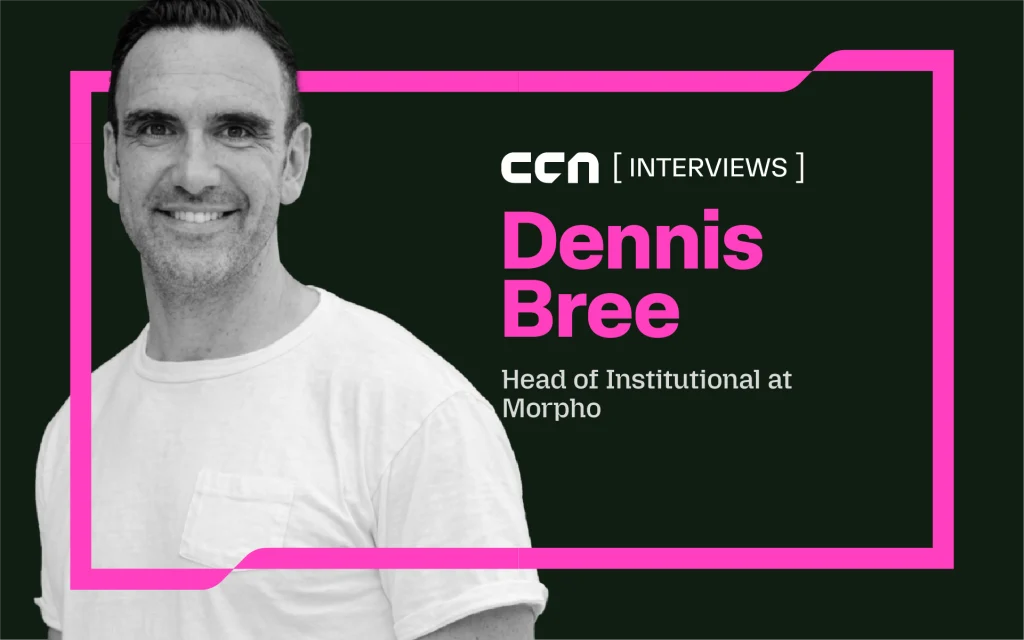
Morpho’s Dennis Bree discusses institutional DeFi, programmable lending infrastructure and tokenized credit markets. | Credit: CCN.com
Share
Key Takeaways
Institutions no longer want shared DeFi exposure and increasingly prefer isolated, customizable lending infrastructure.
Morpho built programmable vaults allowing institutions to encode lending mandates and risk parameters directly onchain.
Stablecoin regulation accelerated institutional interest by giving banks clearer frameworks for on chain lending participation.
Dennis Bree believes blockchain infrastructure will eventually become invisible as institutions focus only on risk and returns.
Traditional financial institutions are approaching decentralized finance with a very different set of expectations than crypto native firms. Rather than seeking exposure to shared liquidity pools and generalized market risk, banks and asset managers increasingly want lending systems that mirror the structure, controls and transparency of traditional credit markets.
CCN’s Giuseppe Ciccomascolo interviewed Dennis Bree, Head of Institutional at Morpho, about how institutional players are approaching onchain lending, why customizable infrastructure is becoming central to adoption and how blockchain based credit markets could evolve over the coming years. Bree said institutions are no longer interested in generalized exposure and instead want infrastructure that allows them to define their own lending conditions and operational rules.
Institutions Want Isolated Risk Instead of Shared Exposure
Bree said many institutions still misunderstand how decentralized lending infrastructure works.
“The biggest misconception is that DeFi is one big pool of risk,” he said.
According to Bree, institutional participants often assume they are exposed to the same counterparties and collateral across an entire protocol, while Morpho’s structure separates markets and vaults individually.
“Institutions can define exactly what collateral they accept and on what they lend,” he said. “It’s closer to a structured credit desk than what most people imagine when they hear DeFi.”
Morpho originally focused on optimizing lending rates on top of existing decentralized finance systems, but Bree said institutional requests gradually reshaped the platform’s direction.
“Institutions kept saying to us they wanted more efficiency and transparency,” he said.
Those requests led Morpho to build programmable vault infrastructure that allows institutions to set independent lending parameters and operational mandates.
“We built institutions essentially what they were asking for,” Bree said. “Programmable, isolated, auditable lending infrastructure that they could deploy on their own terms.”
Bree described how large institutions can embed lending mandates directly into blockchain infrastructure rather than relying on traditional oversight structures.
“If you’ve got a pension fund and it has a mandate that says only lend against USDC collateral or Bitcoin collateral, you can encode those rules directly into a vault,” he said.
He explained that blockchain based vaults can execute those instructions autonomously while preserving transparency and removing layers of manual administration.
“No one could override those rules once they’re set,” Bree said.
Banks Prefer Shared Infrastructure Instead of Building Internally
Bree said many banks increasingly view blockchain lending infrastructure similarly to cloud computing services or financial messaging systems.
“The reason banks don’t build this themselves is the same reason they don’t build their own cloud infrastructure,” he said. “It’s expensive, it’s slow and it’s not their core competency.”
He added that earlier lending protocols provided little flexibility because participants inherited the same protocol wide risk structure.
“We separate the infrastructure from the strategy,” Bree said.
According to Bree, institutional interest accelerated significantly after regulatory clarity around stablecoins improved.
“I think it was when the GENIUS Act passed,” he said. “That changed the conversation overnight.”
Bree described stablecoins as “the blood of DeFi in lending markets” and said regulatory frameworks gave institutions confidence to engage more directly with on chain lending systems.
“Once we had a regulatory framework in place, institutions effectively had the green light to engage,” he said.
Customization Became Critical for Institutional Adoption
Bree argued that the ability to customize lending conditions remains one of the main reasons institutions are beginning to reconsider decentralized finance.
He explained that institutional participants were unwilling to accept pooled exposure without the ability to define collateral standards, exposure caps or operational rules independently.
“With Morpho, we’ve got this isolated market design and vault structure that solves this directly,” Bree said.
Tokenized Treasuries Gaining Traction Through Practical Use Cases
Bree said tokenized treasuries and private credit products are gaining traction because they address immediate balance sheet and yield management needs.
“Tokenized treasuries give institutions a way to earn yield on idle stablecoin reserves with familiar, understood collateral,” he said.
He added that tokenized assets become more valuable when they can actively participate in lending markets instead of remaining passive holdings.
“Holding them and using them as collateral in lending markets rather than just holding them passively is the real shift,” Bree said.
Blockchain Infrastructure Could Eventually Fade Into Background
Looking toward the future, Bree said institutions may eventually stop distinguishing between blockchain based infrastructure and traditional financial systems.
“My hope by 2030 is that there won’t necessarily be a distinction between on chain and off chain,” he said.
He compared the transition to financial messaging infrastructure, where users no longer think about the systems operating underneath transactions.
“Nobody should ask whether their lending position is on chain or off chain,” Bree said. “It just works.”
Disclaimer:
The information provided in this article is for informational purposes only. It is not intended to be, nor should it be construed as, financial advice. We do not make any warranties regarding the completeness, reliability, or accuracy of this information. All investments involve risk, and past performance does not guarantee future results. We recommend consulting a financial advisor before making any investment decisions.
Giuseppe Ciccomascolo began his career as an investigative journalist in Italy, where he contributed to both local and national newspapers, focusing on various financial sectors.
Upon relocating to London, he worked as an analyst for Fitch's CapitalStructure and later as a Senior Reporter for Alliance News. In 2017, Giuseppe transitioned to covering cryptocurrency-related news, producing documentaries and articles on Bitcoin and other emerging digital currencies. He also played a pivotal role in establishing the academy for a cryptocurrency exchange website. Crypto remained his primary area of interest throughout his tenure as a writer for ThirdFloor.


 Easy
Easy