Key Takeaways
- Crypto Rover warned that Bitcoin could face renewed downside pressure after the Senate delayed a vote on the CLARITY Act until September.
- Bitcoin previously fell from about $97,000 to $64,000 around an earlier delay, but repeating that 34% loss today would send BTC to roughly $42,600—not $33,000.
- Bitwise CIO Matt Hougan says crypto can survive without immediate congressional action, while Arthur Hayes sees an eventual path to $1 million Bitcoin.
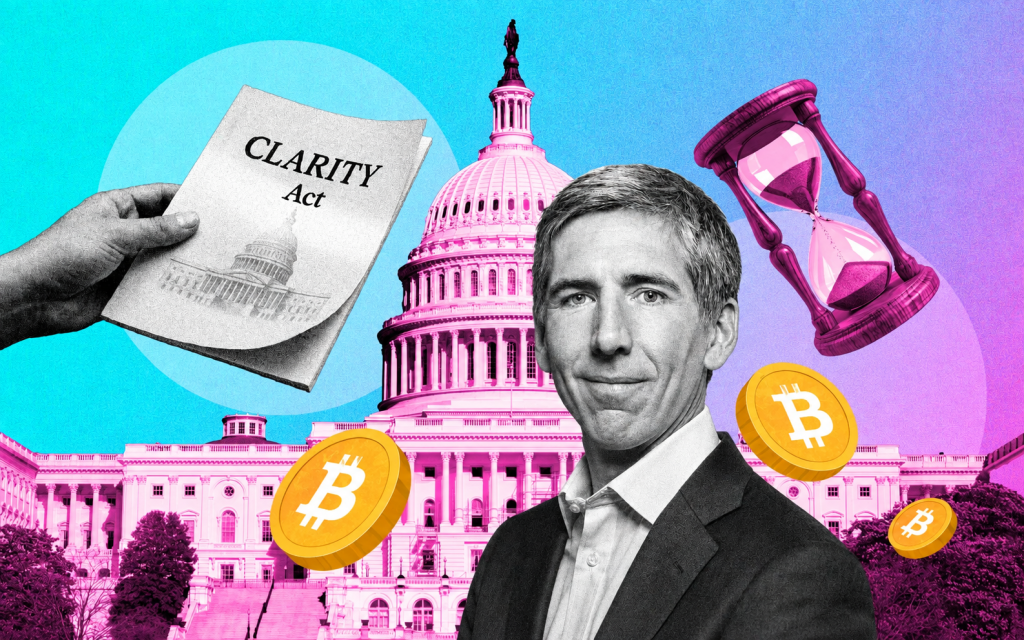
Bitcoin is back in regulatory limbo after US Senate leaders pushed a long-awaited vote on the CLARITY Act beyond the chamber’s August recess.
The delay prompted an immediate warning from crypto analyst Crypto Rover, who pointed to Bitcoin’s plunge from roughly $97,000 to $64,000 around a previous setback for the legislation.
Bitcoin traded near $64,600 on Friday, putting the market uncomfortably close to the level where the earlier selloff ended.
Could another CLARITY Act delay trigger an equally painful move—and send Bitcoin toward $33,000?
Crypto Rover Warns Bitcoin Could Repeat Its Last CLARITY Act Crash
“CLARITY Act is delayed AGAIN,” Crypto Rover wrote in a X post, adding that no Senate vote was expected before the recess.
The analyst highlighted side-by-side Bitcoin charts showing sharp declines around earlier regulatory delays.
His key comparison was BTC’s fall from about $97,000 to $64,000.
That move wiped $33,000 from Bitcoin’s price, representing a decline of approximately 34%.
While regulatory clarity has long been viewed as a potential gateway for more institutional capital, legislative failure is viewed as extending the uncertainty keeping investors away.
However, the charts only show that the events occurred around the same period. They do not prove that the earlier delay caused Bitcoin’s decline.
Interest-rate expectations, leverage, and wider risk sentiment can all have a much larger effect on BTC than a single development in Washington.
How Far Would Bitcoin Fall if the Same Crash Happened Again?
There are two ways to interpret a repeat of the earlier move — and they produce very different Bitcoin price targets.
If Bitcoin repeated the same percentage decline, a 34% fall from approximately $64,600 would erase about $22,000.
That would put BTC near $42,600.
If Bitcoin instead repeated the same $33,000 nominal decline, its price would fall to approximately $31,600.
The same dollar loss would now represent a much steeper drop of about 51% because Bitcoin is starting from a lower price.
Bitcoin would have to fall roughly 49% from $64,600 to reach exactly $33,000.
In short, history repeating in percentage terms points toward the low $40,000s. A move toward $33,000 would require a substantially more severe relative decline.
POLITICO Reports CLARITY Act Vote Delayed Until September
POLITICO first reported that Senate Republican leaders were abandoning hopes of holding a pre-recess vote on the landmark crypto market-structure bill.
Senate Majority Leader John Thune later confirmed the delay, saying Democrats had resisted a vote and that the legislation would be placed near the front of the agenda when lawmakers return.
The Senate is scheduled to reconvene on Sept. 14.
However, the remaining disputes are significant.
Democrats have pushed for stronger government ethics provisions amid concerns over President Donald Trump’s family crypto businesses.
They have also sought changes to address law-enforcement objections and to parts of the legislation handled by the Senate Agriculture Committee.
Republicans need Democratic votes to reach the 60-vote threshold generally required to advance the measure.
Matt Hougan Says Crypto Will Survive the CLARITY Act Delay
Bitwise Chief Investment Officer Matt Hougan is less alarmed about the industry’s long-term prospects.
Hougan has said that passing the CLARITY Act would be the best outcome for crypto and could signal the start of a new bull market.
However, he does not believe another delay — or even the bill’s ultimate failure — would stop the sector from expanding.
In an Aug. 4 memo, Hougan said the bill would enter a “walking dead” state if it missed the pre-recess deadline. It could continue lurching toward a possible September or year-end vote without providing investors with a definitive result.
Prediction-market traders had cut the probability of the bill passing in 2026 to 27% when Hougan published the memo, down from 82% in February.
The prolonged uncertainty may be worse for markets than a clear defeat, Hougan argued, because professional investors can delay allocations while waiting to see whether the legislation survives.
But his broader message was direct:
“More importantly, crypto will be fine.”
Not Everyone Thinks Bitcoin Is Going Lower
While Crypto Rover focused on the downside, Arthur Hayes has outlined a dramatically different long-term scenario.
The BitMEX co-founder believes Bitcoin could eventually reach $1 million after the artificial-intelligence investment boom turns into a credit crisis and forces governments to inject enormous amounts of liquidity into the financial system.
In his essay Situationship, Hayes argued that investors are treating AI infrastructure as a conventional technology boom when it may be closer to a debt-fueled real-estate cycle.
Data centers are buildings financed through loans, leases and outside capital, he said.
But the advanced chips inside them can become economically obsolete far faster than the facilities and debt used to finance them.
Hayes expects governments to intervene because AI infrastructure is viewed as strategically important.
In his view, the resulting liquidity would flow into scarce financial assets, potentially driving Bitcoin’s price to $1 million or more.
The information provided in this article is for informational purposes only. It is not intended to be, nor should it be construed as, financial advice. We do not make any warranties regarding the completeness, reliability, or accuracy of this information. All investments involve risk, and past performance does not guarantee future results. We recommend consulting a financial advisor before making any investment decisions.

Kurt Robson is a London-based reporter at CCN, specialising in the fast-moving worlds of crypto and emerging technology. He began his career covering local news in Cornwall after graduating from Falmouth University with First Class Honours in Journalism. There, he cut his teeth on everything from council meetings to missing swans.
He quickly rose through the ranks to become a frontline journalist at several of the UK’s leading national newspapers. Over the years, he has interviewed musicians and celebrities, reported from courtrooms and crime scenes, and secured multiple front-page exclusives.
Following the upheaval of the COVID-19 pandemic, Kurt shifted his focus to technology journalism—just ahead of the AI boom. With a natural curiosity and a trained eye for emerging trends, he has found a new rhythm in reporting on innovation.
At CCN, Kurt's work focuses on the cutting edge of crypto, blockchain, AI, and the evolving digital world. Drawing on his background in people-first reporting and his deep interest in disruptive tech, Kurt delivers stories that are insightful, entertaining, and human-centric.