Key Takeaways
- Bitwise CIO Matt Hougan estimated the CLARITY Act had roughly a 50-50 chance of passing, although prediction-market odds have since fallen.
- Hougan argued that crypto adoption and regulatory progress would continue even if Congress failed to approve the bill.
- Crypto Rover identified a bullish Bitcoin reaction but warned that elevated open interest could precede a fall toward $50,000 or $47,000.
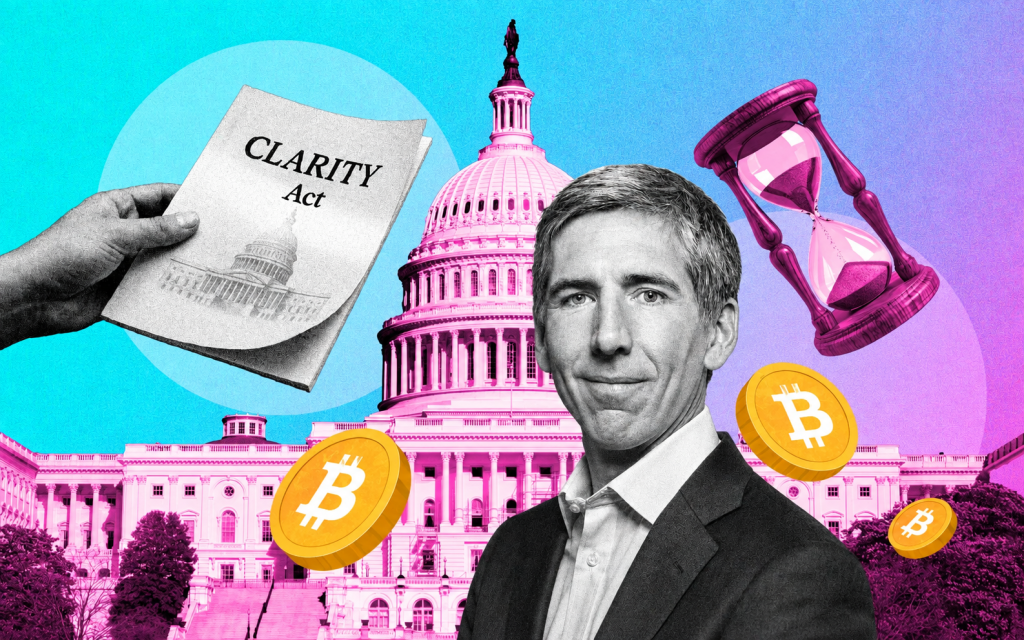
Bitwise Chief Investment Officer Matt Hougan believes crypto can continue thriving even if the United States Congress fails to pass the CLARITY Act.
The executive has given the landmark crypto market-structure bill only a coin-toss chance of passing.
However, he argued that institutional adoption and alternative rulemaking by the Securities and Exchange Commission (SEC) would keep the industry moving forward.
While Hougan recently outlined how Bitcoin could eventually reach $1 million, analyst Crypto Rover sees a potentially volatile road ahead, including a possible final correction toward $50,000.
Hougan Gives CLARITY Act a 50-50 Chance
Hougan previously characterized the chances of the CLARITY Act passing as roughly 50-50, pushing back against more pessimistic market predictions.
“The best thing you can say for the Clarity Act is it has had a thousand chances to die, and it hasn’t died yet,” Hougan said in a late-July interview.
However, the chances have continued to deteriorate.
In an Aug. 4 blog post, Hougan noted that Polymarket traders had reduced the probability of the bill passing in 2026 to 27%, down from 82% in February.
The Senate is scheduled to begin its August state work period after Friday, Aug. 7, and will not return until Sept. 14, according to its 2026 legislative calendar.
Hougan said senators would have to file for cloture by Wednesday to leave enough time for a vote before the break.
Hougan said passage could provide the starting gun for a new bull market, but said that failure before the recess had become the more likely scenario.
Crypto Can Survive Without Congress
Despite the uncertainty surrounding the CLARITY Act’s passage, Hougan said failure would not ruin crypto’s long-term prospects.
“More importantly, crypto will be fine,” he wrote.
Hougan pointed to SEC Chair Paul Atkins, who said the regulator was “ready, willing, and able to come out with rules that address the same issues [as] Clarity.”
SEC rulemaking could initially produce a more innovation-friendly framework than a bipartisan law, Hougan argued.
The drawback is that a future administration could install a less supportive SEC chair and reverse some of those rules.
Nevertheless, Hougan believes crypto is approaching a point at which its progress will become practically impossible to unwind.
“The genie’s out of the bottle,” he said in the earlier interview.
Adding: “I think the industry will be too big to kill two years from now.”
Hougan cited BlackRock’s Bitcoin exchange-traded fund, Robinhood’s blockchain push, and stablecoin infrastructure involving major payment firms as evidence that finance is already moving on-chain.
That view complements Hougan’s long-term Bitcoin outlook.
In March, he argued that a set of “reasonably conservative assumptions” could take Bitcoin to $1 million.
His valuation model assumes the global store-of-value market grows to approximately $121 trillion over the next decade. Bitcoin would need to capture around 17% of that market to reach seven figures.
“As I see it, the base case—that the store-of-value market will continue to grow as it has, and Bitcoin will continue to gain market share as it has—leads you to much, much higher prices than we have today,” Hougan wrote.
Crypto Rover Spots Bullish Bitcoin Signal—but Sees $47K Risk
Hougan’s structural optimism comes as Crypto Rover highlighted a bullish reaction in Bitcoin’s short-term price action.
In his latest YouTube update, Rover pointed to Bitcoin’s roughly 2.5% rally after Strategy disclosed the sale of more than $100 million worth of BTC.
“If the biggest holder of Bitcoin is selling off Bitcoin in the lows of the bear market, it is actually quite a bullish signal,” Rover said, arguing that buyers appeared willing to absorb the selling pressure.
However, Rover warned that Bitcoin’s surging open interest could produce a large liquidation-driven move in either direction.
“It doesn’t always mean that Bitcoin needs to move towards the downside whenever open interest is sitting so high,” he said.
“But historically, it provides us and tells us a story that a big move is on the way.”
Rover identified $62,400 as Bitcoin’s most important near-term support. A breakdown could leave the cryptocurrency with limited volume support below that level.
In the opposite direction, he identified $67,100 as resistance, predicting that Bitcoin would “most likely see an extended push towards the upside” if it broke above that region.
Despite the potentially bullish breakout setup, Rover expects another correction first.
“I think there’s going to be one final correction to grab the lower-side liquidity for Bitcoin that is laying around that $50,000 region,” he said.
“Of course, my target is $47,000, but the majority of the liquidity is laying around $50K,” Rover added.
The analyst previously placed the likely Bitcoin bear-market bottom between $ 47,000 and $ 60,000.
CLARITY Act Could Enter a ‘Walking Dead’ Phase
Even if lawmakers miss the August deadline, Hougan does not expect work on the CLARITY Act to stop entirely.
Instead, he predicted that the legislation would enter a “walking dead” state — unable to pass immediately but also difficult to kill completely.
The Senate could revisit the bill in September, and lawmakers could also attempt to attach it to a broader omnibus spending package during a potential lame-duck session in December.
“After Wednesday’s deadline passes, I expect a steady drumbeat of stories about sneaking Clarity through in the fall or winter,” Hougan wrote.
That lingering possibility could prove frustrating for crypto investors.
Hougan said uncertainty surrounding the bill was keeping some professional investors on the sidelines because they feared a definitive failure could send prices lower.
However, he argued that Washington’s slow progress would not amount to a verdict on crypto’s role in global finance.
“At this point, crypto has enough momentum that it will reshape finance for decades, regardless of what happens in the next few days,” Hougan concluded.
The information provided in this article is for informational purposes only. It is not intended to be, nor should it be construed as, financial advice. We do not make any warranties regarding the completeness, reliability, or accuracy of this information. All investments involve risk, and past performance does not guarantee future results. We recommend consulting a financial advisor before making any investment decisions.

Kurt Robson is a London-based reporter at CCN, specialising in the fast-moving worlds of crypto and emerging technology. He began his career covering local news in Cornwall after graduating from Falmouth University with First Class Honours in Journalism. There, he cut his teeth on everything from council meetings to missing swans.
He quickly rose through the ranks to become a frontline journalist at several of the UK’s leading national newspapers. Over the years, he has interviewed musicians and celebrities, reported from courtrooms and crime scenes, and secured multiple front-page exclusives.
Following the upheaval of the COVID-19 pandemic, Kurt shifted his focus to technology journalism—just ahead of the AI boom. With a natural curiosity and a trained eye for emerging trends, he has found a new rhythm in reporting on innovation.
At CCN, Kurt's work focuses on the cutting edge of crypto, blockchain, AI, and the evolving digital world. Drawing on his background in people-first reporting and his deep interest in disruptive tech, Kurt delivers stories that are insightful, entertaining, and human-centric.