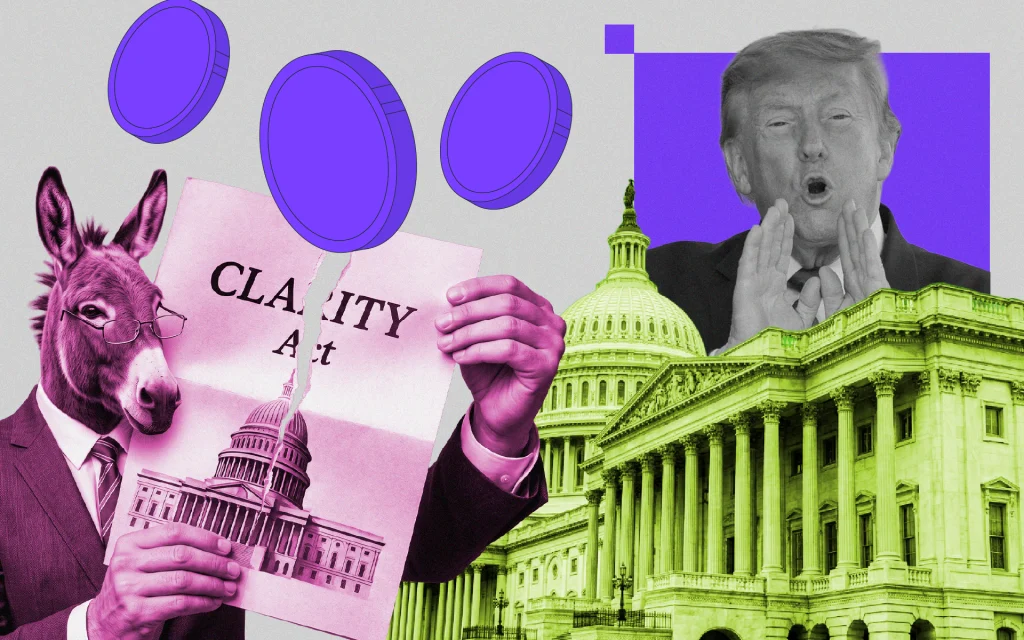
Could Sept. 15 Open the Institutional DeFi Floodgates? Former Lawmakers Say CLARITY Act Is the First Step
Share
Key Takeaways
Bitcoin has survived bigger shocks than a delayed CLARITY Act, including China’s mining ban and the 2022 crypto crisis.
A stalled CLARITY Act could trigger a 15–30% sentiment-driven correction, not an existential collapse.
Citi, Galaxy Digital and Senator Lummis all see delayed adoption and uncertainty, not Bitcoin going to zero.
The idea that Bitcoin could collapse to zero if the US CLARITY Act fails is not supported by either market history or current data.
While the Digital Asset Market Structure bill has become one of crypto’s biggest political catalysts, Bitcoin’s investment thesis extends far beyond a single piece of US legislation.
JUST IN: 🇺🇸 Tomorrow, July 17, the US House Financial Services Committee will hold a field hearing on how the CLARITY Act can drive financial innovation. pic.twitter.com/lui4W2TSjq
A more realistic question is not whether Bitcoin could go to zero, but how much downside investors should expect if Congress misses its latest legislative window.
The Senate is under growing pressure to move the CLARITY Act before the August recess. Multiple reports suggest that failure to advance the bill this month could delay comprehensive US crypto market structure legislation until 2027, leaving the industry operating under the existing patchwork of SEC enforcement and CFTC oversight.
Former House Financial Services Committee Chair Patrick McHenry said the CLARITY Act gives Congress an opportunity to proactively establish clear rules for digital assets instead of relying on reactive regulation.
For over two decades in Congress, I saw how bold, forward-looking legislation can move our country ahead, and how outdated rules leave us scrambling to catch up. The Clarity Act is Congress’s chance to be proactive: establish consumer protections, provide regulatory certainty and…
He argued the bill would strengthen consumer protections, provide regulatory certainty, and give entrepreneurs the confidence to build in the US rather than wait for regulators or courts to define the industry’s future.
Try Our Recommended Crypto Exchanges
Sponsored
Disclosure
We sometimes use affiliate links in our content, when clicking on those we might receive a commission at no extra cost to you. By using this website you agree to our terms and conditions and privacy policy.
History Suggests Regulation Creates Volatility, Not Extinction
Bitcoin has repeatedly survived events that were arguably more severe than a delayed market structure bill.
In 2021, China effectively banned Bitcoin mining, eliminating more than half of the global hash rate within weeks. The network continued operating normally as miners relocated.
In 2022, the collapse of Terra, Three Arrows Capital, Celsius and FTX wiped out hundreds of billions of dollars in crypto market value. Bitcoin lost more than 75% from its peak before eventually recovering.
More recently, US spot Bitcoin ETFs introduced institutional demand that simply did not exist during previous bear markets. Those investment vehicles continue to provide a structural source of capital that is largely independent of congressional negotiations.
What Would Actually Happen to Bitcoin if CLARITY Act Fails?
The immediate effect of a CLARITY failure would likely be sentiment-driven rather than fundamental.
A legislative setback would prolong regulatory uncertainty for exchanges, token issuers and developers. Institutional firms considering new crypto products could delay launches while waiting for clearer rules.
That uncertainty could reduce short-term demand for digital assets, particularly altcoins whose regulatory status remains disputed.
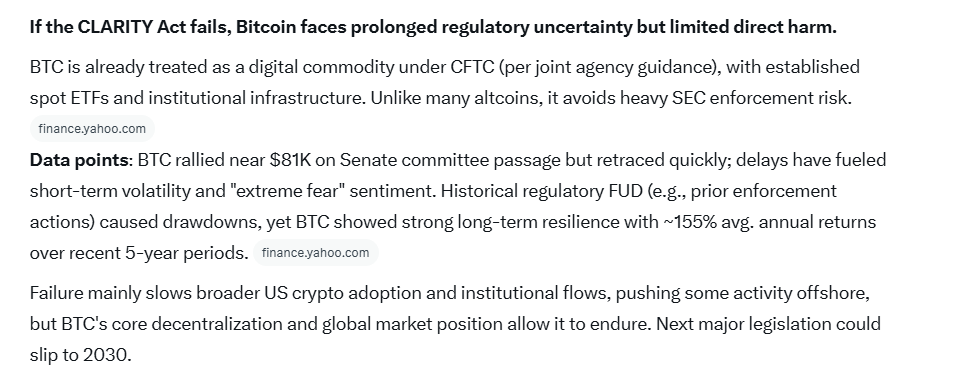
What happens to Bitcoin if CLARITY Act fails: Grok
Bitcoin, however, occupies a different position.
Unlike many crypto assets, Bitcoin is broadly treated as a commodity and faces relatively little debate over its classification. The CLARITY Act primarily affects the broader digital asset ecosystem by defining regulatory boundaries between the SEC and CFTC rather than determining whether Bitcoin itself can legally exist.
How Far Could Bitcoin Fall if the CLARITY Act Stalls?
Several market observers have tied recent Bitcoin strength partly to optimism surrounding crypto legislation. If that optimism disappears, Bitcoin could experience a typical “sell-the-news-that-never-came” reaction.
During previous macro-driven corrections, Bitcoin has frequently fallen 15% to 30% over relatively short periods without altering its long-term trend.
If the CLARITY Act stalls, Bitcoin could realistically fall another 10-25% in the near term from current levels around $63,000–$65,000, testing key supports near $55,000–$60,000 before finding a floor. BTC already retraced from near $81,000 highs tied to the Senate committee passage, reflecting priced-in uncertainty amid ETF outflows and “extreme fear” sentiment, while its established commodity status under CFTC (separate from the bill) limits direct damage compared to altcoins.
Such a decline would also likely coincide with weaker sentiment across crypto equities, exchanges and higher-beta assets like Ethereum and XRP, whose regulatory outlook depends more directly on market structure legislation.
Current legislative uncertainty has already reduced prediction-market confidence that the bill becomes law this year, illustrating that markets have begun pricing in delay risk rather than assuming passage.
Why Bitcoin Going to Zero Remains Highly Unlikely
For Bitcoin to reach zero, several conditions would need to occur simultaneously:
Global trading would have to cease.
Mining would have to become permanently uneconomic.
Institutional holders would need to liquidate entirely.
Governments worldwide would have to coordinate comprehensive enforcement.
None of those conditions depend on the CLARITY Act.
Bitcoin remains traded globally, secured by one of the world’s largest decentralized computing networks, held by public companies, asset managers and ETFs, and increasingly integrated into traditional finance.
The CLARITY Act could accelerate institutional adoption by providing regulatory certainty. Failure could delay that process and increase volatility.
But according to Bitcoin’s own history, missing one legislative milestone is far more likely to produce another cyclical correction than an existential collapse. The downside is measured in percentages, not a path to zero.
Even CLARITY Supporters Don’t Predict Bitcoin Going to Zero
Though not everyone believes the CLARITY Act will determine Bitcoin’s long-term trajectory. Citigroup, for example, recently lowered its 12-month Bitcoin target after US crypto legislation stalled. However, the bank did not project a collapse.
Instead, it said delayed legislation would reduce a potential regulatory catalyst for institutional inflows, while macroeconomic conditions and investor demand would remain the dominant drivers of price. In its downside scenario, Citi projected Bitcoin at around $58,000 rather than anywhere near zero.
Galaxy Digital’s Head of Research Alex Thorn has also downplayed the idea that a failed CLARITY Act would derail crypto entirely. Thorn said the industry could still receive “most of what it wants” through agency guidance, even if Congress fails to pass comprehensive legislation this year, although he acknowledged that legislation remains the preferred outcome .
LATEST: 🇺🇸 Galaxy head of research Alex Thorn says even if the CLARITY Act fails, the crypto industry will still get "most of what it wants" from agency guidance over the next 2.5 years. pic.twitter.com/9gAL8LEZjJ
Lummis has taken the opposite position. Rather than warning Bitcoin would collapse, she argues the cost of failure is strategic, not existential.
She recently wrote: “This is likely our last chance to get real legislation for digital assets on the books before 2030.”
We have to be fair; we can't write crypto ethics rules for one person. This is bigger than @POTUS; it has to stand the test of time. Look at Congress's stock trading problem—Nancy Pelosi is exhibit A.
Disclaimer:
The information provided in this article is for informational purposes only. It is not intended to be, nor should it be construed as, financial advice. We do not make any warranties regarding the completeness, reliability, or accuracy of this information. All investments involve risk, and past performance does not guarantee future results. We recommend consulting a financial advisor before making any investment decisions.
Dr. Guneet Kaur is a senior editor at CCN.com and a Science Fellow at Exponential Science. She is a fintech and blockchain expert with extensive experience in digital finance education, blockchain ecosystems, and cryptocurrency markets. She has worked with global media such as Cointelegraph, as well as education and blockchain platforms, to design and lead strategic content and learning initiatives. As an educator and assessor for top-tier executive programs, she bridges real-world fintech trends with academic insight.
Dr. Kaur is also a published researcher and peer reviewer across fintech and data science journals, including Financial Innovation Journal and International Journal of Big Data Intelligence and Applications. Her work spans data-driven analysis, Web3 innovation, and technical content development. With a strong foundation in both industry and academia, she translates complex financial technologies into practical applications, empowering learners, professionals, and institutions across the rapidly evolving digital finance landscape.