Bitcoin outperformed stocks and gold in September as ETF inflows and spot demand strengthened. Here’s why Q4 could bring an even bigger move. | Credit: CCN.com
Share
Key Takeaways
Bitcoin outperformed stocks and gold in September, gaining roughly 7% as the S&P 500 remained comparatively flat and gold fell more than 6%.
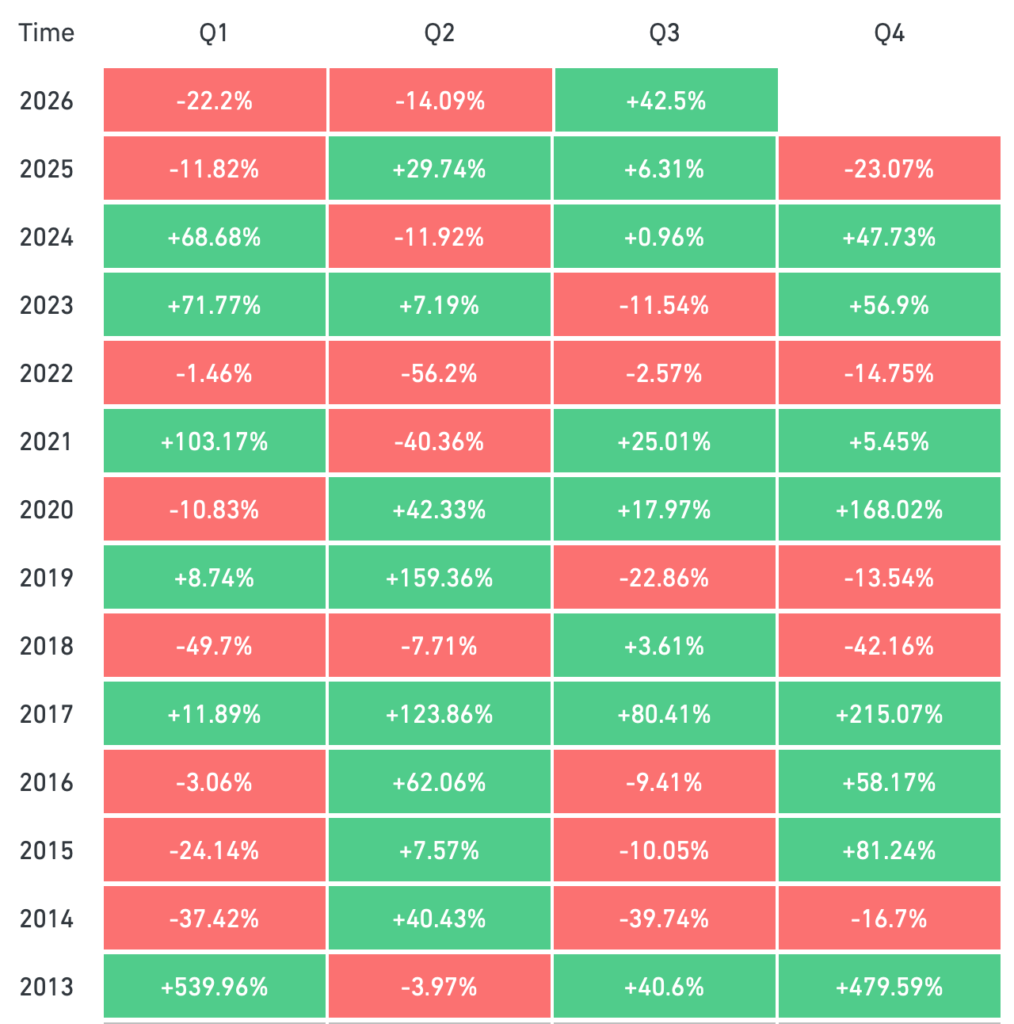
BTC finished Q3 about 42.5% above its quarterly open, marking one of its strongest third-quarter performances on record.
Q4’s trajectory could depend heavily on ETF demand, with Bitfinex estimating that inflows could help absorb overhead supply and support another breakout.
Bitcoin is entering the fourth quarter with something it has lacked for much of 2026: clear momentum over traditional markets.
The divergence has strengthened the argument that crypto is beginning to trade on its own catalysts rather than simply following Wall Street.
🚨 Bitcoin Outperforming Stocks And Gold Heading Into Q4
🚀 Bitcoin has been September’s clear winner against traditional markets. BTC gained roughly 7% this month, while the S&P 500 barely moved and gold dropped more than 6%. Much of the altcoin market joined the rebound as… pic.twitter.com/b5TGvGSRCp
Bitfinex data paints an even stronger picture over the full quarter. Bitcoin ended Q3 roughly 42.5% above its $58,585 quarterly open, putting the cryptocurrency on course for its strongest quarter since Q4 2024 and its second-best third quarter since 2013.
Yet the setup for Q4 is not without obstacles. Bitcoin now faces a major concentration of supply between $84,000 and $86,500, while leverage has fallen sharply. That means the next leg higher will increasingly depend on real spot buyers.
New Trending Crypto Wallet Offers
Sponsored
Disclosure
We sometimes use affiliate links in our content, when clicking on those we might receive a commission at no extra cost to you. By using this website you agree to our terms and conditions and privacy policy.
Bitfinex noted that the 10-year Treasury yield reached 5.17% on September 25, a level that typically makes risk assets less attractive, as investors can earn higher returns from lower-risk government debt.
Bitcoin initially fell toward $75,000 following the Fed’s decision but rapidly recovered. It later surged above $85,000, while other risk assets posted much more modest recoveries.
Bitfinex described the move as a notable decoupling from previous tightening cycles, when Bitcoin generally behaved like a high-beta version of equities.
The rebound has also spread beyond BTC. Santiment said much of the altcoin market participated as capital rotated back toward crypto, suggesting improving appetite for risk across digital assets.
Meanwhile, speculative leverage has actually declined.
Aggregate Bitcoin futures open interest dropped from more than 700,000 BTC on September 21 to 644,000 BTC by September 29. The seven-day decline of 49,000 BTC was the biggest since October 2025.
That could make the rally structurally healthier, but it creates another requirement: spot buyers must keep showing up.
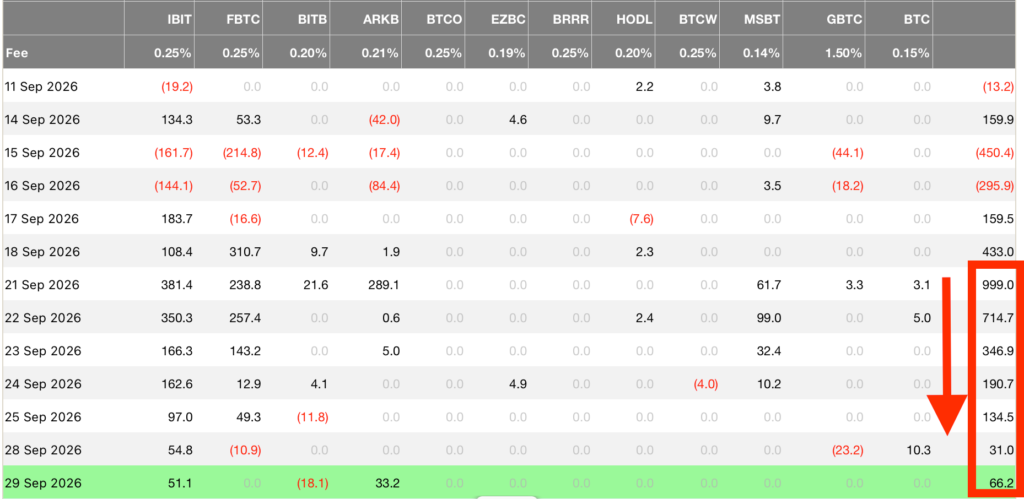
US spot Bitcoin ETFs recorded nine consecutive days of inflows totaling $3.08 billion through late September, according to Bitfinex. The previous week alone saw $2.38 billion of inflows, the strongest weekly total since October 2025.
Corporate accumulation has continued alongside ETF demand.
ETF absorption must recover before $84,000 can be reclaimed. | Credit: Bitfinex
Bitfinex’s Bitcoin Absorption-to-Emission ratio, which compares ETF purchases with roughly 450 BTC of daily miner issuance, fell from 25.6 times issuance on September 21 to just 1.8 times on September 29.
That matters because Bitcoin is facing significant overhead supply. Around 1.39 million BTC has a cost basis between $84,000 and $86,500, creating a zone where investors who previously bought at higher prices may sell as they return to breakeven.
Bitfinex estimates that ETF absorption may need to recover to five times daily issuance — roughly $190 million per day — to help clear that supply.
Why Q4 Could Be Bitcoin’s Next Major Test
The immediate battle is now concentrated around a relatively narrow price range.
Bitfinex found that the amount of Bitcoin with a cost basis between $82,500 and $84,000 increased from roughly 110,000 BTC on September 27 to 306,000 BTC three days later. That suggests spot buyers are absorbing coins being sold by both profit-takers and underwater holders.
A move above $85,000 would also push Bitcoin’s supply-in-profit metric back above 75%, while clearing $86,500 would put the entire 1.39 million BTC overhead cluster into profit.
From there, Bitfinex calculates that only around 513,000 BTC sits between $86,500 and $90,000, potentially reducing resistance around Bitcoin’s $87,722 yearly opening price.
Options markets are, meanwhile, pricing in relatively subdued volatility. Bitcoin’s 30-day implied volatility recently fell near one-year lows even during a 5% pullback, suggesting traders were not aggressively buying downside protection.
There are still clear risks. Higher Treasury yields remain a headwind; ETF flows could reverse, and a sustained break below $81,300 would weaken the current structure.
But unlike earlier rallies driven heavily by leverage, Bitcoin enters Q4 with futures positioning substantially cleaner and institutional spot demand playing a larger role.
The question now is whether those buyers can continue absorbing supply. If they can, Bitcoin’s September outperformance against stocks and gold may prove to have been the opening act rather than the finale.
Disclaimer:
The information provided in this article is for informational purposes only. It is not intended to be, nor should it be construed as, financial advice. We do not make any warranties regarding the completeness, reliability, or accuracy of this information. All investments involve risk, and past performance does not guarantee future results. We recommend consulting a financial advisor before making any investment decisions.
Giuseppe Ciccomascolo began his career as an investigative journalist in Italy, where he contributed to both local and national newspapers, focusing on various financial sectors.
Upon relocating to London, he worked as an analyst for Fitch's CapitalStructure and later as a Senior Reporter for Alliance News. In 2017, Giuseppe transitioned to covering cryptocurrency-related news, producing documentaries and articles on Bitcoin and other emerging digital currencies. He also played a pivotal role in establishing the academy for a cryptocurrency exchange website. Crypto remained his primary area of interest throughout his tenure as a writer for ThirdFloor.