Bitcoin shows early recovery signals, but confirmation is pending, analysts say.
Altcoin weakness highlights risk-off sentiment.
Market direction hinges on holding key levels.
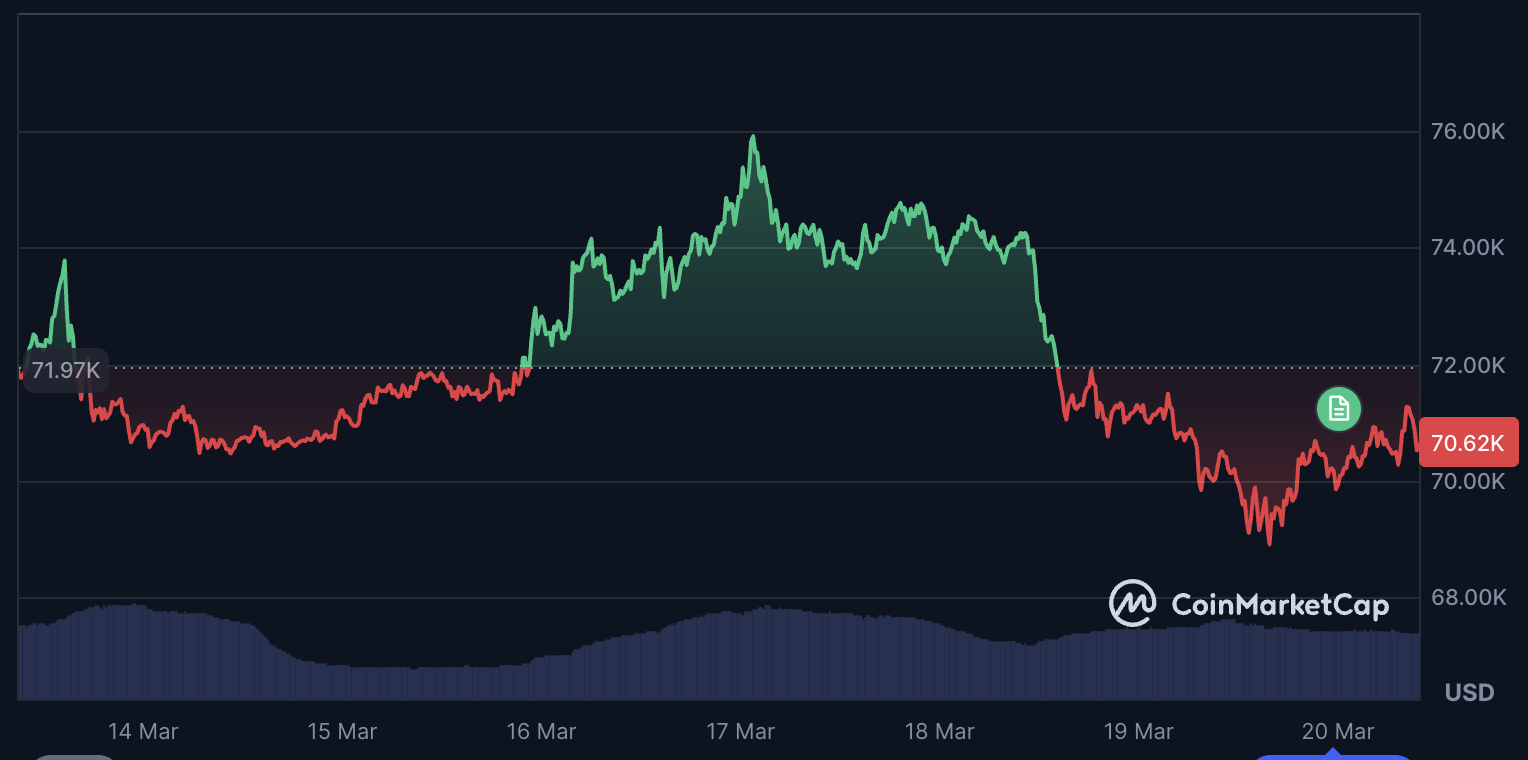
Bitcoin’s recovery above the $70,000 level has revived debate over whether the market is entering a new bullish phase or simply staging another short-lived rebound, as on-chain data improves while broader crypto activity — particularly in altcoins — continues to weaken.
Try Our Recommended Crypto Exchanges
Sponsored
Disclosure
We sometimes use affiliate links in our content, when clicking on those we might receive a commission at no extra cost to you. By using this website you agree to our terms and conditions and privacy policy.
On-Chain Data Signals Early Bullish Shift, Glassnode Says
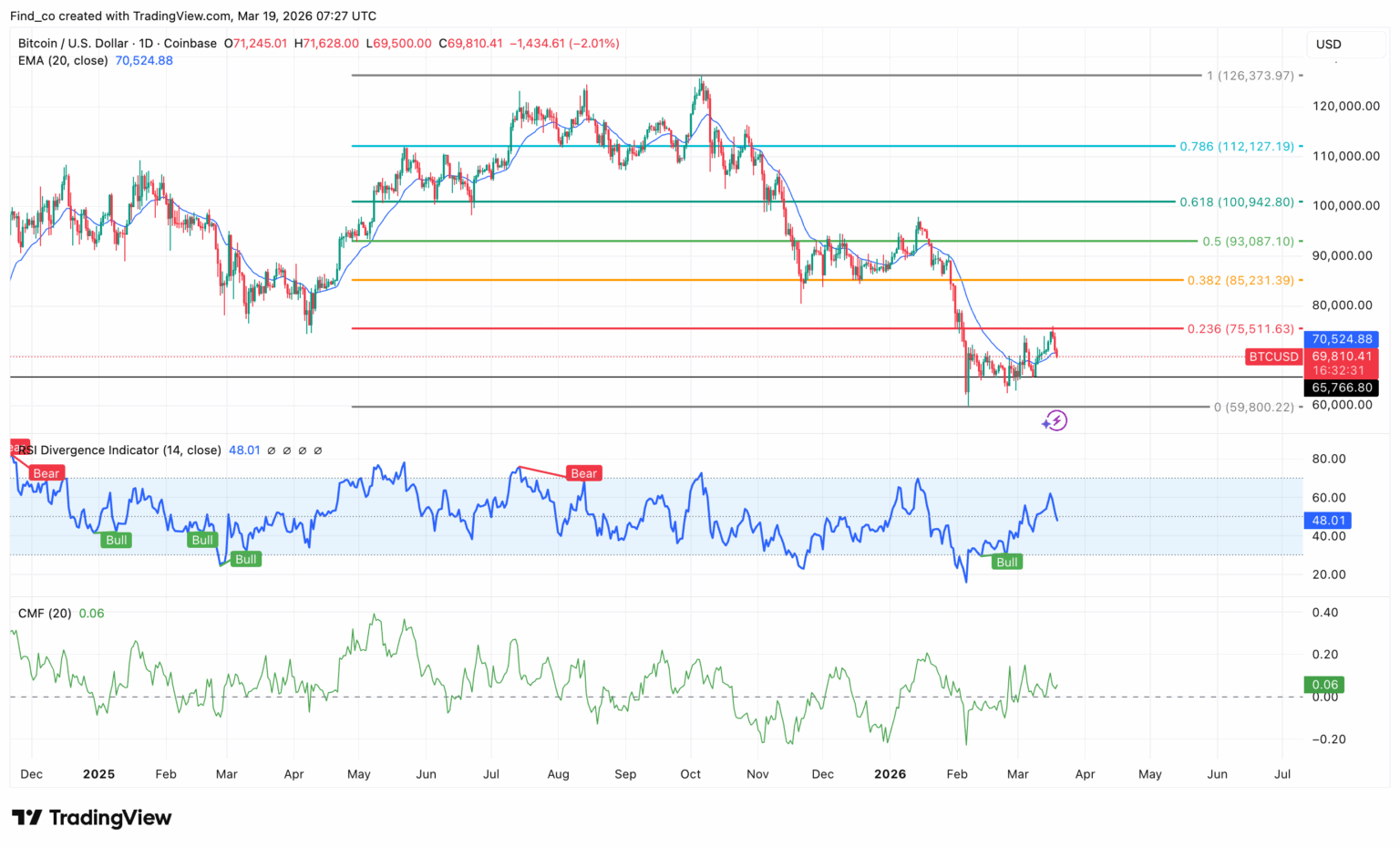
Blockchain analytics firm Glassnode said Bitcoin’s move into the mid-$70,000 range has pushed the market into a technically significant zone, adding that limited resistance may lie ahead.
According to the report, Bitcoin has broken out of a dense accumulation range between $59,000 and $72,000 and entered a relatively thin “air gap” extending toward $82,000.
This zone, defined by the UTXO Realized Price Distribution (URPD), contains little historical supply, suggesting fewer sellers and a smoother path higher in the near term.
Source: CoinMarketCap
At the same time, key profitability metrics are beginning to recover.
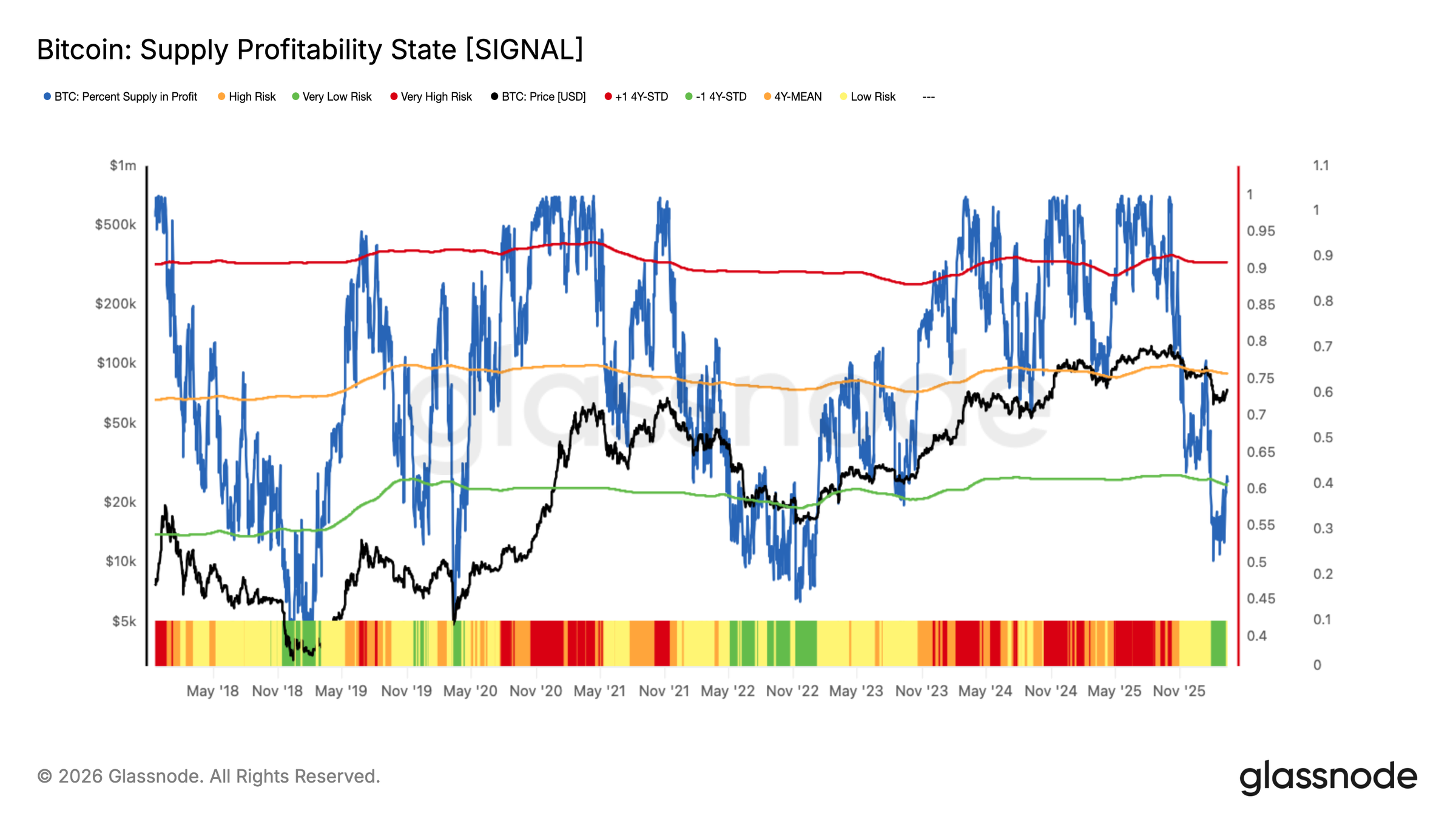
The percentage of Bitcoin supply in profit has climbed back to around 60%, a level historically associated with early-stage recoveries following bear market lows.
However, Glassnode cautioned that a sustained move above roughly 75% is typically required to confirm a transition into a full bull market.
The Key To Unlocking Further Bitcoin Upside
As Bitcoin approached $74,000, realised profits among short-term investors surged to $18.4 million per hour, according to the report.
To unlock further upside, towards the $78,000–$82,000 range, Glassnode said that it will depend on the market’s ability to absorb this selling pressure.
Bitcoin’s profitability chart | Source: Glassnode
Off-chain indicators have also pointed to improving conditions.
Spot Bitcoin ETF inflows have rebounded, signalling renewed institutional demand, while futures positioning on the CME remains relatively subdued, Glassnode reported.
Meanwhile, spot market flows have turned positive across major exchanges, with Coinbase activity stabilising and Binance-led selling pressure easing.
Altcoin Trading Activity Collapses as Interest Fades
In contrast to Bitcoin’s strengthening outlook, activity across the altcoin market continues to deteriorate sharply.
Crypto analyst Darkfrost noted that trading volumes on Binance and other major exchanges have fallen significantly, reflecting a clear drop in investor interest.
Binance currently processes around $7.7 billion in altcoin volume, while other exchanges collectively account for roughly $18.8 billion.
🗞️ Altcoin trading volumes collapse as investor interest fades
The analysis of altcoin trading volumes on Binance and other major exchanges highlights a clear loss of investor interest.
⚠️ Although the bear market is already well underway, altcoins continue to significantly… pic.twitter.com/D0epZzF5d2
By comparison, Binance recorded between $40 billion and $50 billion in altcoin trading volume during October 2025 and February 2025.
The decline highlights a broader risk-off environment, where capital is concentrating in Bitcoin while speculative appetite for smaller tokens weakens.
Despite the downturn, the analyst said historically low participation levels have often preceded attractive market opportunities.
Whether the current move evolves into a sustained breakout or stalls into another consolidation phase will depend on the market’s ability maintain momentum above the $70,000 threshold in the weeks ahead.
Kurt Robson is a London-based reporter at CCN, specialising in the fast-moving worlds of crypto and emerging technology. He began his career covering local news in Cornwall after graduating from Falmouth University with First Class Honours in Journalism. There, he cut his teeth on everything from council meetings to missing swans.
He quickly rose through the ranks to become a frontline journalist at several of the UK’s leading national newspapers. Over the years, he has interviewed musicians and celebrities, reported from courtrooms and crime scenes, and secured multiple front-page exclusives.
Following the upheaval of the COVID-19 pandemic, Kurt shifted his focus to technology journalism—just ahead of the AI boom. With a natural curiosity and a trained eye for emerging trends, he has found a new rhythm in reporting on innovation.
At CCN, Kurt's work focuses on the cutting edge of crypto, blockchain, AI, and the evolving digital world. Drawing on his background in people-first reporting and his deep interest in disruptive tech, Kurt delivers stories that are insightful, entertaining, and human-centric.