Key Takeaways
- Peter Schiff argues AI could hurt Bitcoin’s price by competing for speculative capital, electricity and data-center capacity.
- There is evidence behind the infrastructure argument: Bitcoin miners are shifting power and capital toward AI, while some have sold BTC to fund that transition.
- Schiff’s claim that AI could uncover a fatal Bitcoin vulnerability remains hypothetical; no such flaw has been identified.
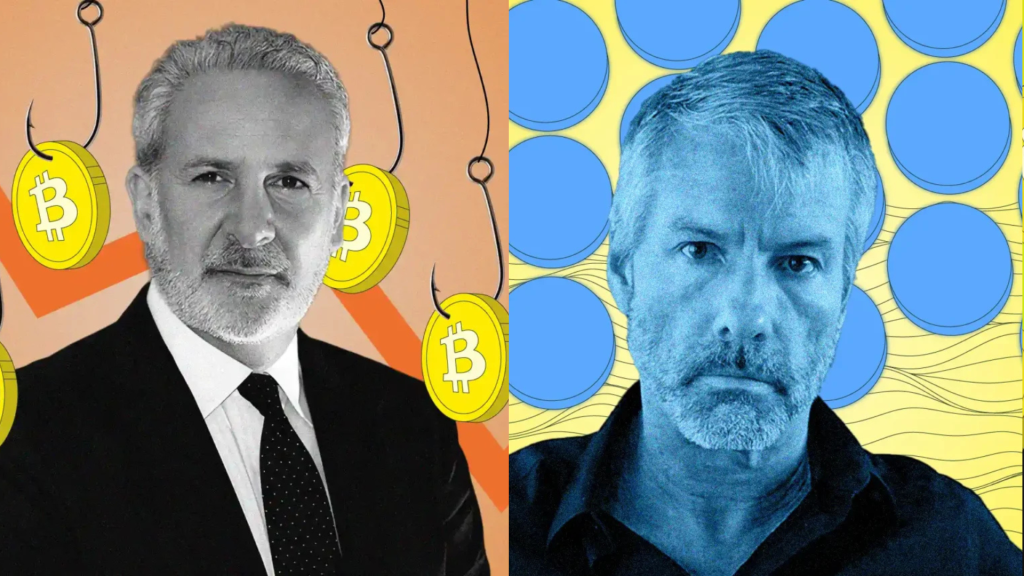
Peter Schiff is pushing back against attempts to bundle Bitcoin into the artificial intelligence investment boom, arguing that AI could compete for the same capital and infrastructure that helped fuel BTC’s rise.
“AI isn’t bullish for Bitcoin; it’s a threat to it,” Schiff wrote on Aug. 23. He argued that AI and Bitcoin increasingly compete for “speculative capital, electricity, and data-center infrastructure.”
For Bitcoin investors, the capital argument is the most immediate.
If investors seeking high-growth exposure increasingly allocate capital to AI companies and infrastructure rather than Bitcoin, Schiff believes BTC will lose part of the speculative bid that has historically amplified its bull markets.
There is no public data proving that money invested in AI would otherwise have flowed into Bitcoin. But the competition is already visible inside the Bitcoin mining industry itself.
Bitcoin Miners Are Choosing AI Over Mining
CoinShares found that public Bitcoin miners had signed more than $70 billion of AI and high-performance computing contracts by early 2026. It estimates that listed miners could generate as much as 70% of their revenue from AI by year-end, compared with roughly 30% previously.
The economics explains the shift.
The weighted average cash cost of producing one Bitcoin among public miners reached about $79,995 in Q4 2025, while mining revenue per unit of computing power fell toward multi-year lows. AI infrastructure, meanwhile, can provide longer contracts and more predictable returns.
That transition can reach the Bitcoin market itself.
MARA sold roughly $1.1 billion worth of Bitcoin earlier this year as it expanded into AI computing and addressed convertible debt obligations. CoinShares also documented miners reallocating power away from Bitcoin as AI economics became more attractive.
If miners repeatedly sell BTC to fund expensive AI data center projects, this creates additional supply in the market. If mining capacity is converted into AI capacity, Bitcoin also loses some of the computing power that would otherwise secure the network.
Neither does this automatically mean BTC prices fall. Bitcoin’s mining difficulty adjusts as computing power enters or leaves the network, allowing block production to adapt to changing hash rate.
Could AI Actually Break Bitcoin?
Schiff’s more extreme argument goes further.
He suggested that increasingly capable AI could uncover previously missed weaknesses in Bitcoin’s code, cryptography, wallets, or network, potentially damaging confidence in the scarcity and security assumptions that support BTC’s valuation.
There is currently no evidence that AI has discovered such a vulnerability.
AI should also not be confused with quantum computing. Today’s generative AI systems do not suddenly possess the computational ability to break Bitcoin’s cryptographic signatures simply because their models become more capable.
The price risk would emerge only if a genuine vulnerability were discovered and markets concluded that Bitcoin funds or its supply rules were at risk.
For now, the measurable AI threat is economic rather than cryptographic.
Bitcoin was trading around $77,000 on Aug. 24, after reaching approximately $79,455 last week, its highest level in three months. That recovery suggests investors are not currently pricing in AI as an existential risk to Bitcoin.
But Schiff’s argument identifies a real change underneath the price: AI companies are increasingly willing to pay more for the power, land, and capital Bitcoin miners once used almost exclusively for mining.
Whether that becomes bearish for BTC depends on what follows. If AI drives sustained miner Bitcoin sales and diverts investment demand, the price impact could become visible.
If miners use AI revenue to strengthen their balance sheets while Bitcoin demand continues through ETFs and treasury buyers, the two industries may coexist without the zero-sum outcome Schiff expects.
Top Trending Crypto Articles
The information provided in this article is for informational purposes only. It is not intended to be, nor should it be construed as, financial advice. We do not make any warranties regarding the completeness, reliability, or accuracy of this information. All investments involve risk, and past performance does not guarantee future results. We recommend consulting a financial advisor before making any investment decisions.

Dr. Guneet Kaur is a senior editor at CCN.com and a Science Fellow at Exponential Science. She is a fintech and blockchain expert with extensive experience in digital finance education, blockchain ecosystems, and cryptocurrency markets. She has worked with global media such as Cointelegraph, as well as education and blockchain platforms, to design and lead strategic content and learning initiatives. As an educator and assessor for top-tier executive programs, she bridges real-world fintech trends with academic insight.
Dr. Kaur is also a published researcher and peer reviewer across fintech and data science journals, including Financial Innovation Journal and International Journal of Big Data Intelligence and Applications. Her work spans data-driven analysis, Web3 innovation, and technical content development. With a strong foundation in both industry and academia, she translates complex financial technologies into practical applications, empowering learners, professionals, and institutions across the rapidly evolving digital finance landscape.