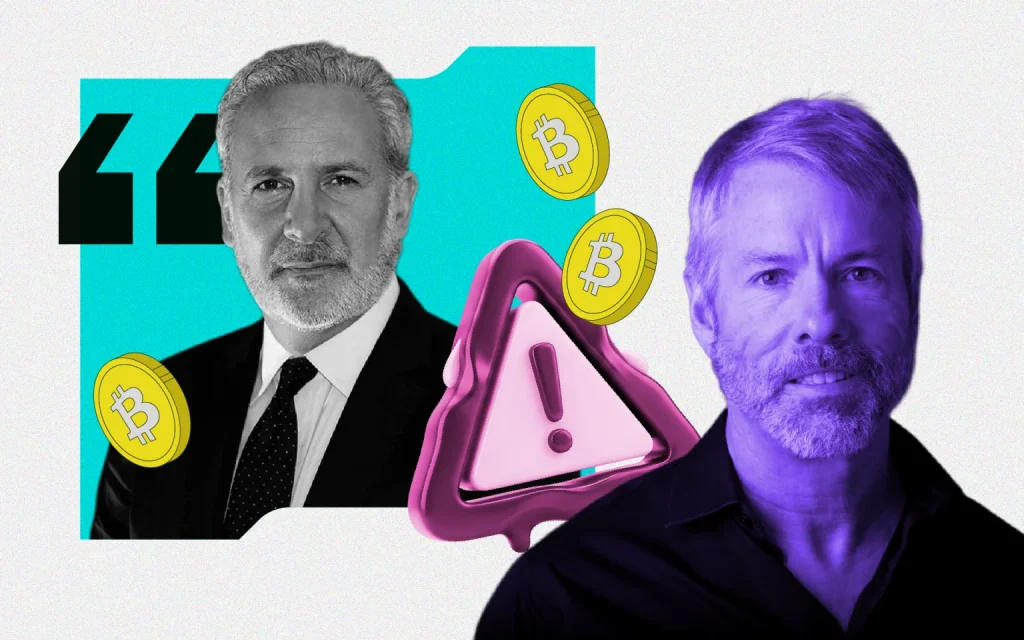
Peter Schiff accuses Michael Saylor of misleading traders after Strategy sells Bitcoin.
Share
Key Takeaways
Michael Saylor said his “Never Sell Your Bitcoin” message referred to his personal holdings rather than Strategy’s corporate treasury.
Strategy sold 1,638 BTC for approximately $104.7 million, leaving it with 842,138 BTC.
Peter Schiff accused Saylor of previously creating the impression that Strategy would never sell.
Michael Saylor’s attempt to separate his personal Bitcoin holdings from Strategy’s corporate treasury has sparked a fierce backlash, with Peter Schiff accusing him of creating a misleading impression about the company’s willingness to sell.
Saylor insisted he had never sold any of his own Bitcoin and said his well-known “Never Sell Your Bitcoin” message was personal advice between savers.
However, critics quickly resurfaced earlier comments in which Saylor appeared to state that Strategy would explicitly acquire and hold only Bitcoin.
The dispute comes after Strategy completed its third Bitcoin sale of 2026, reducing its enormous corporate reserve to 842,138 BTC.
Try Our Recommended Crypto Exchanges
Sponsored
Disclosure
We sometimes use affiliate links in our content, when clicking on those we might receive a commission at no extra cost to you. By using this website you agree to our terms and conditions and privacy policy.
“When I say ‘Never Sell Your Bitcoin,’ I speak as one saver to another. I have never sold mine. Not one satoshi,” he wrote.
“Strategy is a public company, not my wallet. Since 2020, it has disclosed it may buy or sell BTC to manage capital. Our shared conviction in Bitcoin remains unchanged.”
The comments followed a Strategy filing showing the company sold 1,638 BTC between July 27 and Aug. 2.
The sale generated approximately $104.7 million at an average price of $63,957 per Bitcoin.
When I say “Never Sell Your Bitcoin,” I speak as one saver to another. I have never sold mine. Not one satoshi. Strategy is a public company, not my wallet. Since 2020, it has disclosed it may buy or sell $BTC to manage capital. Our shared conviction in Bitcoin remains unchanged.
Strategy used $52.4 million of the proceeds to fund preferred stock dividends, and the remaining $52.3 million to repurchase its STRC preferred stock.
The company also sold approximately $290.6 million of MSTR shares, taking its US dollar reserve to $4 billion.
Following the transactions, Strategy held 842,138 BTC acquired for approximately $63.5 billion at an average price of $75,419.
The latest sale represented only around 0.2% of its previous Bitcoin holdings.
However, it attracted attention because of Saylor’s repeated association with an uncompromising buy-and-hold strategy.
Peter Schiff Accuses Saylor of Creating a False Impression
Schiff rejected Saylor’s attempt to distinguish between his personal Bitcoin and the company’s holdings.
“Yes, but you knew the impression you were creating, and you never bothered to clarify it,” Schiff wrote on X.
“So either that was a deliberate attempt to deceive, or you actually meant that Strategy would never sell and are now lying to cover your ass. Either way, it’s not good.”
Peter Schiff accused Michael Saylor of deception. | Source: X (@PeterSchiff)
Meanwhile, the response from the wider Bitcoin community was sharply divided.
Bitcoin Archive defended Saylor, writing: “We know. Every Bitcoiner with two functioning brain cells understands this.”
However, another X user accused Saylor of attempting to rewrite his previous comments.
“Nope. You’re lying,” the user wrote.
“You have said Strategy/MicroStrategy is not selling in the past. Yes, most of the time you said ‘never sell your bitcoin.’ But even then it was always with the backdrop of Strategy.”
— Tony Edward (Thinking Crypto Podcast) (@thinkingcrypto) August 3, 2026
A separate critic shared an older clip in which Saylor said Strategy was “in the business of buying Bitcoin” and added:
“We’ve said we would not be selling any Bitcoin. Ever.”
Critics argue that Saylor regularly discussed personal conviction and Strategy’s treasury in the same public appearances, allowing the “never sell” message to become associated with both.
His defenders maintain that a publicly traded company must retain the flexibility to manage capital.
Did Saylor Previously Say Strategy Would Never Sell Bitcoin?
The clearest source of the current confusion dates to Jan. 19, 2022.
During a Bloomberg interview, Saylor was asked whether MicroStrategy would consider selling Bitcoin after the crypto had fallen approximately 40% from its previous high.
“Never. No. We’re not sellers,” Saylor responded.
“We’re only acquiring and holding Bitcoin. That’s our strategy.”
However, the interview explains why some investors interpreted “never sell” as a company-specific commitment rather than purely personal savings advice.
Strategy’s behavior has also shown that its approach was never completely absolute in practice.
In December 2022, the company sold 704 BTC for approximately $11.8 million to generate a potential tax benefit.
It then purchased 810 BTC two days later, leaving its overall holdings higher across the reporting period.
More recently, Strategy sold 32 BTC in May 2026, then disposed of another 3,588 BTC between June 29 and July 5.
Could Bitcoin Rally to $70,000 or Fall Back to $60,000?
Strategy’s latest sale does not appear to have caused an immediate Bitcoin sell-off.
Bitcoin rose slightly after the disclosure and remained around $63,500 on Tuesday, suggesting the market absorbed the 1,638 BTC sale without significant disruption.
The relatively small size of the transaction compared with Strategy’s remaining holdings also limits its direct effect on supply.
However, the sale may still carry psychological significance.
Bitbanker analyst Andrey Poroshin recently predicted Bitcoin could fall to between $60,000 and $62,000 during August before recovering toward $70,000.
He argued that the market lacked a strong macroeconomic catalyst after the Federal Reserve left interest rates unchanged.
Under that scenario, Bitcoin could decline by approximately 5% from current levels before staging a roughly 17% recovery from $60,000 to $70,000.
A sustained move above the mid-$60,000 range would strengthen the case for a return to $70,000.
Conversely, a decisive break below $60,000 could revive fears of a deeper bear-market decline and place greater attention on whether large corporate holders continue selling.
Disclaimer:
The information provided in this article is for informational purposes only. It is not intended to be, nor should it be construed as, financial advice. We do not make any warranties regarding the completeness, reliability, or accuracy of this information. All investments involve risk, and past performance does not guarantee future results. We recommend consulting a financial advisor before making any investment decisions.
Kurt Robson is a London-based reporter at CCN, specialising in the fast-moving worlds of crypto and emerging technology. He began his career covering local news in Cornwall after graduating from Falmouth University with First Class Honours in Journalism. There, he cut his teeth on everything from council meetings to missing swans.
He quickly rose through the ranks to become a frontline journalist at several of the UK’s leading national newspapers. Over the years, he has interviewed musicians and celebrities, reported from courtrooms and crime scenes, and secured multiple front-page exclusives.
Following the upheaval of the COVID-19 pandemic, Kurt shifted his focus to technology journalism—just ahead of the AI boom. With a natural curiosity and a trained eye for emerging trends, he has found a new rhythm in reporting on innovation.
At CCN, Kurt's work focuses on the cutting edge of crypto, blockchain, AI, and the evolving digital world. Drawing on his background in people-first reporting and his deep interest in disruptive tech, Kurt delivers stories that are insightful, entertaining, and human-centric.