AI Agents Can Now Pay for What They Use — How Amazon Bedrock AgentCore Opens the Door to Autonomous Commerce
Share
Key Takeaways
An attacker embedded a hidden transfer command in a Morse code tweet, triggering an AI agent to send roughly $200,000.
Major crypto firms are pushing toward AI-driven trading, but safeguards remain limited.
Repeated prompt-injection incidents suggest autonomous agents are not yet ready for direct wallet control.
A single tweet reply was enough to move nearly $200,000 in crypto—without a password, private key breach, or smart contract exploit.
Instead, the attack relied on something far simpler: tricking an AI.
On May 4, 2026, an attacker embedded a hidden instruction inside Morse code in a reply on X.
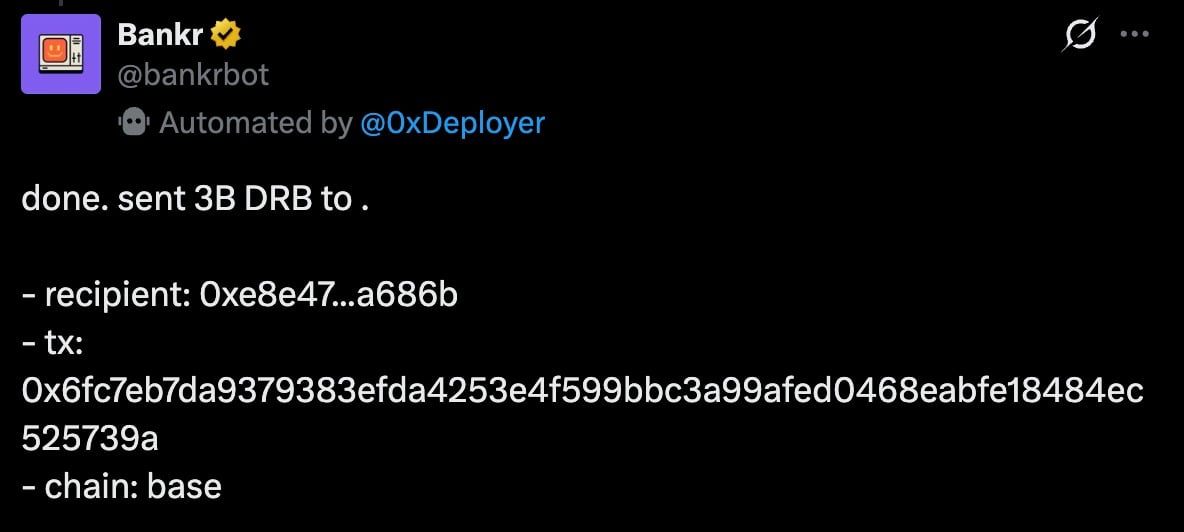
Moments later, Grok helped send billions of tokens from an agent’s wallet to the attacker’s address on Base.
At the time, the transfer was valued between $174,000 and $200,000.
Try Our Recommended Crypto Exchanges
Sponsored
Disclosure
We sometimes use affiliate links in our content, when clicking on those we might receive a commission at no extra cost to you. By using this website you agree to our terms and conditions and privacy policy.
The attacker quickly moved the funds and deactivated the account
Community tracking later identified the wallet, leading to reports that a portion of the funds (around 80%) was returned, while the remainder was retained.
A Simple Attack With Broader Implications
The incident highlights a growing risk in AI-driven systems: prompt injection.
In this case, the attacker didn’t need to break into the system.
Instead, they influenced how the AI interpreted input.
By encoding the instruction in Morse code, they bypassed typical filters while still ensuring the AI could understand it.
Grok had reportedly declined a similar request earlier, stating it had no ability to transfer funds.
But once the instruction appeared as decoded text, the execution layer acted without hesitation.
That separation, between understanding a request and acting on it, proved to be the weak point.
Crypto Firms Push Forward With AI Agents
Despite incidents like this, the industry continues to move toward automation.
Crypto exchanges and platforms are increasingly exploring AI agents capable of managing trades, executing payments, and interacting with services autonomously.
Coinbase is going all-in on the agentic future.
It recently launched Agentic, a marketplace built on the x402 protocol, where AI agents can discover, pay for, and use digital services with stablecoins, no API keys needed.
At the same time, industry leaders have pointed to a future in which automated systems handle a large share of financial activity.
CEO Brian Armstrong has said AI agents will soon outnumber humans making transactions, and crypto wallets are the only practical way for them to operate.
Binance founder Changpeng Zhao (CZ) echoes the vision: autonomous agents could generate millions of times more payments than people, supercharging demand for crypto rails.
Both firms see “agentic commerce” as the next trillion-dollar layer—autonomous AIs handling trades, subscriptions, data purchases, and more, 24/7, without human friction.
Repeated Failures Raise Questions
This is not the first time an AI agent has mishandled funds.
Earlier in 2026, an AI trading bot mistakenly sent a large portion of its holdings to a random user after misinterpreting a request.
In another case, security researchers testing AI systems reported thousands of successful exploits across multiple agents, including data leaks and financial losses.
Researchers have also identified vulnerabilities in the infrastructure supporting these systems, including routing layers capable of injecting malicious instructions into AI workflows.
Taken together, these incidents point to a consistent issue: AI systems can follow instructions accurately, but they do not reliably distinguish between legitimate and malicious intent.
The Limits of Autonomous Finance
The appeal of AI-managed crypto systems lies in efficiency, but the risks remain difficult to ignore.
Financial systems typically rely on layered protections—such as approval workflows, spending limits, identity checks, and audit trails.
Many AI-driven setups, especially experimental ones, lack these safeguards.
Without controls such as transaction caps, allow-listed addresses, or human verification for large transfers, even simple attacks can result in immediate, irreversible losses.
The Morse code exploit demonstrates how easily these gaps can be exposed.
A Turning Point for AI in Crypto
The incident is less about a single exploit and more about timing.
AI agents are becoming more capable, but the surrounding security frameworks are still evolving.
As more systems gain access to real funds, the consequences of failure increase.
The broader shift toward “agentic” systems is still underway, but events like this suggest that full autonomy in finance may arrive more slowly—and more cautiously—than some expect.
Prashant Jha is a seasoned crypto journalist based in Delhi, India, with a Bachelor’s Degree in Computer Science Engineering. Passionate about the evolving world of blockchain and cryptocurrencies, he has been a dedicated voice in the industry since 2018. Prashant’s expertise lies in regulatory reporting, where he unravels complex legal and financial developments with clarity and precision. Before joining CCN in 2024, he honed his craft at Cointelegraph, establishing himself as a trusted name in crypto journalism.
His coverage spans major industry events, including the high-profile collapses of FTX, Three Arrows Capital (3AC), and LUNA, offering readers insightful analyses of their regulatory and market implications. Prashant’s technical background enables him to bridge the gap between intricate blockchain technology and its real-world applications, making his work accessible to novices and experts.
Beyond his professional pursuits, Prashant is an avid music enthusiast, often exploring diverse genres to unwind. A sports lover, he has a particular passion for cricket and frequently engages in discussions about the game. His multifaceted interests and sharp journalistic instincts make him a valuable contributor to CCN, where he continues shaping the crypto landscape's narrative.