$WLFI Trading Guide: Full List of Exchanges & the Common Mistakes To Avoid.
Share
Key Takeaways
WLFI will become tradable and transferable for the first time on September 1, 2025.
Early backers can claim 20% of their tokens.
The WLFI Lockbox is required for all unlocks and claims. However, users have reported issues.
Political ties and token concentration raise questions about decentralization.
As politics and crypto continue to collide, World Liberty Financial (WLFI) stands out as both an example and an active case study of how financial innovation can be shaped by political influence.
In October 2024, World Liberty Financial (WLF) launched as a decentralized finance (DeFi) platform with direct political ties.
Its token, WLFI, was sold in a presale restricted to accredited investors under Securities and Exchange Commission (SEC) rules and raised $550 million.
According to plans, on September 1, WLFI will become tradable and transferable on the open market for the first time.
However, not everything has gone smoothly in the run-up to WLFI’s highly anticipated token unlock. While excitement is high, the project has already disruption affecting some Coinbase Wallet users.
I'm Still Facing same issue please help me Team of @worldlibertyfi 🦅
Frustrations mounted over the unlock box as users struggled to connect and activate Lockbox despite completing KYC and holding tokens on-chain, turning to public figures and tagging World Liberty Financial.
WLFI acknowledged the issues in a post, telling users that some wallets were still under review. The team said its compliance unit was continuing to unlock accounts and set up a dedicated email, for those still unable to connect.
We hear your concerns. Some of you may not yet be able to connect your wallet. Our compliance team is continuing to review and unlock additional wallets. If your wallet isn’t active yet, please check back soon or reach out to [email protected] for assistance.
This article explains how presale participants can unlock their tokens, the timeline for the first listings, and what the debut of WLFI means for the wider crypto market.
World Liberty Financial: Ethereum Layer-2, Trump Ties, $550M Token Sale, and the USD1 Stablecoin
WLF was built on Ethereum’s layer-2 with Aave V3 technology. It entered the market with heavy political ties. Donald Trump was Chief Crypto Advocate, while Eric Trump and Donald Trump Jr. were named Web3 Ambassadors.
Try Our Recommended Crypto Exchanges
Sponsored
Disclosure
We sometimes use affiliate links in our content, when clicking on those we might receive a commission at no extra cost to you. By using this website you agree to our terms and conditions and privacy policy.
The first WLFI token sale on October 15 raised $550 million, with 75% of proceeds flowing to the Trump family through affiliated companies such as WLF Holdco LLC.
The sale was restricted to accredited investors under SEC rules, which limited participation to wealthy individuals, licensed professionals and institutions.
This created an intense concentration of tokens, with one wallet holding more than 2.7 million WLFI.
WLF also manages a crypto treasury worth more than $1.5 billion treasury. Another part of its ecosystem is USD1, a stablecoin pegged to the U.S. dollar and backed by Treasuries, designed to support lending, payments and cross-chainliquidity.
Supporters describe WLF as an attempt to challenge traditional banking, but critics argue it mirrors the same centralized structures DeFi set out to avoid.
WLFI is turning into a complete disappointment. They claim holders can vote and decide, but then they release only 20% and list futures a week earlier (again, nobody voted for this). This is not what we voted for, and it’s clear you don’t care about holders or their opinion
With that foundation built, WLFI now enters its next phase as a tradable and transferable asset on the open market.
WLFI Token Launch: Uniswap Listing, Exchange Futures, and September 1 Unlocks
The most significant shift for WLFI is that the token is now becoming tradable and transferable on the open market.
Specifically, decentralized exchanges like Uniswap are likely to be among the first to list WLFI.
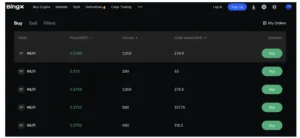
As for centralized exchanges, several major platforms including Binance, OKX, and BingX have already enabled pre-market perpetual futures trading for the token.
WLFI on BingX | Source: BingX
Until now, it has been restricted to presale allocations, but with the launch on the Ethereum mainnet, WLFI has moved into its next phase as a liquid digital asset.
This marks a significant milestone for the project, drawing attention partly due to its association with Eric Trump.
He positioned WLFI as a flagship initiative linking politics, finance, and crypto and compared Donald Trump to the debanked crypto community.
“The people in the cryptocurrency were debanked just like Trump was being debanked.”
How the WLFI Lockbox Works: Claiming and Securing Your Tokens
The WLFI Lockbox is an audited smart contract built on Ethereum to manage token unlocks securely. Users must activate the Lockbox before claiming, which moves their WLFI into the contract. After activation, wallets will show a zero balance, something WLFI explained as expected and part of the system.
Audited by Cyfrin, the Lockbox acts as the trusted channel for early supporters to access their tokens as they unlock.
In its official X thread on August 22, 2025, WLFI detailed how the rollout will work:
Initial unlock: 20% of tokens purchased in the $0.015 and $0.05 rounds unlock on September 1 at 8:00 a.m. ET (12:00 UTC).
Remaining 80%: Future unlocks will follow a community governance vote, giving token holders a say in the release schedule.
Locked categories: Founders, advisors, partners, and team members will not unlock in this phase, keeping the focus on early supporters.
New buyers: WLFI will be listed on decentralized exchanges (DEXs) and centralized platforms, with official partners to be announced.
The WLFI Lockbox: An onchain smart contract audited by Cyfrin will handle all unlocks. Users must activate the Lockbox to participate, moving their WLFI into the contract. Wallets will temporarily show zero WLFI after activation, which WLFI described as an expected system feature.
Timeline: The Lockbox opens on August 25, midday ET, giving presale participants a week to activate before the first 20% claims go live on September 1, 2025.
What Happened With the WLFI Lockbox Connection Issue for Coinbase Wallet Users?
On August 25, 2025, right after the Lockbox went live, some Coinbase Wallet users ran into problems connecting. Many could not sign the unlock agreement or activate their Lockbox, which left them stuck during a critical pre-trading period.
WLFI’s team later explained that the disruption was not a Coinbase-wide outage but a short-lived compatibility glitch between the wallet’s Web3 interface and the Lockbox contract.
With more than $40 billion tied to the initial unlock and intense political attention surrounding the project, the issue quickly became a talking point across social channels.
Thanks for your patience, Coinbase Wallet users — the connection issue with the $WLFI Lockbox has been resolved. You should be able to connect normally now. If you still see an error, refresh and try reconnecting. As always, only use links from our official profile. 🦅☝️
The team moved fast. Within hours, WLFI confirmed the fix and told Coinbase Wallet users they could reconnect without trouble.
However, many users kept complaining.
WLFI Lockbox Users Still Blocked Despite KYC, Tokens On-Chain
Ivan Dimitrov, Machine Learning Engineer at Wisdom-io, reached out to CCN to raise concerns over persistent issues with the WLFI Lockbox.
Lockbox activation for WLFI tokens. | Source: WLF Governance Forum
Despite completing KYC verification and holding tokens on-chain, Dimitrov says he and many other users remain unable to activate the Lockbox. According to him, the governance forum shows hundreds of affected users experiencing the same problem.
WLF acknowledged wallet access issues on August 27, noting that its compliance team is still reviewing accounts and gradually enabling more wallets.
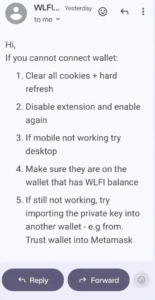
WLFI reply to Ivan Dimitrov | Source: Ivan Dimitrov
WLFI replied to complaints. Ivan Dimitrov shared the response with CCN. But he said it felt like copy-paste instructions rather than real support. Many felt the team was simply checking a box️ instead of addressing the underlying problem, as reports of the issue continued.
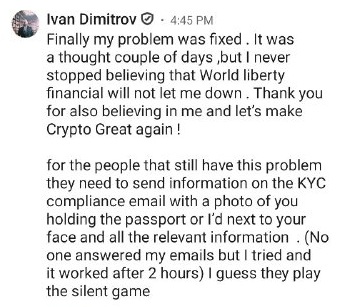
On August 29, Dimitrov notified CCN that his issue with World Liberty Financial was resolved after a few days once he submitted the required KYC compliance details by emailing a photo of himself with his passport and other necessary information. Although the company never directly replied to his emails, the problem was fixed within two hours of sending the documents. He encouraged others facing similar issues to follow the same process and expressed his continued trust in the company.
Self-resolution to WLFI’s lockbox issue. | Source: Ivan Dimitrov
WLFI Pre-Launch Trading Explained: How Hyperliquid Lets You Long or Short Before Token Debut
While the official token debut is set for September 1, traders don’t have to wait to gain exposure. Thanks to Hyperliquid, a decentralized derivatives exchange, investors can now long or short WLFI before it officially goes live. This pre-launch trading product has already attracted massive attention, driving billions in trading volume and shaping WLFI’s early market narrative.
On August 23, 2025, Hyperliquid rolled out a 3× leveraged WLFI-USD perpetual contract, often called a “Hyperp.” This allows traders to speculate on WLFI’s price without owning the actual token.
In simple terms, a $1,000 deposit gives traders control over a $3,000 WLFI position, multiplying both profits and risks.
Why Pre-Launch Trading Matters
Pre-TGE (Token Generation Event) trading provides an early price discovery mechanism, letting the market decide WLFI’s value before spot trading begins.
Speculation catalyst: Traders can bet on WLFI’s hype cycle ahead of its official release.
Arbitrage potential: Once WLFI lists on centralized and decentralized exchanges, price gaps between perpetual and spot markets could create profitable opportunities.
Impact on the HYPE Token
The Hyperliquid ecosystem runs on its native HYPE token, which benefits from WLFI trading activity:
97% of trading fees are used for buybacks and burns
28.5 million HYPE tokens have already been burned, creating deflationary pressure
Institutional adoption: Over $1.5 billion worth of HYPE has been locked in treasuries
High staking yields: Programs offering up to 55% APR attract liquidity providers
This creates a feedback loop where WLFI speculation directly strengthens the broader Hyperliquid ecosystem.
Is WLFI Safe? Breaking Down the Risks of Trump-Linked Crypto
While WLFI is attracting attention for its political ties and ambitious vision, investors and users should be aware of several risks:
Concentrated ownership: Early allocations and Trump family control (up to 75% of proceeds) create governance centralization and manipulation risks.
Regulatory uncertainty: WLFI’s political ties increase the chance of SEC scrutiny, potential classification as a security, or delisting.
Reputational and ethical risk: Strong association with the Trump brand may alienate mainstream DeFi users and institutional investors.
Liquidity and volatility: Token unlocks (20% on Sept 1, 2025, rest by governance vote) could trigger sharp price swings.
Transparency and governance issues: Critics point to opaque structures, payouts to insiders, and weak community safeguards.
Smart contract and technical risk: The WLFI “Lockbox,” though audited, could face bugs, user errors, or vulnerabilities.
Macro and political risk: Changes in political climate or legal backlash against Trump-linked ventures may directly impact WLFI’s adoption.
Conclusion
The WLFI token launch marks a turning point for World Liberty Financial. After raising $550 million in a restricted presale, the project now opens its doors to broader markets. WLFI becomes a tradable and transferable asset with exchange liquidity for the first time.
The process is built around the WLFI Lockbox, a smart contract designed to handle every unlock. Early backers can claim 20% of their allocations on September 1, while the community will vote on how the remaining 80% is released. This structure adds a governance layer and highlights questions about concentration and control.
WLFI combines politics, finance and crypto in a way few projects have attempted. Its future will depend not only on exchange listings and adoption, but also on whether it can balance decentralization with its strong ties to the Trump family.
How does WLFI compare to other political tokens like $TRUMP?
Unlike memecoins, WLFI ties directly to a DeFi platform with lending and stablecoin features.
What is the WLFI Lockbox and how do I use it?
The WLFI Lockbox is an audited smart contract on Ethereum for token distribution. Users must activate it on Aug. 25, moving WLFI into the contract, then claim 20% unlocked tokens from Sept. 1 at 8:00 a.m.
When can I first sell WLFI tokens?
WLFI tokens become tradable and transferable on September 1, 2025, at 12:00 UTC.
Which exchanges will list WLFI first?
WLFI will list on decentralized exchanges (DEXs) like Uniswap first, followed by centralized exchanges (CEXs) such as BingX, with specific partners to be announced closer to September 1, 2025.
Disclaimer:
The information provided in this article is for informational purposes only. It is not intended to be, nor should it be construed as, financial advice. We do not make any warranties regarding the completeness, reliability, or accuracy of this information. All investments involve risk, and past performance does not guarantee future results. We recommend consulting a financial advisor before making any investment decisions.
Dr. Lorena Nessi is an award-winning journalist and media technology expert with 15 years of experience in digital culture and communication. Based in Oxfordshire, UK, she combines academic insight with hands-on media practice.
She holds a PhD in Communication, Sociology, and Digital Cultures, and an MA in Globalization, Identity, and Technology.
Lorena has taught at Fairleigh Dickinson University, Nottingham Trent University, and the University of Oxford. She is a former producer for the BBC in London, with additional experience creating television content in Mexico and Japan.
Her research focuses on digital cultures, social media, technology, capitalism, and the societal impact of blockchain innovation.
She has written extensively on digital media and emerging technologies, with her work featured in both academic and media platforms. Her Web3 expertise explores how blockchain technologies shape culture, economics, and decentralized systems.
Outside of work, Lorena enjoys reading science fiction, playing strategic board games, traveling, and chasing adventures that get her heart racing. A perfect day ends with a relaxing spa and a good family meal.


 Easy
Easy