Polymarket US introduces tiered taker fees, charging smaller traders up to 36% more than Kalshi’s standard rate on comparable trades. | Credit: CCN.com
Share
Key Takeaways
Prediction markets function like stock markets for questions, where prices reflect the crowd’s odds on real-world events.
Platforms like Polymarket and Kalshi enable users to trade on crypto, politics, sports, and macroeconomic data using simple yes/no contracts.
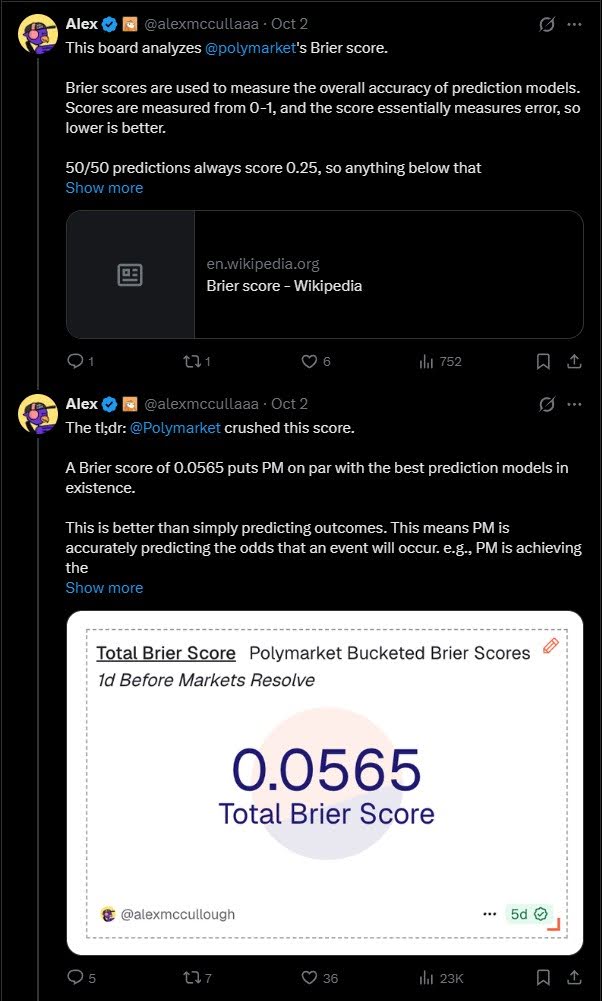
Researchers have found that prediction market prices often align with real-world probabilities, and Polymarket’s own data indicates accuracy above 90% before events are resolved.
Web3 prediction markets utilize smart contracts to reduce fees and remain open 24/7; however, they introduce risks such as smart contract bugs and unclear rules in certain countries.
Prediction markets might sound confusing, but their core concept is actually quite simple: you trade “tiny” stocks in real-life events. Oftentimes, each stock pays $1 if something happens and $0 if it doesn’t. The price between those numbers tells you the crowd’s odds.
For example, a prediction market might ask: “Will Bitcoin be above $100,000 on December 31?”
If the “Yes” share trades at $0.70, the market indicates there’s about a 70% chance it will happen. The price fluctuates as new information becomes available, such as the announcement of a new Bitcoin ETF.
Economists and regulators often refer to these as “event contracts.” The United States Commodity Futures Trading Commission (CFTC) describes them as derivatives that pay out based on a specific event, such as GDP numbers or the amount of snowfall that may occur overnight.
In other words, think of them like a stock market for questions, rather than companies. Sites like Polymarket and Kalshi have built entire businesses around this idea, allowing people to trade on politics, sports, inflation numbers, and more.
Top Crypto Tax Accounting Software
Sponsored
Disclosure
We sometimes use affiliate links in our content, when clicking on those we might receive a commission at no extra cost to you. By using this website you agree to our terms and conditions and privacy policy.
Market question: Will Ethereum be above $5,000 on December 31?
You can buy Yes or No shares.
If Yes trades at $0.40, the market suggests a roughly 40% chance that ETH will finish above $5,000.
Do some research, read the news, and if you think the odds are higher than 40%, buy Yes. If you feel the opposite, buy No.
Continue to track the topic, as investors will buy or sell over time as new information becomes available. ETF approvals, Fed decisions, network upgrades, and other factors can impact the price, much like in the stock market.
Real-World Platforms
Here are some real-world platforms you can utilize.
Polymarket
Polymarket is a blockchain-based platform that typically utilizes stablecoins, such as USDC. It hosts markets on everything from elections to sports to crypto prices.
It will soon re-enter the US market after a year-long ban due to compliance issues. Some even view it as one of the first decentralized finance (DeFi) platforms to see full US government regulation.
Kalshi
Kalshi is a CFTC-regulated exchange that lists event contracts on various assets, including inflation, interest rates, sports, and more.
Interestingly, the CFTC tried to block some of these markets, like crypto and economics, but Kalshi sued and won the right to offer such events.
Older Markets
Long-standing prediction markets often use similar logic, but don’t use real cash. Metaculus, for example, doesn’t consider itself a prediction market as it “directly solicits predicted probabilities from its users” rather than using a currency.
Why Do People Care About Prediction Markets?
Prediction markets do two big things:
Gather information: Markets pull together the views of thousands of people. As Ethereum.org puts it, they use “crowd wisdom and financial incentives” to forecast events.
Quantify opinions: Instead of saying “I think there’s a good chance,” the market says “there’s a 70% chance,” and that number updates in real time as news breaks. In short, they turn knowledge into prices.
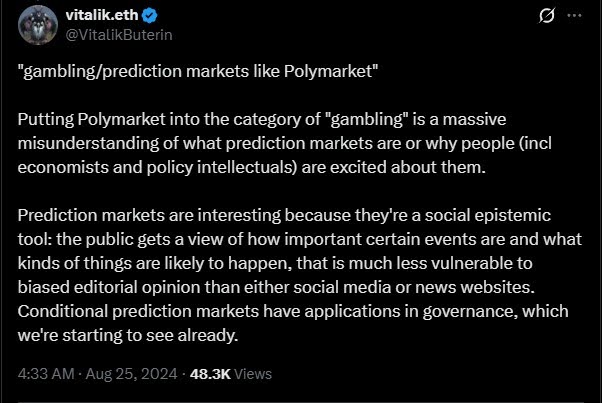
Ethereum founder Vitalik Buterin considers prediction markets a “social epistemic tool,” or a view of the public’s opinion on certain events.
Prediction markets look like sports betting at first, as both let you risk money on outcomes outside of your control, but they’re different in a few key ways:
Continuous trading: Prediction markets allow you to enter and exit before an event concludes, similar to trading a stock. You don’t just set a bet and wait.
Probabilities over parlays: Prices directly map to odds (a $0.25 price corresponds to a 25% chance), so you can see what the crowd believes at any given moment.
More than sports: Platforms list events on inflation, elections, ETF approvals, and even the weather.
Legally, the line between prediction markets and betting gets blurry fast. The CFTC treats many event contracts as derivatives, but it bans markets tied to activities such as terrorism or assassination, and warns that some sports contracts may be considered “gaming.”
These confusing rules are why some platforms, like Kalshi, go out of their way to comply with US regulations, while others remain crypto-native and stay outside of the US.
At the same time, crypto markets present new challenges: smart contract bugs, oracle failures, and unclear regulatory status in countries such as the US.
Dashboard with details on Polymarket’s accuracy. | Credit: Alex X profile
Pros and Cons
Prediction markets have both pros and cons, depending on one’s stance.
Pros
Fast reactions: Web3 prediction markets are globally available, with near-instant responses to news and other price-changing factors via on-chain technology.
Clear signals: A single number quantifies what the crowd thinks.
Bet on everything: Prediction markets allow potential profit from almost any market event.
Cons:
Regulatory risk: Courts and regulators debate whether specific event markets constitute illegal gambling, particularly in the context of sports. This issue is part of what Kalshi faced during its lawsuit.
Addiction risk: Bank of America analysts warn that easy access to sports betting and prediction markets can cause addiction for susceptible users.
Information gaps: Insiders might out-play casual users who don’t understand the data they’re betting on. While information gaps are a problem in the traditional stock market, high-tier stock trading isn’t nearly as accessible as sports betting and prediction markets.
If you ever decide to try prediction markets, follow these basic safety rules, which aren’t too different from traditional crypto or stock trading guidelines:
Understand local laws: Some markets or platforms may not operate in your country or state. For example, as of this writing, Polymarket is only just re-entering the U.S. market.
Start small: Treat prediction markets like a high-risk game, not your primary form of income.
Read the fine print: Examine how the platform resolves disputes and understand its approach to handling event contract cancellations. Basically, know how it handles your money when problems arise.
Use them for learning, not just betting: Even if you don’t end up trading, prediction market prices alone can help you understand how the world views events.
Are prediction markets legal in the United States?
Prediction markets sit in a gray area. Platforms like Kalshi are CFTC-regulated, while crypto-native sites like Polymarket now operate through U.S. brokerages. Some states still treat many event contracts as gambling, especially for sports.
Do prediction markets really work as forecasts?
Studies by economists and recent data from Polymarket show that, while not perfect, market odds often match real-world outcomes and can be more accurate than simple polls or guesses.
How much money do I need to start using a prediction market?
Many platforms let you start with small amounts, sometimes just a few dollars or the equivalent in stablecoins, so you can learn without risking too much at first.
What’s the main difference between prediction markets and sports betting?
Sportsbooks usually lock in your bet until the game ends. Prediction markets let you trade in and out before the event finishes, and they cover non-sports events like elections, inflation prints, and crypto prices.
Disclaimer:
The information provided in this article is for informational purposes only. It is not intended to be, nor should it be construed as, financial advice. We do not make any warranties regarding the completeness, reliability, or accuracy of this information. All investments involve risk, and past performance does not guarantee future results. We recommend consulting a financial advisor before making any investment decisions.
Max Moeller is a Chicago‑based writer and video editor passionate about games, tech, and crypto. Whether it’s crafting clear, insightful articles or piecing together engaging video retrospectives, he’s driven by curiosity and takes pride in keeping things human. Since 2017, Max has been published in a variety of notable crypto magazines.


 Easy










 Polymarket vs Kalshi: Will Crypto Beat Regulated Finance in Billion-Dollar Prediction Market Boom?