Strategy is the largest corporate Bitcoin holder, owning 649,870 BTC, or over 3% of Bitcoin’s total supply, valued at around $60–70 billion.
Strategy doesn’t publish wallet addresses or on-chain proofs. Instead, its holdings are verified via SEC filings (10-Q, 10-K) audited under U.S. law.
The company withholds wallet data to avoid hacking risks and because its assets are spread across multiple custodians and cold storage setups.
Strategy’s approach satisfies regulators but leaves some in the crypto community demanding cryptographic transparency.
Strategy (previously MicroStrategy) has become the world’s largest corporate holder of Bitcoin, with a staggering 649,870 BTC in its treasury as of November 17, 2025.
This position represents over 3% of Bitcoin’s total supply, making Strategy a pivotal player in the crypto ecosystem.
These numbers are drawn from Strategy’s SEC filings and confirmed by leading market data trackers. Yet, the company has never published its wallet addresses or signed an on-chain message verifying ownership.
As a U.S. public company, it must file reports with the Securities and Exchange Commission (SEC), including quarterly (10-Q) and annual (10-K) filings.
Form 10-Q is a quarterly report that details the company’s financial performance, asset holdings, and any major events or risks over the previous three months. In contrast, form 10-K, an annual report that provides a comprehensive overview of the company’s financial statements, operations, and business strategy for the entire year.
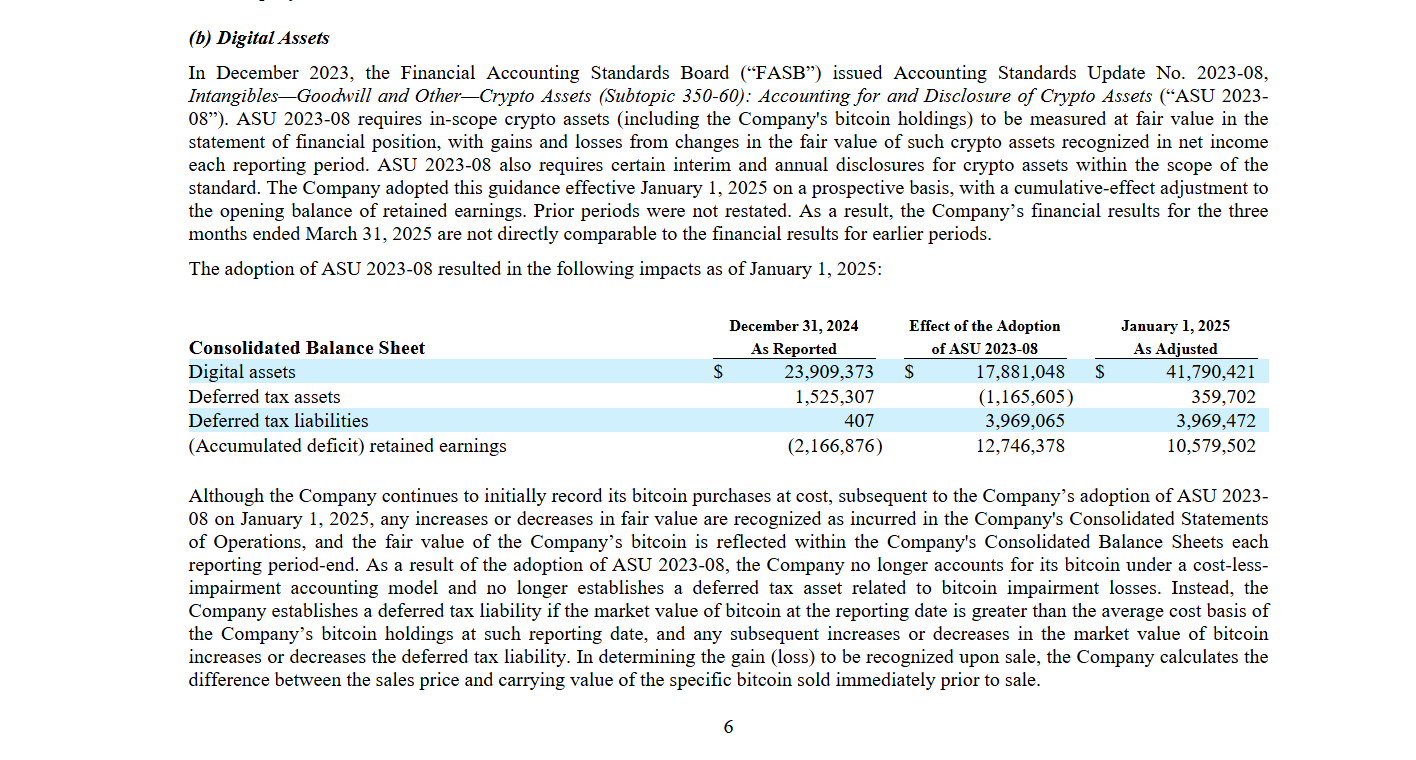
Excerpt from Strategy’s Q1 2025 SEC filing detailing the adoption of ASU 2023-08. | Source: SEC
Both documents are publicly available on the SEC’s EDGAR database and are reviewed by independent auditors. They serve as formal proof of the company’s financial position, including its Bitcoin holdings, cost basis, and valuation, under U.S. law.
Security risks: Publishing wallets holding billions in BTC could make them prime hacking targets.
Operational complexity: Strategy’s Bitcoin is distributed across multiple custodians and cold storage arrangements.
Regulatory compliance: The company’s proof lies in its SEC-audited filings, not public wallet disclosure.
Liability context: Proof of assets alone doesn’t show liabilities or pledged collateral, which are key parts of the financial picture.
In Saylor’s view, “Proof of Reserves” isn’t applicable to a publicly audited company, because investors already receive verifiable financial disclosures under U.S. law.
I asked @saylor if @MicroStrategy has any plans to publish on-chain proof of reserves
His answer will SHOCK you
“It’s a bad idea.”
– Security Risk – Irrelevant without also having Big 4-audited liabilities
— Mitchell Askew ✝️🇺🇸 (@MitchellHODL) May 27, 2025
Inside the Transparency Debate Surrounding Strategy’s Bitcoin Holdings
While Strategy’s legal disclosures are extensive, many in the crypto community argue that on-chain transparency is the true standard.
Independent On-Chain Analysis
Blockchain analytics platforms such as Arkham Intelligence and Glassnode have identified clusters of wallets believed to belong to Strategy, matching most of its declared holdings.
However, since Strategy never confirmed these addresses, such identifications remain unofficial.
Strategy’s approach mirrors how traditional firms disclose gold, cash, or other reserve assets.
Gold Bug Bitcoiners need to take a god damn seat and let Saylor cook. | Source: @BritishHodl on X.
Steps To Independently Verify Strategy’s Reported Bitcoin Holdings
Even though you can’t verify Strategy’s Bitcoin holdings directly on-chain, there are still several reliable, transparent ways to confirm that the company truly holds what it claims.
1. Check SEC Filings (Official Source of Truth)
As a U.S. public company, Strategy is required by law to report its financials to the Securities and Exchange Commission (SEC).
You can verify its Bitcoin holdings by reviewing its 10-Q (quarterly) and 10-K (annual) filings on theSEC’s EDGAR database.
In these filings, Strategy discloses:
The exact number of Bitcoin it holds.
The total acquisition cost and average purchase price.
Funding details, such as stock sales, debt, or convertible notes used to buy BTC.
Valuation updates and impairment losses based on market conditions.
Because these reports are audited and legally binding, falsifying them would constitute federal securities fraud, a crime punishable by severe penalties.
2. Review Investor Updates and Press Releases
Strategy regularly publishes press releases and investor updates after major Bitcoin purchases.
Each release typically lists:
The number of BTC acquired.
The purchase value in USD.
The date and source of funds.
You can find these on the company’s official investor relations page or through trusted financial outlets like Bloomberg, Yahoo Finance, and Reuters.
3. Cross-Check Data on Market Trackers
Platforms such as CoinGecko and Bitcoin Treasuries aggregate corporate Bitcoin holdings using public filings.
These independent trackers confirm that Strategy currently holds about 649,870 BTC, valued between $60–70 billion, aligning with SEC data.
4. Analyze Blockchain Clusters (Unofficial)
Blockchain analytics firms like Arkham Intelligence and Glassnode have identified wallet clusters that are likely linked to Strategy.
Strategy just purchased $835.6M of BTC at an average price of $102,171. | Source: @arkham on X.
While the company has never confirmed these addresses, the on-chain totals correspond closely to its publicly reported holdings, offering additional confidence, though not official verification.
So you can’t “see” Strategy’s Bitcoin on the blockchain, but you can verify it through regulatory filings, audited reports, and consistent third-party data.
This system represents a different kind of proof, legal and financial rather than cryptographic, designed for investor protection under U.S. securities law.
Comparing Financial Audits Vs. On-Chain Proof Of Reserves
Both financial audits and on-chain proof of reserves aim to verify that an entity truly holds the assets it claims, but they approach transparency from two very different philosophies.
A financial audit, like the one Strategy undergoes, relies on traditional regulatory oversight through the U.S. SEC and external accounting firms.
These audits confirm Bitcoin holdings and valuations using documentation, custodian attestations, and corporate disclosures, providing assurance to shareholders and regulators. However, this process is off-chain, occurs quarterly, and offers limited public visibility beyond the company’s filings.
By contrast, on-chain proof of reserves offers real-time, cryptographic transparency. It allows anyone to verify wallet balances directly on the blockchain, often through signed messages proving ownership.
This model favors the crypto-native principle of “don’t trust, verify”, but it introduces security risks by exposing public wallet data and lacks the formal regulatory framework of traditional audits.
Aspect
Financial Audit (Strategy)
On-Chain Proof Of Reserves
Verification method
SEC-audited financial reports
Cryptographic on-chain verification
Public wallet disclosure
❌ No
✅ Yes
Frequency
Quarterly (10-Q / 10-K)
Real-time or periodic
Regulatory oversight
✅ SEC & U.S. law
⚠️ None or limited
Public verifiability
Limited to filings
Fully on-chain
Security risks
Low (no public wallet data)
Higher (exposed wallet targets)
Audience
Institutional investors
Crypto community
In essence, financial audits prioritize compliance and security, while on-chain proofs emphasize openness and verifiability. Each serves a different audience: institutional investors trust audits; the crypto community values transparency on-chain.
Is Strategy’s Proof of Bitcoin Holdings Good Enough?
That depends on what “proof” means to you:
If you trust audited corporate disclosures backed by legal accountability – then yes, Strategy’s proof is sufficient.
If you prefer trustless, on-chain verification where you can see every satoshi – then no, Strategy hasn’t provided that.
Despite criticism, Strategy’s disclosures have remained consistent for years, and the company’s Bitcoin totals align closely with external blockchain data.
Criticism of Bitcoin Treasury Companies
Bitcoin treasury companies, public firms holding massive BTC reserves, face growing scrutiny. Analysts like Matthew Sigel of VanEck warn that the model can backfire when share prices fall near the net asset value (NAV) of their Bitcoin:
Issuing new shares in that condition dilutes investors instead of adding value.
Critics also highlight the lack of revenue diversification, transparency, and auditable proof of reserves, since many firms never publish wallet addresses or liabilities.
Over-reliance on a volatile asset exposes shareholders to amplified downside risk. Sigel urges such companies to pause share issuances near NAV, favor buybacks, and tie executive pay to NAV growth rather than BTC accumulation – steps that could stabilize investor confidence as the market matures.
Trust, Transparency And The Future Of Corporate Bitcoin
Strategy undeniably holds a massive Bitcoin position, and by all conventional financial standards, it’s been transparent.
However, by crypto-native standards of “Don’t trust – verify,” its approach falls short.
Until Strategy embraces hybrid verification models – combining traditional audits with cryptographic proofs – questions around “Where’s the proof?” will persist.
Still, Strategy remains the benchmark for institutional Bitcoin adoption, blending Wall Street regulation with blockchain conviction, even if the wallets stay secret.
Does Strategy Provide a Public Proof of Reserves (PoR)?
No. Strategy (formerly MicroStrategy) does not publish on-chain Proof of Reserves. The company instead verifies its Bitcoin holdings through SEC-regulated financial audits and independent accounting reviews.
Why Doesn’t Strategy Reveal Its Bitcoin Wallet Addresses?
Executive Chairman Michael Saylor has stated that revealing wallet addresses could expose billions in Bitcoin to hacking risks. Strategy believes regulated audits and custodian attestations are safer than public on-chain proofs.
How Are Strategy’s Bitcoin Holdings Verified If Not On-Chain?
Strategy’s Bitcoin balance is audited quarterly and annually under U.S. law via 10-Q and 10-K filings with the Securities and Exchange Commission (SEC). These filings are legally binding and reviewed by independent auditors.
Which Is More Reliable — On-Chain Proof or Financial Audits?
Both have strengths: on-chain PoR offers open, cryptographic transparency, while audits provide legal and regulatory assurance. Strategy’s approach prioritizes security and compliance, whereas PoR appeals to the crypto community’s trustless verification ethos.
Disclaimer:
The information provided in this article is for informational purposes only. It is not intended to be, nor should it be construed as, financial advice. We do not make any warranties regarding the completeness, reliability, or accuracy of this information. All investments involve risk, and past performance does not guarantee future results. We recommend consulting a financial advisor before making any investment decisions.
Dr. Guneet Kaur is a senior editor at CCN.com and a Science Fellow at Exponential Science. She is a fintech and blockchain expert with extensive experience in digital finance education, blockchain ecosystems, and cryptocurrency markets. She has worked with global media such as Cointelegraph, as well as education and blockchain platforms, to design and lead strategic content and learning initiatives. As an educator and assessor for top-tier executive programs, she bridges real-world fintech trends with academic insight.
Dr. Kaur is also a published researcher and peer reviewer across fintech and data science journals, including Financial Innovation Journal and International Journal of Big Data Intelligence and Applications. Her work spans data-driven analysis, Web3 innovation, and technical content development. With a strong foundation in both industry and academia, she translates complex financial technologies into practical applications, empowering learners, professionals, and institutions across the rapidly evolving digital finance landscape.


 Easy
Easy