Home / Education / Crypto / Investing / Solana Users Just Got Access to Nvidia, Amazon & Meta Stocks On-Chain: Here’s How Ondo Finance Made It Possible
Ondo Finance brings tokenized Nvidia and Amazon stocks to Solana with exchange-backed liquidity, instant settlement and DeFi integration. | Credit: CCN.com
Share
Key Takeaways
Ondo Finance brought over 200 U.S. stocks and ETFs on-chain to Solana, including Nvidia, Amazon, Meta, and Walmart.
The assets are backed by traditional exchange liquidity (NYSE and NASDAQ) rather than on-chain pools.
Solana’s 3.2 million daily active users now have direct access to institutional-grade tokenized equities.
Tokenized stocks on Solana combine blockchain settlement with market reliability, offering faster settlement, global access, and potential DeFi integration.
For years, tokenized stocks have been discussed as one of the most promising bridges between traditional finance and blockchain. The idea is simple: bring real-world equities on-chain so they can trade with the speed, programmability, and global access of crypto, without losing the liquidity and price integrity of Wall Street.
That idea just took a major step forward.
Ondo Finance has expanded its Ondo Global Markets platform to Solana, bringing more than 200 tokenized U.S. stocks, ETFs, bonds, and commodities to the network for the first time. The launch gives Solana’s 3.2 million daily active users access to blue-chip equities like Nvidia, Amazon, Meta, and Walmart, alongside broad-market ETFs, leveraged products, and commodity-linked instruments.
These assets are backed by traditional exchange liquidity, not thin on-chain pools, solving one of the biggest problems tokenized equities have faced so far, Ondo Finance told CCN.
This is not just a new product launch. It marks a shift in how on-chain capital markets can scale.
What Ondo Global Markets Is and Why This Launch Matters
Ondo Global Markets is already the largest tokenized securities platform in the world by total value locked (TVL). After launching on Ethereum in September 2025 and expanding to BNB Chain a month later, the platform surpassed $460 million in TVL and processed more than $6.8 billion in cumulative trading volume.
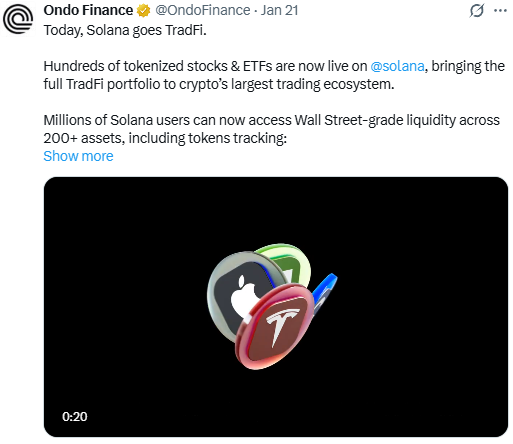
Ondo Finance announces asset tokenization on Solana. | Credit: Ondo Finance X profile
With its expansion to Solana, Ondo becomes the largest real-world asset issuer on the network by asset count, instantly multiplying the scope of investable assets available to Solana users.
Unlike many tokenized stock experiments that rely on fragmented on-chain liquidity, Ondo connects directly to the liquidity of major traditional exchanges such as the NYSE and NASDAQ.
This allows users to execute million-dollar trades with near-zero slippage, even across hundreds of assets.
Ian De Bode, President of Ondo Finance, explained the significance: “For the first time, Solana users can rest assured that they can buy tokenized stocks in size at brokerage prices, giving them peace of mind when trading on-chain.”
That assurance, price fidelity and execution at scale, is what separates institutional-grade tokenization from earlier retail experiments.
Tokenized equities are not “synthetic” assets in the sense of pure derivatives. Each token represents a claim on real-world security held and managed through a regulated infrastructure.
The critical challenge has always been liquidity.
On-chain liquidity pools work well for crypto-native assets, but they break down when you try to support hundreds, or thousands, of equities with deep order books. Fragmentation leads to slippage, poor pricing, and limited scalability.
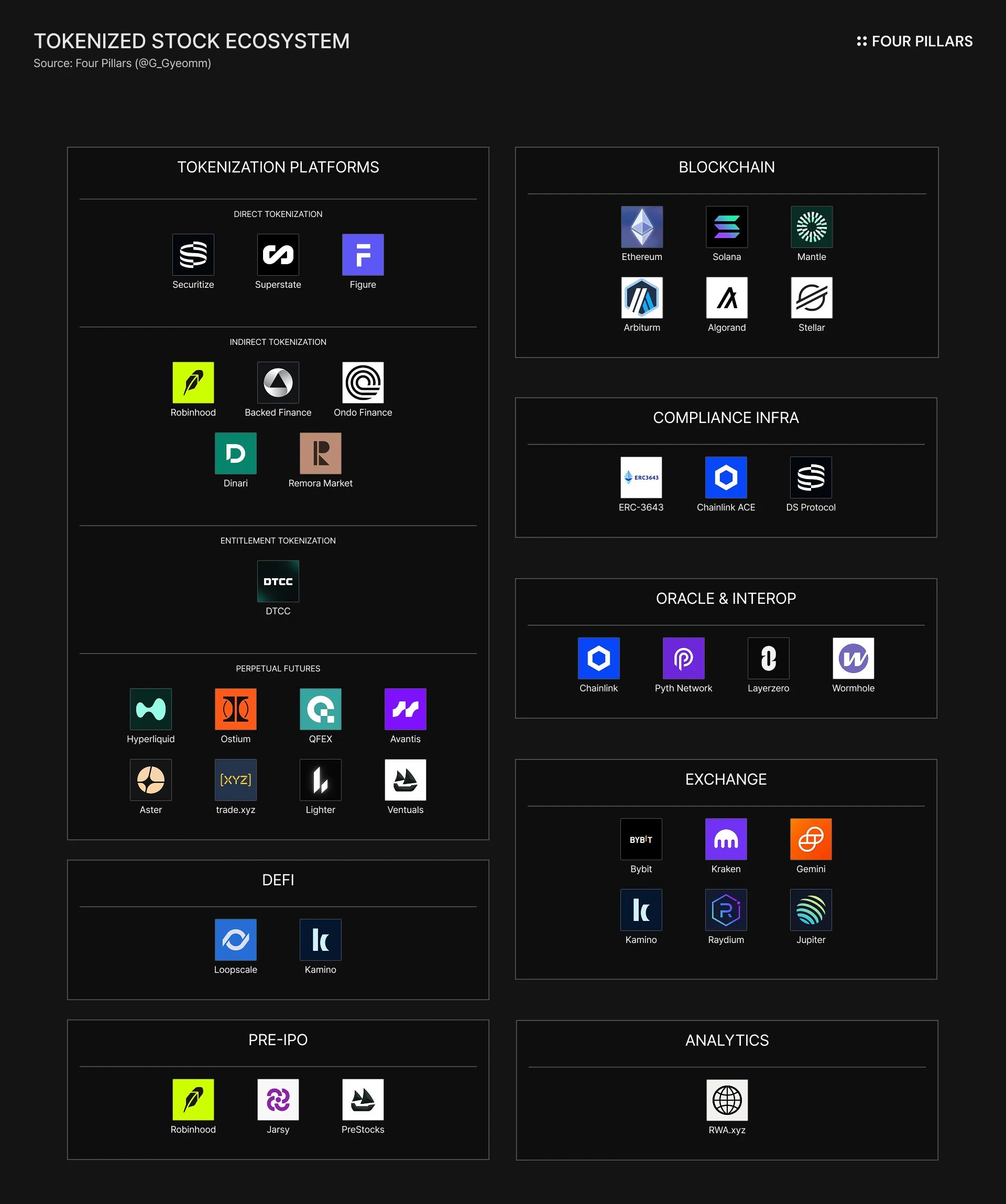
What’s tokenized now? | Credit: X
Ondo’s model sidesteps this problem entirely by anchoring tokenized stocks to off-chain exchange liquidity, while still allowing them to trade and settle on-chain.
Global accessibility, without traditional brokerage friction.
For Solana users, this means tokenized equities behave more like traditional stocks in terms of execution, but more like crypto in terms of accessibility and programmability.
Why Solana Is Emerging as a Hub for Tokenized Wall Street Assets
The network is designed for high-throughput, low-cost financial applications, making it a natural home for capital markets infrastructure. Its performance characteristics allow for real-time trading experiences that feel familiar to traditional market participants.
Nick Ducoff, Head of Institutional Growth at the Solana Foundation, highlighted this alignment: “Solana is designed to support high-performance financial applications at a global scale. As Solana powers internet capital markets, real-world assets are an important part of that future.”
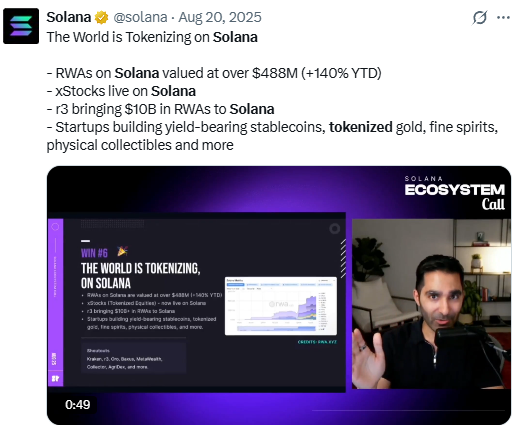
Tokenization on Solana is increasing notably. | Credit: Solana X profile
With Ondo’s launch, Solana now offers one of the broadest catalogs of tokenized equities available on any blockchain, spanning:
Major asset managers, banks, and exchanges are increasingly exploring on-chain representations of traditional assets. In parallel, legacy institutions are moving toward 24/7 trading, real-time settlement, and programmable ownership.
Just days before Ondo’s announcement, the New York Stock Exchange revealed plans to launch 24/7 U.S. stock trading via a new on-chain tokenized exchange, a signal that traditional finance is no longer treating blockchain as a side experiment.
Other players are moving in the same direction:
Franklin Templeton has tokenized money market funds.
Major payment networks are integrating stablecoins into settlement rails.
Tokenized stocks on Solana fit squarely into this trend: finance moving from batch-based, geographically limited systems toward always-on, globally accessible infrastructure.
What Tokenized Stocks Change and What Risks Remain for Investors
For users, tokenized stocks do not eliminate market risk. Nvidia, Amazon, and Meta remain volatile equities subject to earnings cycles, macro conditions, and valuation shifts.
What changes is access and integration.
Tokenized stocks can:
Be traded alongside crypto assets in the same wallet.
Ondo’s team told CCN that Ondo Global Markets’ expansion to Solana follows the same infrastructure model that made it the world’s largest tokenized securities platform by TVL.
“Rather than creating fragmented onchain liquidity pools that can’t scale efficiently beyond a handful of assets, Ondo taps directly into the liquidity of traditional exchanges like NASDAQ and NYSE. This approach enables the platform to launch with over 200 tokenized stocks and ETFs on day one, with the ability to scale to thousands more assets,” an Ondo Finance spokesperson said.
“The integration leverages Solana’s high-performance blockchain infrastructure and seamless discovery through leading ecosystem platforms, making tokenized equities accessible to Solana’s 3.2 million daily active users.”
According to Ondo Finance’s spokesperson, this liquidity model unlocks million-dollar trade sizes with near-zero slippage across hundreds of assets, something that would be impossible with traditional AMM-based approaches.
“This launch represents a significant expansion in what’s available to onchain investors. For the first time, Solana users can access a broad catalog of tokenized U.S. stocks and ETFs spanning technology and growth stocks, blue-chip equities, sector ETFs, leveraged ETFs, and commodity-linked funds, all backed by Wall Street liquidity,” they added.
“The key advantage is peace of mind: users can trade tokenized stocks at brokerage prices in institutional size without worrying about liquidity constraints or price slippage. This bridges the gap between traditional finance infrastructure and onchain capital markets, enabling Solana’s internet capital markets vision to scale rapidly with real-world assets that have genuine depth.”
Ondo Global Markets launched on Ethereum in September 2025, expanded to BNB Chain in October, and now Solana. This demonstrates a multi-chain strategy that brings tokenized securities to the largest and most active blockchain ecosystems. The platform has already surpassed $495 million in TVL and $7 billion in cumulative trading volume.
“The immediate focus is scaling asset coverage. While we’re launching with over 200 stocks and ETFs on Solana, our liquidity model enables us to expand to thousands of assets over time. Beyond that, we continue evaluating additional blockchain integrations and asset classes that align with our mission of bringing traditional financial markets onchain with institutional-grade liquidity and infrastructure,” Ondo concluded.
Ondo Pushes Toward “Internet Capital Markets” on Solana
Ondo Finance often frames its mission around the idea of “internet capital markets.” The Solana expansion makes that concept tangible.
Internet capital markets are not about replacing Wall Street overnight. They are about rebuilding its core functions, trading, settlement, custody, and access, on infrastructure that is faster, more transparent, and globally available.
By combining:
Wall Street liquidity
Blockchain settlement
High-performance networks like Solana
Ondo is demonstrating how tokenization can move beyond niche use cases and into mainstream financial workflows.
As DeFi, tokenized securities, and institutional adoption converge, the line between “crypto markets” and “traditional markets” continues to blur.
For the first time, Solana users are not just trading tokens that represent new digital experiments. They are accessing the same equities that anchor global portfolios—on-chain, in real time, at scale.
That shift matters more than any single stock listing.
Tokenized stocks are blockchain-based representations of real-world equities. Each token reflects exposure to an underlying stock or ETF held through regulated financial infrastructure, allowing users to trade traditional assets on-chain without relying on conventional brokerage accounts.
Which stocks are available on Solana through Ondo Finance?
Ondo Global Markets launched over 200 tokenized assets on Solana, including major U.S. stocks such as Nvidia, Amazon, Meta, and Walmart, along with broad-market ETFs, sector ETFs, leveraged products, and commodity-linked ETFs.
How is this different from earlier tokenized stock experiments?
Most earlier models relied on on-chain liquidity pools, which struggle to scale across hundreds of assets and large trade sizes. Ondo connects tokenized stocks directly to NYSE- and NASDAQ-backed liquidity, enabling million-dollar trades with near-zero slippage and brokerage-grade pricing.
Can users trade large amounts without slippage?
Yes. By tapping into traditional exchange liquidity rather than fragmented on-chain pools, Ondo’s model supports institutional-sized trades with minimal price impact, even across a wide range of assets.
Disclaimer:
The information provided in this article is for informational purposes only. It is not intended to be, nor should it be construed as, financial advice. We do not make any warranties regarding the completeness, reliability, or accuracy of this information. All investments involve risk, and past performance does not guarantee future results. We recommend consulting a financial advisor before making any investment decisions.
Giuseppe Ciccomascolo began his career as an investigative journalist in Italy, where he contributed to both local and national newspapers, focusing on various financial sectors.
Upon relocating to London, he worked as an analyst for Fitch's CapitalStructure and later as a Senior Reporter for Alliance News. In 2017, Giuseppe transitioned to covering cryptocurrency-related news, producing documentaries and articles on Bitcoin and other emerging digital currencies. He also played a pivotal role in establishing the academy for a cryptocurrency exchange website. Crypto remained his primary area of interest throughout his tenure as a writer for ThirdFloor.


 Easy
Easy