Here is what to expect from XRP price in April | Credit: Hameem Sarwar
Share
Key Takeaways
Uncertainty linked to the CLARITY Act bill has put XRP’s price in a make-or-break situation.
While XRP trades around $1.31, Weighted Sentiment has spiked, creating a bullish divergence.
Exchange inflows have reduced, with an indicator supporting a turnaround to the upside.
April 2026 may be the most consequential month for XRP in recent history.
The CLARITY Act, navigating its legislative pathway through Washington with increasing but uneven momentum, is approaching a make-or-break timeline.
However, XRP’s market value is not yet fully priced in the development.
This is largely because the legislative picture remains complicated. Senate delays, stablecoin compromise negotiations, and a critical April 13 committee deadline have created a narrow yet still viable window for passage.
Yet, this could impact XRP’s price.
If the bill clears Congress in April, the regulatory architecture governing XRP’s status as a digital commodity would shift from contested to settled.
But what happens if delays continue? Let’s find out.
What Links the Act With the Crypto
The CLARITY Act’s April trajectory is not a straightforward story of imminent passage.
It is a race against a specific and unforgiving deadline.
Senate Majority Leader John Thune indicated in mid-March that the bill would not see floor action before April.
More critically, analysts tracking the bill’s progress have identified April 13 as the make-or-break moment.
If the CLARITY Act does not clear the committee by that date, passage in 2026 becomes highly unlikely as the legislative calendar tightens toward summer recess and midterm positioning.
The probability assessment is not uniformly optimistic.
Get These Top Crypto Casino Offers Now!
Sponsored
Disclosure
We sometimes use affiliate links in our content, when clicking on those we might receive a commission at no extra cost to you. By using this website you agree to our terms and conditions and privacy policy.
While some reports have cited an 80% chance of meaningful progress by late April, that figure reflects the committee’s progress rather than full passage.
Committee clearance by April 13 would keep the bill alive and on a viable 2026 timeline.
Failure to clear the committee by that date would effectively defer the CLARITY Act’s impact on XRP’s price into 2027 at the earliest.
Indicators Support Big Move for XRP Price
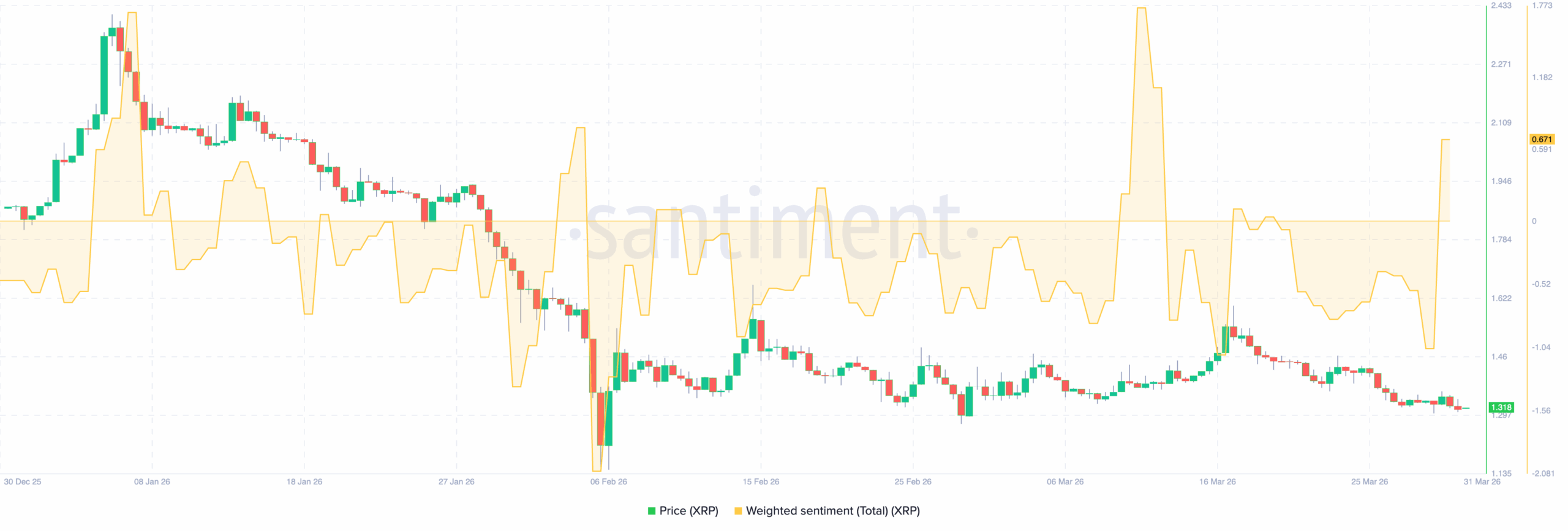
Amid the development, XRP’s sentiment and price are telling completely opposite stories right now, and that divergence has become the most important signal.
From December 30 through January, weighted sentiment oscillated positively as price held above $1.78.
That alignment was healthy as optimism matched XRP’s price strength. Then February’s selloff changed everything.
XRP’s price collapsed toward $1.46, sentiment swung negative, and the two metrics finally realigned in the wrong direction.
What followed was a months-long pattern in which sentiment recovered faster than price.
Throughout February and March, sentiment repeatedly spiked positively, reaching 2.43 around March 10.
However, the altcoin’s price barely responded, grinding between $1.40 and $1.55.
Now, on March 31, the pattern repeats, but with added intensity. Sentiment has surged to 0.671, while price simultaneously sits at $1.318, its lowest level since early February.
This suggests the crowd is growing optimistic just as the price hits new lows.
Historically, on this chart, extreme sentiment spikes without price confirmation have resolved in one of two ways.
Either price catches up violently to sentiment, or sentiment crashes back toward price reality.
Given XRP’s proximity to critical support near $1.36 identified on the price chart, and the MACD bullish crossover already in place, the contrarian case for a sharp bounce is building.
But sentiment alone never guarantees a move
Why April Is Important for the Altcoin
The April 13 committee deadline deserves more analytical attention than it is currently receiving.
It is the binary event that determines whether the CLARITY Act’s XRP-positive impact occurs in the current cycle or is deferred entirely to a future one.
A committee clearance on or before April 13 maintains the bill’s 2026 viability and signals to the market that the 80% progress probability cited in some reports has materialized.
That signal alone, without full passage, would likely trigger a meaningful XRP price as institutional participants begin pre-positioning for the demand unlocking that passage would complete.
Conversely, a failure to clear the committee by April 13 would not simply delay XRP’s regulatory catalysis.
It would remove the most immediate and most powerful fundamental catalyst from the 2026 price outlook entirely.
Consequently, this could leave XRP dependent on macroeconomic recovery and its existing legal clarity for price support.
On-Chain Data Shows Bullish Signs
Meanwhile, the on-chain flow data tells a quietly constructive story for XRP.
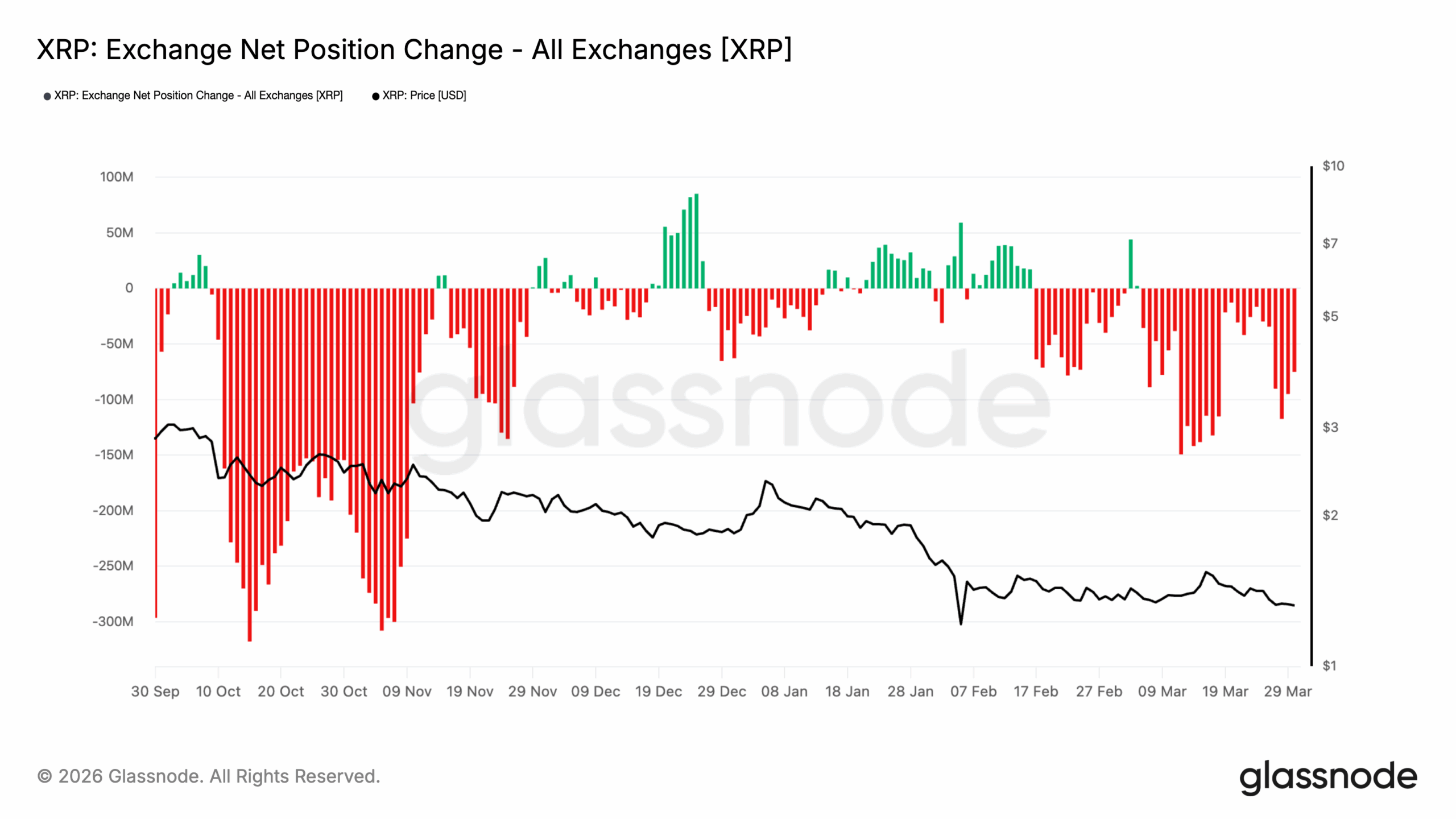
Glassnode’s Exchange Net Position Change chart from September 2025 through March 31 reveals a persistent pattern of outflows.
Throughout October and November, massive red bars dominated, with hundreds of millions of XRP flowing onto exchanges daily.
For context, this peaked near 300 million in late October. More exchange supply means more available selling pressure, and XRP’s price reflected that, declining steadily from $3 toward $1.30.
Since December, however, the picture has shifted amid fewer exchange supplies, which means less selling pressure.
So, when demand returns, price moves faster.
March has maintained this pattern consistently. Despite XRP trading near its lowest levels since February, exchange outflows continue.
XRP Exchange Net Position Change | Credit: Glassnode
Combined with the positive sentiment spike, this outflow trend adds a powerful layer to the bull case. If sustained, XRP’s price will likely trade closer to $2 next month.
XRP Price Prediction:
From a technical perspective, XRP’s price is under pressure. However, the setup for a reversal is maturing fast.
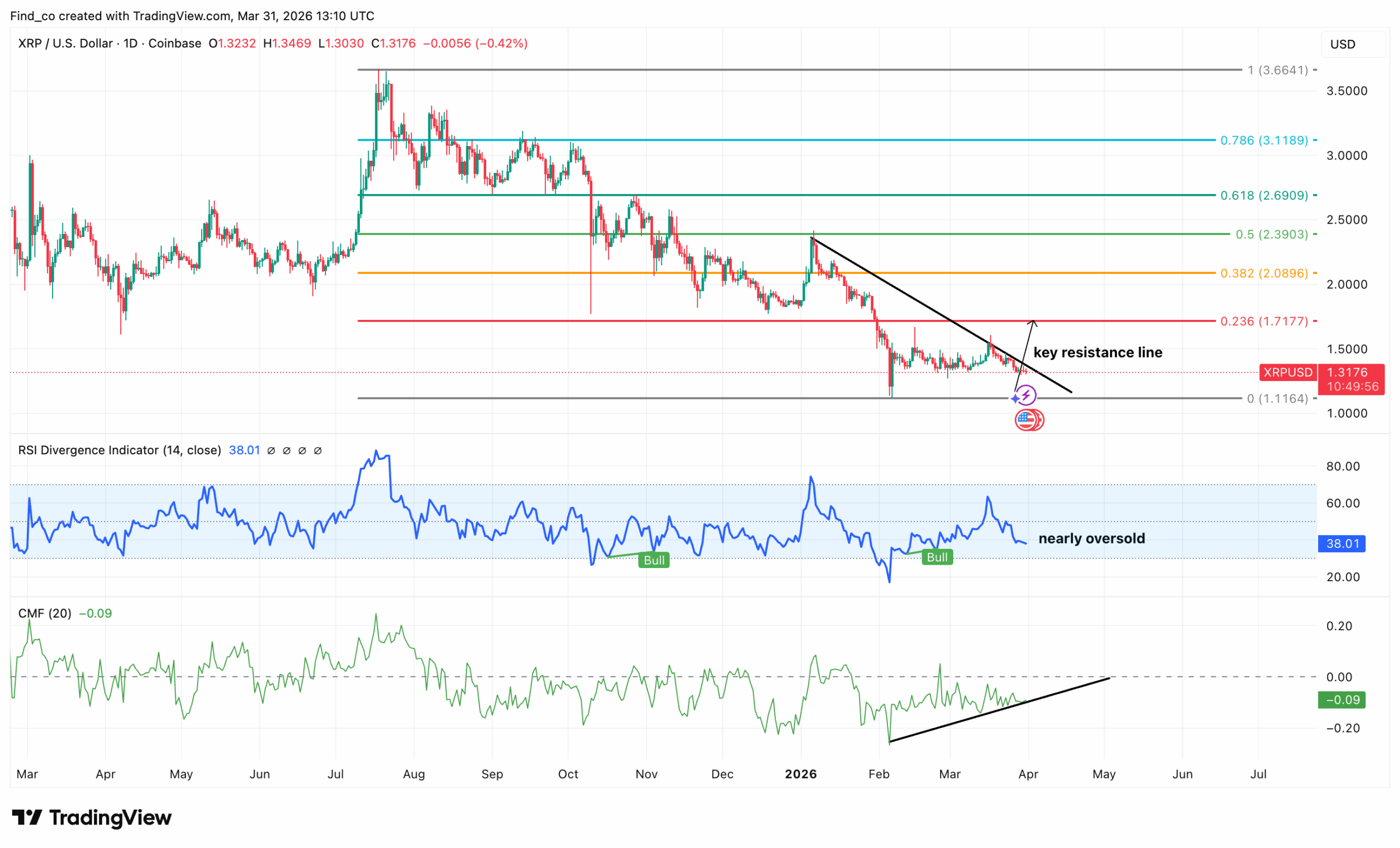
On the daily chart, XRP is hovering just above the 0 Fibonacci floor at $1.12 after a decline from the January peak of $3.66.
A descending trendline (annotated as the key resistance line) has capped every recovery attempt since February.
But at the time of writing, the price is pressing directly against it. A daily close above this line would represent the first genuine structural break since the downtrend began.
Two signals are converging simultaneously. First, the RSI at 38.01 is approaching oversold territory and has already printed two bullish divergence signals.
Each preceded meaningful recoveries. A third divergence forming at current levels would be the most powerful yet, given how deep the decline has been.
Second, the CMF is diverging bullishly. While XRP’s price has continued lower, the CMF has been making higher lows since February, forming a clear ascending trendline on the indicator.
That means capital flows are quietly improving even as prices drift down.
As it stands, the resistance trendline break is the trigger. Above it, the 0.236 level at $1.72 becomes the first meaningful recovery target.
Until then, holding $1.12 remains the absolute priority. Alternatively, if selling pressure increases, this outlook might change, and XRP’s price might decline below $1.
Key Risks to the Scenario
The legislative calendar is the primary risk. Senator Thune’s mid-March delay signal has already compressed the viable window.
The stablecoin yield compromise, still unresolved as of March 31, must be finalized before the bill advances.
The banking lobby’s review of the Tillis-Alsobrooks language raises the possibility of further revisions that could push the committee’s timeline beyond April 13.
Each of these variables represents an independent pathway through which the passage scenario fails to materialize on the timeline that XRP’s price is beginning to anticipate.
The macro environment is the second risk. Bitcoin’s struggle below $80,000 and the Federal Reserve’s decision to keep rates unchanged at 3.5% to 3.75% have created a broad headwind for altcoins.
A legislative win for XRP arriving in a macro environment where risk appetite remains suppressed by the Iran war’s energy shock would produce a more muted price response than the same catalyst would deliver in a risk-on context.
The sell-the-news risk is the third.
If the April 13 committee clearance date is sufficiently well anticipated by XRP traders ahead of its arrival, the initial price response could be a brief spike followed by profit-taking, before the structural demand improvement manifests in sustained higher prices.
Managing that dynamic requires distinguishing between the committee clearance event — which would be a process milestone — and full passage, which would be the structural catalyst.
Disclaimer:
The information provided in this article is for informational purposes only. It is not intended to be, nor should it be construed as, financial advice. We do not make any warranties regarding the completeness, reliability, or accuracy of this information. All investments involve risk, and past performance does not guarantee future results. We recommend consulting a financial advisor before making any investment decisions.
Victor Olanrewaju is a crypto analyst and reporter at CCN with deep roots in on-chain research and technical analysis. His crypto journey began in 2017, but it was the 2020 Uniswap airdrop that sparked a full-time pivot into the space.
With a foundation in copywriting, Victor honed his craft creating high-converting content for leading crypto brokers — most notably an XRP price prediction that ranked #1 on Google during the 2021 bull run.
He later joined AMBCrypto in 2022, where he combined storytelling with technical and on-chain analysis to cover key market narratives.
In 2024, he expanded his expertise at BeInCrypto, collaborating with analysts and using tools like Glassnode, Santiment, and IntoTheBlock to break down Bitcoin and altcoin trends.
At CCN, Victor covers the top cryptocurrencies, memecoins, macro shifts, blending real-time insights with deep-dive metrics.
He holds a Bachelor’s degree in Physics from the University of Ibadan, equipping him to simplify complex data for a wide audience. Follow his work or connect on LinkedIn or X.