Key Takeaways
- U.S. lawmakers across parties agree on core principles like consumer protection and responsible innovation.
- For Tron’s Adrian Wall, “rules of the road” help developers and companies build confidently rather than stifling growth.
- Meaningful crypto regulation in the U.S. will only pass with cross-party support.
- Innovations like streaming payments and real-world asset tokenization are expected to expand use cases.
Despite the perception of deep political polarization in the U.S., crypto policy may be one of the few areas where bipartisan alignment is quietly taking shape.
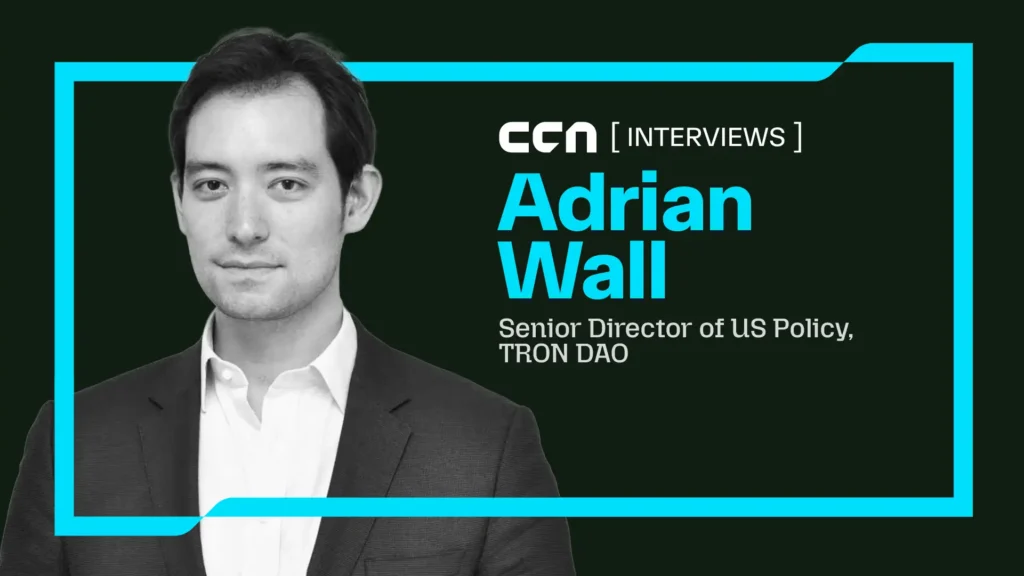
In an interview with Crypto Citizens Network (CCN)’s senior editor, Dr. Guneet Kaur, Adrian Wall, Senior Director of U.S. Policy at Tron DAO, pushed back against the common narrative that Washington is split on digital asset regulation.
“One of the biggest misconceptions is that because American politics is divided, crypto policy must be divided too: that’s actually not the case,” Wall said.
Why Crypto Regulation in the U.S. Is More Bipartisan Than It Seems
According to Wall, lawmakers on both sides of the aisle largely agree on the core goals of crypto policy: consumer protection, responsible innovation, and clear regulatory frameworks.
“The good news is we’re all on the same page when it comes to the fundamentals,” he explained. “What lawmakers don’t always agree on is how to get there.”
That distinction, he argues, is critical. While debates continue over implementation, the shared foundation makes bipartisan legislation not only possible but necessary.
“I can guarantee the only way clarity gets passed is through bipartisan legislation,” Wall said, adding that meaningful regulatory progress could arrive as early as mid-2026.
How Clear Crypto Regulations Can Drive Blockchain Innovation
A key theme in Wall’s remarks is that regulation and innovation are not mutually exclusive. In fact, he believes clarity is what enables growth.
“You can have both clear regulation and innovation; they don’t stifle one another,” he said. “As long as the rules of the road are clear, you can innovate within those boundaries.”
For developers, issuers, and institutions alike, predictability matters more than permissiveness. Knowing how to operate, even within constraints, allows companies to build with confidence.
Why Crypto Policy Education Is Critical for U.S. Lawmakers
Wall emphasized that one of the most important, and often overlooked, aspects of crypto policy is education.
Tron, he said, takes a deliberate approach when engaging policymakers, often translating complex crypto concepts into familiar analogies from traditional finance.
“When you start using technical terms like DeFi or stablecoins, it can be difficult for legislators,” he noted. “So we explain it using examples they already understand.”
One such example is the LIBOR transition.
Wall compares the proposed “clean slate” approach in crypto regulation to the LIBOR Act, which addressed legacy issues in traditional finance while enabling future reforms.
This kind of framing helps bridge the knowledge gap between policymakers and the rapidly evolving crypto ecosystem.
Stablecoins Are Powering Global Crypto Adoption and Financial Inclusion
Wall highlighted stablecoins as one of the most important drivers of real-world crypto adoption today.
“Stablecoins are hugely important,” he said. “They’re offering financial access to people who may not have access to a bank account.”
Tron, which hosts a significant share of global Tether (USDT) circulation, plays a central role in this ecosystem, particularly in emerging markets where traditional banking infrastructure is limited.
Stablecoins enable faster, cheaper cross-border payments and open access to financial services through decentralized finance (DeFi).
“Financial inclusion without financial literacy is a bridge to nowhere,” Wall added, underscoring the importance of educating users alongside expanding access.
Stablecoins vs CBDCs: Why the Industry Favors Digital Dollars
On the debate between stablecoins and central bank digital currencies (CBDCs), Wall made his position clear.
“Stablecoin is already a digital dollar,” he said. “It doesn’t carry the same political encumbrances as a CBDC.”
He highlighted privacy and security as major challenges for CBDCs, arguing that markets will favor solutions already widely used and trusted.
“Adoption is going to play out in the market, and it’s going to go toward stablecoins,” he said.
Future of Crypto: Streaming Payments and Tokenization Trends
Looking ahead, Wall sees stablecoins evolving beyond payments into programmable financial tools.
He highlighted concepts such as “streaming payments,” in which users receive money continuously in real time rather than at fixed intervals, as well as the tokenization of real-world assets.
“Once we get the rules of the road, the innovation doesn’t stop,” he said. “The use cases are going to be things we haven’t even thought about yet.”
Biggest Challenges in U.S. Crypto Policy: Why Patience Matters
While momentum is building, Wall cautioned that regulatory change takes time.
“You have to have patience,” he said. “Building coalitions and passing responsible policy requires listening to all sides.”
For now, however, he remains optimistic. With bipartisan alignment on core principles and growing engagement between industry and regulators, the path toward clear crypto regulation in the U.S. appears increasingly within reach.
The information provided in this article is for informational purposes only. It is not intended to be, nor should it be construed as, financial advice. We do not make any warranties regarding the completeness, reliability, or accuracy of this information. All investments involve risk, and past performance does not guarantee future results. We recommend consulting a financial advisor before making any investment decisions.

Giuseppe Ciccomascolo began his career as an investigative journalist in Italy, where he contributed to both local and national newspapers, focusing on various financial sectors.
Upon relocating to London, he worked as an analyst for Fitch's CapitalStructure and later as a Senior Reporter for Alliance News. In 2017, Giuseppe transitioned to covering cryptocurrency-related news, producing documentaries and articles on Bitcoin and other emerging digital currencies. He also played a pivotal role in establishing the academy for a cryptocurrency exchange website. Crypto remained his primary area of interest throughout his tenure as a writer for ThirdFloor.

Dr. Guneet Kaur is a senior editor at CCN.com and a Science Fellow at Exponential Science. She is a fintech and blockchain expert with extensive experience in digital finance education, blockchain ecosystems, and cryptocurrency markets. She has worked with global media such as Cointelegraph, as well as education and blockchain platforms, to design and lead strategic content and learning initiatives. As an educator and assessor for top-tier executive programs, she bridges real-world fintech trends with academic insight.
Dr. Kaur is also a published researcher and peer reviewer across fintech and data science journals, including Financial Innovation Journal and International Journal of Big Data Intelligence and Applications. Her work spans data-driven analysis, Web3 innovation, and technical content development. With a strong foundation in both industry and academia, she translates complex financial technologies into practical applications, empowering learners, professionals, and institutions across the rapidly evolving digital finance landscape.


 Easy
Easy