Didn't report your crypto taxes? Here's what you can do. | Credit: Veronica Cestari/CCN.com
Share
Key Takeaways
Whether in the U.S., U.K., EU, or Asia, regulators now treat digital assets as taxable property.
By 2026, new international data-sharing rules, including CARF, DAC8, and Form 1099-DA, will give tax authorities near-total visibility into wallet activity.
Every crypto sale, swap, or payment constitutes a taxable event, and failure to report can result in fines of up to $100,000 and potential imprisonment.
Maintain meticulous records of every trade, use the correct local tax forms, and consult a qualified tax advisor.
Navigating the tax implications of cryptocurrency has become one of the most pressing issues for investors worldwide. What once felt like a lightly regulated frontier has quickly become a zone of rigorous oversight and swift enforcement.
Whether you’re based in the U.S, the UK, the European Union, or parts of Asia, failing to report crypto transactions or misinterpreting your obligations can lead to hefty penalties, backdated tax claims, or even criminal investigations.
Crypto Taxes in the U.S.: What You Need to Know in 2025
In the U.S., the Internal Revenue Service (IRS) treats cryptocurrencies as property, meaning virtually every crypto transaction can trigger a taxable event, whether you sold, traded, or spent crypto.
From January 2025, brokers and exchanges began filing Form 1099-DA for digital-asset transactions; from 2026, they will report gains and losses. This means the IRS will soon have complete visibility into many crypto trades.
Top Crypto Tax Accounting Software
Sponsored
Disclosure
We sometimes use affiliate links in our content, when clicking on those we might receive a commission at no extra cost to you. By using this website you agree to our terms and conditions and privacy policy.
You may owe capital-gains tax (and possibly ordinary income tax) with interest and penalties.
The IRS can impose civil fines and penalties for unreported amounts and fraudulent claims. Failure to file may also result in penalties of up to $100,000 and expose individuals to criminal prosecution, including prison sentences of up to 5 years.
For U.S. citizens and green card holders, obligations are worldwide, so even non-U.S. exchange transactions are subject to these obligations.
If you have crypto transactions and have ignored or under-reported them, expect increasing detection capabilities and a shrinking margin for error.
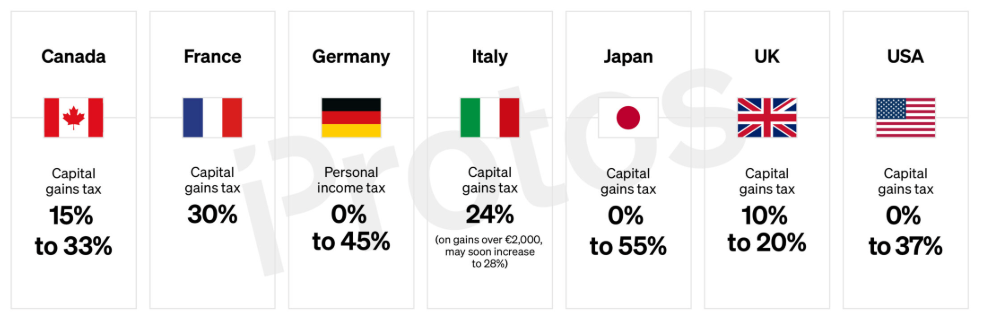
How crypto are taxed in G7 countries. | Credit: Protos
Crypto Tax Compliance Outside the US: What’s Changing in the UK and EU
United Kingdom
In the U.K., HM Revenue & Customs (HMRC) regards crypto-assets as property; disposals may trigger Capital Gains Tax, while mining, staking, or employment-related crypto yield attract Income Tax. The UK, in fact, sent 64,982 “nudge” letters in the 2024-25 tax year to suspected non-filers, more than double the number sent in the prior year.
Penalties range depending on whether the omission was careless, deliberate, or concealed. From 2026, the new Crypto-Assets Reporting Framework (CARF) will introduce the automatic exchange of data, making tax under-reporting far easier to detect.
European Union
Across the EU, the Directive on Administrative Cooperation (DAC8) and the Markets in Crypto-Assets Regulation (MiCA) require exchanges and crypto-asset service providers to share user data across borders, starting in 2026.
Penalties for undeclared crypto holdings and gains are increasing. Some Member States now fine crypto users roughly €750 per unreported account.
European residents cannot assume crypto assets are off-grid. With DAC8 and CARF, the veil of anonymity is rapidly lifting.
Asia: Crypto Tax Landscape and Enforcement Trends
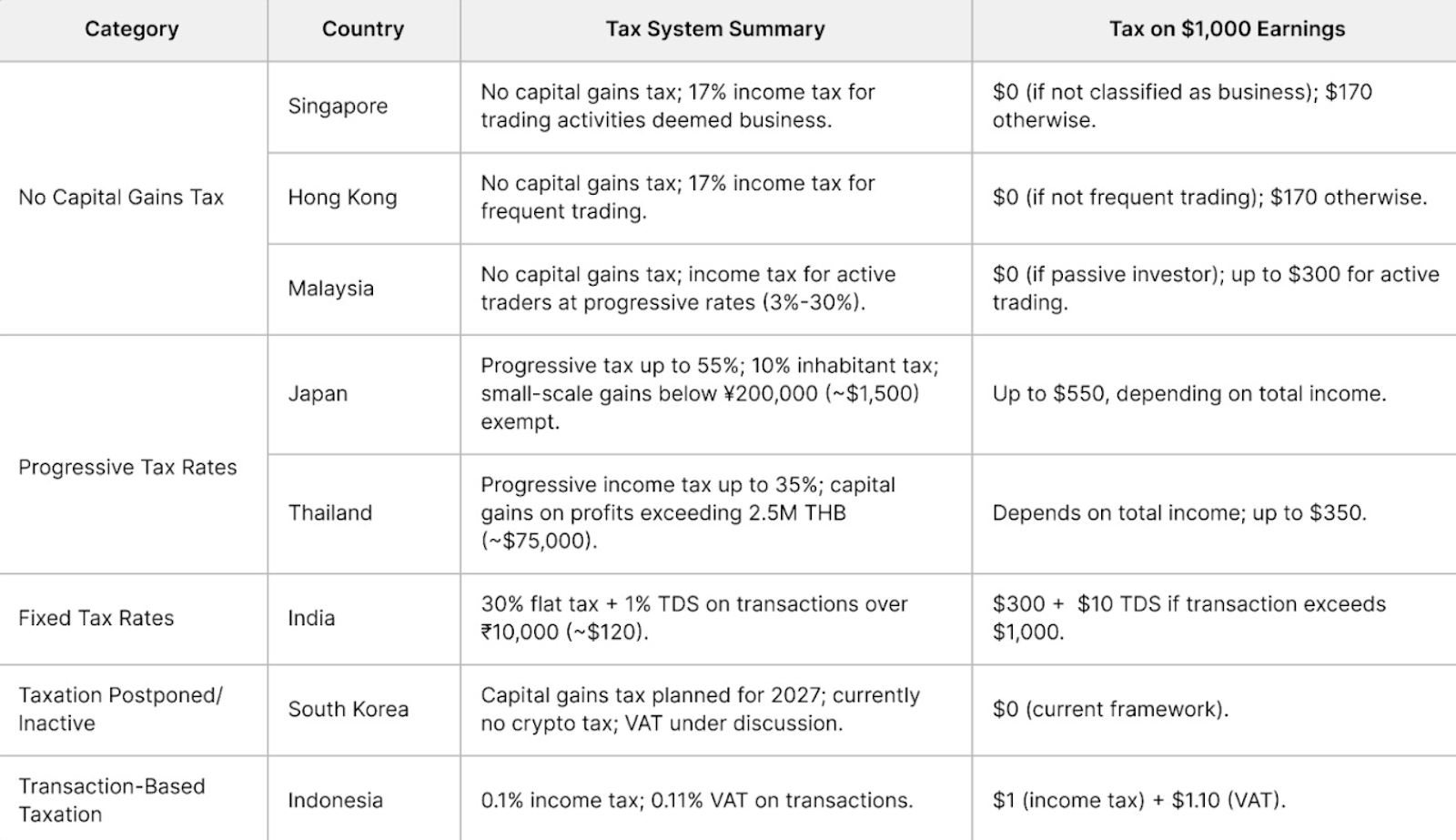
Asia is less uniform than the U.S. or Western Europe, but that doesn’t mean enforcement is lax. In jurisdictions like Singapore, Hong Kong, Japan, and South Korea:
Crypto service providers are required to report large transactions and suspicious activity to local authorities.
For tax-resident individuals, crypto transactions, even those from non-custodial wallets, may be taxable depending on the local classification of income, trading, or business activities.
Countries that were once perceived as “tax-friendly” for crypto are tightening their frameworks. Analysts predict that by 2025, the number of crypto-tax-free countries in Europe is expected to decline significantly, with a similar trend anticipated in Asia.
Crypto taxations in major Asian countries. | Credit: Tiger Research
If you’re a resident of an Asian country (or a non-resident earning crypto there), you must investigate your local obligations; ignoring them based on outdated assumptions is risky.
Consequences of Failing to Report Crypto Taxes
Failing to report crypto taxes can trigger a series of escalating consequences:
Back-tax assessments: Authorities may audit past years and demand unpaid tax plus interest.
Civil penalties: Depending on jurisdiction and severity, you may face percentage-based fines on tax owed (or fixed penalties per unreported account).
Criminal liability: Deliberate concealment or evasion can result in prosecution, leading to significant fines or imprisonment.
Automatic detection: With CARF/DAC8, IRS 1099s, broker reporting, and cross-border data-sharing, detection is no longer unlikely; it is increasingly probable.
Double taxation risk: If you are resident in multiple jurisdictions, overlapping tax regimes may claim the same crypto gains.
Operational risk for exchanges: Some tax-avoidance cases draw regulators’ attention to your exchange usage, wallet service, and transactional patterns.
The crypto tax “grey zone” is shrinking fast. What once felt optional or benign now carries real risk.
How to Correct Missed or Unreported Crypto Taxes?
If tax season has already passed and you haven’t reported your crypto transactions, the worst thing you can do now is ignore it.
Fortunately, most major tax authorities, including those in the U.S., the U.K., the EU, and several Asian jurisdictions, offer mechanisms to correct past mistakes before they escalate into enforcement cases.
1. Voluntary Disclosure Programs
In the U.S., the IRS Voluntary Disclosure Practice allows individuals to come forward before being audited. If you file and pay the taxes owed (plus interest), you can often avoid criminal prosecution and reduce penalties.
The key requirement: you must act before the IRS contacts you. Once a letter of inquiry arrives, leniency options vanish.
The UK offers a similar pathway through HMRC’s Digital Disclosure Service, which enables taxpayers to correct past crypto-related omissions. Those who voluntarily disclose their tax information before being investigated typically face reduced penalties, sometimes as low as 10% of the tax owed, depending on the intent and level of cooperation.
2. EU and Asia: National Amnesty Programs
In the European Union, disclosure frameworks vary by country; however, many countries have ongoing or periodic amnesty schemes for digital asset reporting.
For instance, Italy’s 2023 tax amnesty allowed undeclared crypto holders to pay a small flat-rate fee to regularize their positions. Other countries, including Spain and France, permit voluntary corrections with mitigated penalties if reported before formal proceedings begin.
Asian jurisdictions are following suit. Japan’s National Tax Agency (NTA) and South Korea’s National Tax Service (NTS) have indicated that self-reporting undeclared cryptocurrency income may result in lighter administrative penalties compared to enforced recovery.
Singapore’s Inland Revenue Authority also emphasizes education first, fines later, particularly for first-time offenders.
3. Be Proactive, Not Reactive
Once data-sharing frameworks like CARF, DAC8, and 1099-DA reporting become fully operational in 2026, the window for quiet corrections will effectively close.
Exchanges, brokers, and wallet providers will automatically transmit user transaction data to tax agencies, making omission far easier to detect.
If you suspect your past returns missed crypto income, consult a licensed tax advisor and prepare amended filings as soon as possible.
Acting voluntarily signals good faith and can drastically reduce both financial and legal exposure.
If you’ve realized you might have missed declaring crypto income, the good news is that it’s not too late to fix it. Tax authorities across major jurisdictions prefer voluntary correction over enforcement; however, that window is closing rapidly as reporting frameworks become more stringent.
Here’s what proactive investors and traders should be doing now to stay compliant and avoid costly surprises later:
Calculate taxable events: Any sale, swap, trade, or use of crypto may trigger capital gains. Mining, staking, and airdrops may count as ordinary income.
Use the correct forms: U.S. Form 1040 includes crypto-related questions, while the U.K. SA108 has new boxes for crypto. EU residents must monitor their local forms.
Correct past errors: Many tax authorities allow voluntary disclosures or amnesty programmes, often with reduced penalties.
Seek professional advice: Crypto-tax is complex and rapidly evolving; qualification across jurisdictions is key.
Monitor regulatory shifts: Especially in 2025-26, when CARF, DAC8, and 1099-DA reporting become fully effective.
If you have traded, used, been rewarded in, staked or converted crypto, you almost certainly have tax obligations. Ignoring them until tomorrow is increasingly dangerous.
The age of “crypto tax invisibility” is over: reporting isn’t just best practice, it’s becoming essential.
Do I really have to pay taxes on crypto if I never cashed out to fiat?
Yes. In most jurisdictions, including the U.S., UK, and EU, you owe tax when you dispose of crypto, not just when you convert it to fiat. That means trading one coin for another (e.g., ETH to SOL), using crypto to buy goods, or staking rewards can all trigger taxable events.
What happens if I didn’t report past crypto income?
It depends on intent. If it was an honest mistake, most tax authorities allow voluntary correction or amended filings with reduced penalties. However, deliberate concealment can lead to audits, hefty fines, or even criminal prosecution in severe cases. Acting before the authorities contact you often results in far lighter consequences.
How will the government even be aware of my crypto holdings?
Starting in 2025-26, exchanges and brokers in many jurisdictions will be required to automatically report user data under frameworks such as CARF (OECD), DAC8 (EU), and the IRS 1099-DA (U.S.). These systems link your transactions to your tax ID, providing authorities with unprecedented visibility into your wallets, transfers, and gains.
Are decentralized exchanges (DEXs) and self-custody wallets exempt from tax reporting?
No. Even if you use a DEX or a private wallet, you’re still legally required to report any taxable gains or income. While direct reporting from DEXs is currently limited, data-matching tools and blockchain analytics can still identify wallet activity tied to real-world users, especially when linked to centralized on- and off-ramps.
Disclaimer:
The information provided in this article is for informational purposes only. It is not intended to be, nor should it be construed as, financial advice. We do not make any warranties regarding the completeness, reliability, or accuracy of this information. All investments involve risk, and past performance does not guarantee future results. We recommend consulting a financial advisor before making any investment decisions.
Giuseppe Ciccomascolo began his career as an investigative journalist in Italy, where he contributed to both local and national newspapers, focusing on various financial sectors.
Upon relocating to London, he worked as an analyst for Fitch's CapitalStructure and later as a Senior Reporter for Alliance News. In 2017, Giuseppe transitioned to covering cryptocurrency-related news, producing documentaries and articles on Bitcoin and other emerging digital currencies. He also played a pivotal role in establishing the academy for a cryptocurrency exchange website. Crypto remained his primary area of interest throughout his tenure as a writer for ThirdFloor.


 Easy
Easy