Home / Education / Crypto / Investing / Credit Agency Kroll Assigns Ripple BBB Investment-Grade Rating — What It Means for Institutional Adoption and XRP
XRP bullish sentiment hits a 2-year high after Rakuten integration, but price remains range-bound. Can rising adoption drive XRP toward $5? | Credit: CCN.com
Share
Key Takeaways
Kroll assigned Ripple Prime a BBB rating, signaling solid financial strength and lower credit risk.
Investment-grade ratings make Ripple more attractive to banks, hedge funds, and asset managers.
While not directly rated, XRP benefits from Ripple’s improved institutional standing.
The rating marks a step toward integrating crypto firms into mainstream financial systems.
The digital asset industry has long sought validation from traditional finance. Now, a major milestone has arrived: global credit rating agency Kroll has assigned Ripple Prime an investment-grade issuer rating of BBB.
While this may sound like a technical update, it carries significant implications, not just for Ripple as a company, but for the broader adoption of crypto infrastructure by institutional investors and for the long-term positioning of XRP within global finance.
This article breaks down what the rating means, why it matters, and how it could shape the future of institutional crypto markets.
What a BBB Credit Rating Means for Ripple and Institutional Investors
A BBB rating is considered investment grade, meaning the entity is viewed as having an adequate capacity to meet its financial obligations, with moderate risk.
It indicates lower risk compared to speculative-grade entities
It makes the company more attractive to institutional investors
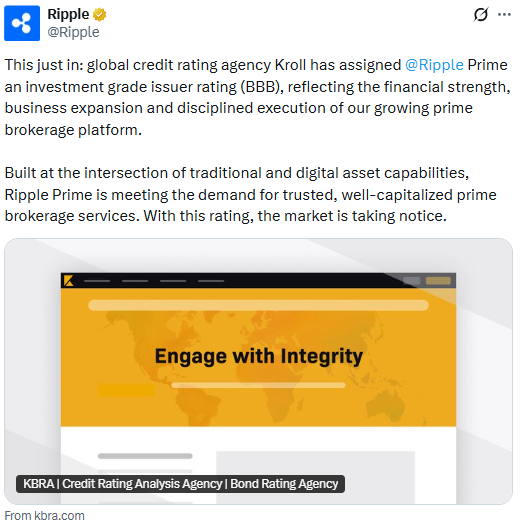
Ripple gets an investment-grade rating from Kroll. | Credit: Ripple X profile
Many large institutions, such as pension funds, insurance companies, and asset managers, are restricted to investing only in investment-grade entities. That means Ripple Prime has now crossed an important threshold: it is eligible for a much wider pool of capital.
The rating was assigned to Ripple Prime’s holding company and its main operating entity, which functions as a regulated broker-dealer and futures commission merchant (FCM). These licenses already place Ripple Prime within the framework of traditional financial markets, and the rating reinforces that positioning.
Ripple Prime Explained: How Ripple Is Building an Institutional Crypto Platform
Ripple Prime is Ripple’s prime brokerage platform, built following its acquisition of Hidden Road in 2025.
A prime broker acts as a central hub for institutional trading, offering services such as:
Traditionally, prime brokers are used by hedge funds and large financial institutions. Ripple Prime aims to bring this model into the digital asset space, while also integrating traditional financial instruments like derivatives and government securities.
The platform has already scaled rapidly, particularly in:
These are core building blocks of global finance, and Ripple’s expansion into these areas signals a strategy far beyond crypto trading alone.
Why Ripple’s Investment-Grade Rating Matters for Institutional Investors
Institutional adoption has been one of the biggest missing pieces in crypto’s evolution. A key barrier has been trust and risk assessment.
This is where a credit rating becomes crucial.
For institutions, a BBB rating provides:
A standardized measure of risk
Confidence in capital strength and governance
Assurance of regulatory alignment
Ripple Prime’s regulatory credentials, like SEC registration, CFTC oversight, FINRA membership, and participation in major clearing systems, already position it within traditional finance. The rating adds another layer of credibility.
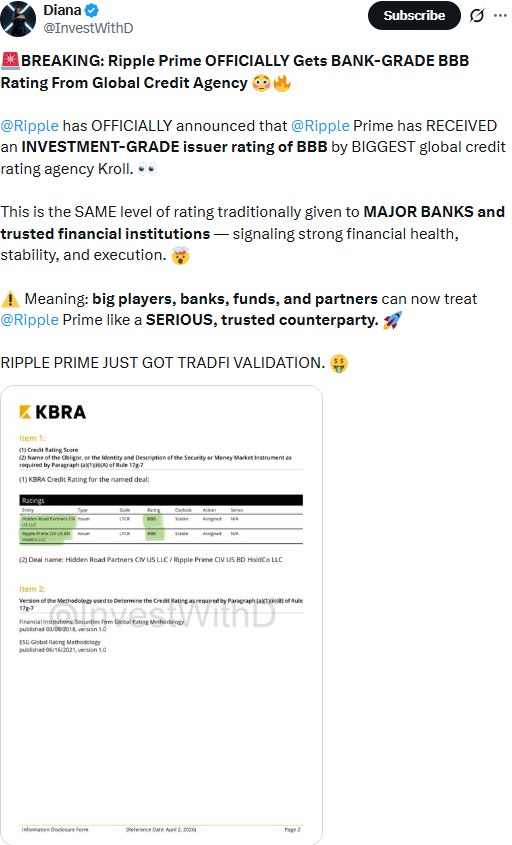
How Ripple’s rating influence big institutions. | Credit: InvestWithD X profile
Just as importantly, Ripple itself provides strong financial backing:
This level of capital support is a key factor behind the rating and signals to institutions that Ripple Prime is not a fragile startup, but a well-capitalized and strategically supported platform.
How XRP Fits Into Ripple’s Institutional Growth Strategy
While the rating applies to Ripple Prime rather than XRP directly, the connection is important.
Ripple’s business model, and much of its revenue, remains tied to digital assets, including XRP. The company holds significant XRP reserves, which represent both:
A source of liquidity and value
A potential risk factor due to price volatility
However, the rating suggests that credit analysts view Ripple’s overall financial position as strong enough to manage this exposure.
For XRP, this development matters in several ways:
Increased legitimacy: Institutional recognition of Ripple strengthens the broader ecosystem around XRP.
Indirect adoption pathways: As Ripple Prime grows, it could create more opportunities for XRP to be used within institutional workflows.
Reduced perceived risk: A stronger parent company reduces concerns about counterparty risk in XRP-related services.
In short, while XRP is not directly rated, it benefits from Ripple’s growing credibility in traditional finance.
Ripple Growth Strategy: Future Expansion Plans for Ripple Prime
Kroll’s assessment highlights that Ripple Prime is still in a scaling phase. Currently, revenues are concentrated in:
Spread-based financing
Repo transactions
Derivatives clearing
However, the company plans to diversify into:
Equity prime brokerage
Delta1 products (such as total return swaps)
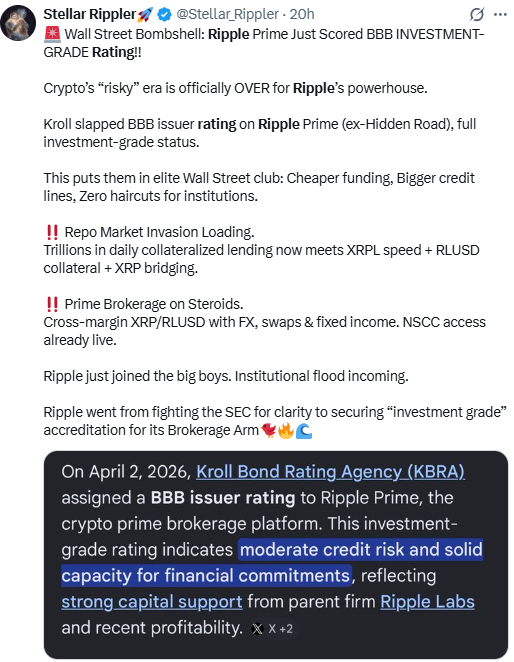
Wall Street welcomes Ripple’s rating news. | Credit: Stellar_Rippler X profile
These are sophisticated financial products typically used by hedge funds and institutional traders. Expanding into these areas could:
Increase revenue stability
Reduce reliance on any single business line
Bring Ripple Prime closer to traditional prime brokerage competitors
Additionally, strong capital reserves and excess regulatory capital provide a buffer against market stress.
Why Ripple’s BBB Rating Matters for the Future of Crypto Adoption
This development represents more than just a rating, it signals a structural shift in how crypto companies are perceived.
For years, the digital asset space has operated largely outside traditional financial frameworks. Now, companies like Ripple are actively bridging that gap.
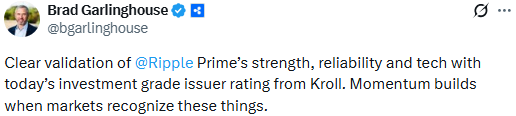
Ripple’s CEO hails the rating announcement. | Credit: Brad Garlinghouse X profile
A few key implications:
1. Convergence of TradFi and Crypto
Ripple Prime operates at the intersection of both worlds, combining:
With investment-grade status, Ripple Prime becomes a more viable partner for:
Banks
Hedge funds
Asset managers
3. Standardization and Maturity
Credit ratings bring crypto firms into familiar evaluation frameworks used across global finance.
This is a crucial step toward making digital assets a mainstream asset class.
Ripple’s Role in Bridging Traditional Finance and Crypto Markets
The BBB rating assigned to Ripple Prime is not just a badge of financial health, it’s a signal that crypto infrastructure is maturing.
By combining:
Strong capital backing
Regulatory integration
Institutional-grade services
Ripple is positioning itself as a key player in the next phase of financial evolution.
For institutional investors, this reduces barriers to entry. For the crypto industry, it marks progress toward legitimacy. And for XRP, it strengthens the foundation for broader adoption.
As traditional finance and digital assets continue to converge, developments like this may become less of an exception, and more of the new standard.
Ripple Prime is Ripple’s institutional prime brokerage platform, offering services like trading, clearing, and financing for large financial clients. It combines traditional financial markets with digital asset infrastructure.
What does a BBB investment-grade rating mean?
A BBB rating means the company is considered financially stable with moderate risk. It is the lowest tier of “investment grade,” making it eligible for many institutional investors.
Why is this rating important for Ripple?
The rating increases Ripple’s credibility in traditional finance and makes it easier to attract institutional investors such as hedge funds, banks, and asset managers.
Does this rating apply to XRP?
No, the rating applies to Ripple Prime as a company, not directly to XRP. However, it can positively influence how institutions view the broader Ripple ecosystem, including XRP.
Disclaimer:
The information provided in this article is for informational purposes only. It is not intended to be, nor should it be construed as, financial advice. We do not make any warranties regarding the completeness, reliability, or accuracy of this information. All investments involve risk, and past performance does not guarantee future results. We recommend consulting a financial advisor before making any investment decisions.
Giuseppe Ciccomascolo began his career as an investigative journalist in Italy, where he contributed to both local and national newspapers, focusing on various financial sectors.
Upon relocating to London, he worked as an analyst for Fitch's CapitalStructure and later as a Senior Reporter for Alliance News. In 2017, Giuseppe transitioned to covering cryptocurrency-related news, producing documentaries and articles on Bitcoin and other emerging digital currencies. He also played a pivotal role in establishing the academy for a cryptocurrency exchange website. Crypto remained his primary area of interest throughout his tenure as a writer for ThirdFloor.


 Easy
Easy