Key Takeaways
- PayPal’s Larry Wade argues regulation is no longer a burden but a moat, with frameworks like the GENIUS Act rewarding firms that already operate above minimum standards.
- Operating under the OCC rules via Paxos, PYUSD entered the market with compliance infrastructure already in place, positioning it ahead as global stablecoin regulation tightens.
- Wade says the industry is shifting toward trust, safety and risk management, especially as mainstream users and merchants demand regulated, reliable financial rails.
- Despite trailing Tether, Wade believes PayPal’s massive user base and reputation will drive long-term adoption of compliant stablecoins.
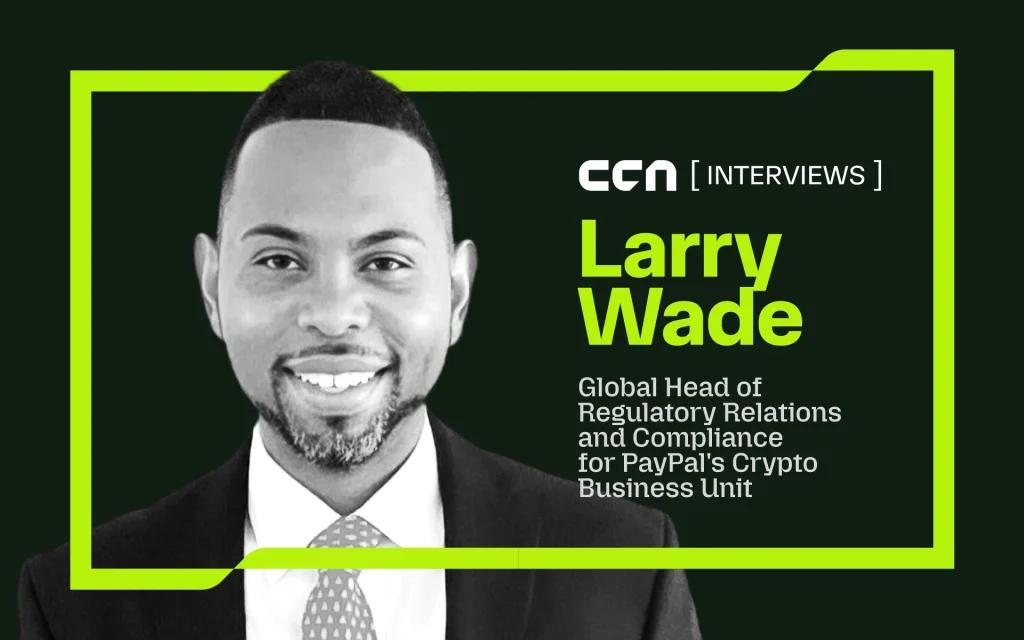
For most of crypto’s history, compliance was seen as the thing that slowed you down. Larry Wade has spent years arguing the opposite. CCN’s Maxwell Moeller sat down with PayPal’s Global Head of Regulatory Relations and Compliance (for Crypto Business Unit) at Consensus 2026 to explore why regulated infrastructure is finally having its moment and what comes next for PYUSD.
Wade did not arrive in crypto through a whitepaper rabbit hole or a bull market windfall. He arrived through dinner.
About nine years ago, a former business school classmate, a commodity trader and ex-military veteran, challenged him to read the Bitcoin whitepaper. Wade, then deep in risk consulting at KPMG and with a career spent working across lines of defense at Fortune 500 firms, was skeptical.
“I thought it was tulips,” he says, with the kind of candor that tends to earn trust in a room full of true believers.
The whitepaper changed his mind. What struck him was not the price speculation or the libertarian ideology surrounding Bitcoin at the time. It was engineering.
“My goodness, this solves the double spend problem,” he recalls. “How do you ever trust this transaction in a digital environment?”
From there, he read broadly, including private chains, public chains, and the potential of smart contracts. Against the backdrop of years spent auditing SWIFT and examining the correspondent banking system, a hypothesis began to form.
“This is going to be what allows for the new rails to move value in this new digital age.”
He brought that conviction to a senior partner at KPMG, helped build the firm’s first risk and compliance methodologies for blockchain and crypto, and five years ago made the jump to PayPal, where he now leads global risk and compliance for the company’s crypto group.
The GENIUS Act and the Moat Question
The GENIUS Act was signed into US law in July 2025, establishing the first Federal framework for stablecoin issuers, requiring 1:1 reserve backing, regular third-party audits and formal licensing. PayPal has described itself as GENIUS-ready. Wade does not dispute that label, but he frames it carefully.
Does regulatory clarity create a competitive moat for PYUSD, or does it level the playing field for every well-capitalized issuer?
“I think it does both,” he says.
His reasoning is straightforward. A regulatory framework sets minimum requirements. What creates competitive advantage is the willingness and ability to go above and beyond those requirements. For PayPal, the foundation was already in place before the federal framework arrived.
“PYUSD was originally regulated by the New York Department of Financial Services,” Wade explains, noting that NYDFS created the first stablecoin regime in the country. Paxos, PYUSD’s issuer, now operates as an entity overseen by the Office of the Comptroller of the Currency (OCC), meaning PYUSD reserves are held as customer property, segregated from Paxos’s corporate balance sheet and subject to ongoing supervision.
That head start, in Wade’s view, is not trivial.
“DFS Part 200 has been the basis for all the stablecoin regimes around the world because it was first. That is a competitive advantage for us.”
Yield Question Nobody Can Cleanly Answer
Not every advantage is uncomplicated. PYUSD currently offers a 4% rewards program to US holders. The OCC published a notice of proposed rulemaking in March 2026 implementing the GENIUS Act, raising questions about whether affiliate yield arrangements are permitted under the new federal framework, with the comment period closing May 1, 2026.
The question Wade is asked, and he has clearly been asked it many times, is how a compliance-first organization handles a situation where compliance posture may force product concessions that less regulated competitors simply avoid.
His answer does not flinch.
“We’re always compliance first. That’s in PayPal‘s DNA. We’re never going to cut corners or skirt.”
But he does not stop there. His broader argument is that the opportunity to skirt regulation in crypto is itself closing.
“We’re hitting that convergence point of real world merchants and the general consumer trying to understand how to leverage this technology,” he says.
“You’re going to need that trust, that safety and soundness, that comes from a solid risk management program. I think there’ll be less opportunity than in the past to play at the edges.”
Scaling Compliance Across Chains
PYUSD is natively issued on Ethereum, Solana, Arbitrum and Stellar. Each new chain is not just a technical deployment. It is a new risk surface: different validator sets, bridge exposure, DeFi integrations, potential for outages. For a compliance function operating at PayPal’s scale, the question is how you build a framework that keeps pace without becoming a bottleneck
Wade describes a formal coin listing policy approved by PayPal’s primary crypto regulator. Every new chain, including new deployments of PYUSD itself, goes through a structured risk assessment process aligned to PayPal’s internal risk taxonomy.
“We’re looking at everything from reputational risk to liquidity risk to engineering risks,” he says. “A team comes together and the SMEs assess from the beginning whether we should even run this chain through the actual risk assessment process.”
The outcome requires overall consensus. From there, continuous monitoring kicks in, covering everything from negative news to network outages, with formal annual reassessments built in.
“You do things up front, you look for what may happen as things are progressing, and then you have that set frequency to continue to make sure this chain is aligned with our risk appetite.”
Market Share Gap and Why Wade Is Not Worried
The uncomfortable number in the room is market share. Tether’s USDT holds roughly 60% dominance in the stablecoin market with a market cap approaching 183 billion dollars. PYUSD, despite growing 680% year over year, sits at around 4 billion dollars.
The blunt version of the criticism is that retail users do not reward compliance. They reward liquidity and availability.
Wade does not accept the premise.
“I think it will reprice,” he says. “Just look at how we transact in everyday value today. We transact with platforms and institutions that we trust.”
He points to the composition of stablecoin flows as evidence. “Roughly $350 billion in stablecoin flows, and less than 1% are in the traditional payment space. That is going to grow as the utility becomes more ubiquitous.”
PYUSD’s supply slipped slightly recently, while USDC grew 7.42% and PYUSD expanded 16.66% over the same period, suggesting that as regulation tightens, the market is beginning to tilt toward compliant issuers.
His structural argument is that PayPal’s 400 million consumer accounts are not a vanity metric. They are a distribution layer that USDT and USDC have spent years trying to build.
Operating Globally When the Rules Are Different Everywhere
With MiCA live in Europe, MAS tightening in Singapore and US federal frameworks still evolving, Wade runs a compliance function across jurisdictions where the rules, priorities and philosophies diverge significantly.
His framework is built around an 80/20 principle.
“About 80% of our compliance framework we can lift and shift anywhere in the world, because these are the key risks that will need to be identified and addressed regardless of where we are,” he says.
“From there, you need to respect that region and understand that bespoke tailoring is required.”
Some jurisdictions prioritize consumer protection. Others want to attract technology business. Some prefer a stablecoin denominated in their own currency. All of it gets factored in.
PayPal’s starting point, he argues, is an advantage others do not have.
“We’ve been moving money around the world for a very long time. We have a great foundation to start from, and that’s how we built the crypto business. It was the enterprise risk management program PayPal already had, plus what’s crypto-specific that we need to adhere to on top.”
Quantum Computing: On the Horizon, Not Yet a Crisis
Wade has spoken publicly about quantum computing as a longer-term threat to crypto infrastructure. His current position is measured.
“Quantum is not just a threat to the digital asset ecosystem. It’s a threat to cryptography,” he says. NIST recently published standards on quantum-resistant cryptography, signaling that work at the macro level is underway.
For now, he frames it as a risk to monitor rather than an immediate compliance requirement. That posture could shift quickly if regulators accelerate their timelines, and Wade makes clear that PayPal’s CISO function is already tracking it closely.
What Mainstream Adoption Looks Like
PayPal serves over 400 million consumers and 35 million merchants. If crypto payments go mainstream at scale over the next three years, the compliance infrastructure required to support that volume will need to be fundamentally different from what exists today.
Wade is optimistic, but not naively so.
“We would love everyone to go faster,” he says. “But you understand why it has to go a little slow, because once a regulation is in place, it’s very hard to unwind it or change it. There needs to be thoughtful rulemaking.”
What he keeps returning to is the advantage that blockchain itself provides from a risk management perspective. The ability to scan wallets, trace transaction history and understand attribution is, in his words, something you simply cannot do in the fiat world.
“This gives me way more to work with to protect our customers,” he says. “It really is just the next step from what PayPal has been doing all along.”
The deliberateness that once made PayPal look slow, he suggests, may turn out to be the thing that lets it scale faster than anyone expects.
The information provided in this article is for informational purposes only. It is not intended to be, nor should it be construed as, financial advice. We do not make any warranties regarding the completeness, reliability, or accuracy of this information. All investments involve risk, and past performance does not guarantee future results. We recommend consulting a financial advisor before making any investment decisions.

Giuseppe Ciccomascolo began his career as an investigative journalist in Italy, where he contributed to both local and national newspapers, focusing on various financial sectors.
Upon relocating to London, he worked as an analyst for Fitch's CapitalStructure and later as a Senior Reporter for Alliance News. In 2017, Giuseppe transitioned to covering cryptocurrency-related news, producing documentaries and articles on Bitcoin and other emerging digital currencies. He also played a pivotal role in establishing the academy for a cryptocurrency exchange website. Crypto remained his primary area of interest throughout his tenure as a writer for ThirdFloor.

Max Moeller is a Chicago‑based writer and video editor passionate about games, tech, and crypto. Whether it’s crafting clear, insightful articles or piecing together engaging video retrospectives, he’s driven by curiosity and takes pride in keeping things human. Since 2017, Max has been published in a variety of notable crypto magazines.
Contact Max: [email protected], reach out on LinkedIn or Youtube.


 Easy
Easy