PayPal ‘Pay With Crypto’ Explained: Near‑Instant Payments, 100+ Coins, and 90% Lower Fees
Share
Key Takeaways
PayPal now supports crypto payments for over 100 coins, including Bitcoin, Ethereum, and PYUSD.
Transactions settle in minutes with fees as low as 0.99% until mid-2026.
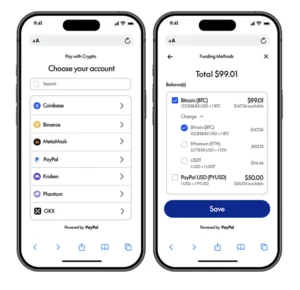
Supported wallets include Coinbase, OKX, Binance, Kraken, Phantom, MetaMask, and Exodus.
Regulatory differences and market volatility remain key challenges to broader adoption.
PayPal’s launch of “Pay With Crypto” marks a major step for global commerce and crypto adoption.
On July 28, 2025, PayPal announced that the service will allow customers in the U.S. and U.S. territories to transact in a select portfolio of cryptocurrencies, including Bitcoin, Ethereum, Litecoin, Bitcoin Cash, Solana, Chainlink, and its stablecoin PYUSD, tapping into a global base of more than 650 million PayPal users, and connecting them to a $3.2 trillion cryptocurrency market.
Buyers can now use 100 cryptocurrencies, like Bitcoin or Solana, at millions of merchants. Payments are instantly converted to USD or PayPal’s stablecoin, PYUSD, with fees up to 90% lower than traditional methods.
With such a feature, a small business in Buenos Aires could save hundreds on international sales to customers in London. And a freelancer in Bangkok could receive payments without waiting days for clearance.
PayPal CEO Alex Chris pointed to the broad range of possibilities, saying users now can pay with crypto and receive instant payments.
With PayPal's open platform, unmatched two-sided network, access to more than 100+ wallets and tokens, and 4% rewards for users holding PYUSD, we’re bringing consumers and businesses together to enable a global commerce system that works for all.
This article explains how the service works, what it offers merchants and consumers, and how it could influence global finance.
How PayPal’s Pay With Crypto Works
PayPal has streamlined the process for buying cryptocurrency, allowing individuals to purchase, hold, and use digital assets directly within the platform.
Top iGaming Sports Betting Sites
Sponsored
Disclosure
We sometimes use affiliate links in our content, when clicking on those we might receive a commission at no extra cost to you. By using this website you agree to our terms and conditions and privacy policy.
The steps may vary slightly depending on the region, but the general process follows this structure:
Log in or sign up: Individuals can create a PayPal account or access an existing one.
Navigate to the crypto section: Users can find this in the PayPal app under Accounts, Crypto, Buy.
Select buy: Users can start the process to purchase cryptocurrency.
Confirm intention to purchase: Individuals should confirm they wish to proceed before moving forward.
Accept terms and conditions: Users must agree to PayPal’s cryptocurrency purchase terms.
Review contact information: Individuals can ensure personal details such as name, address, and date of birth are accurate.
Choose cryptocurrency: Users can select from supported assets, including Bitcoin, Ethereum, Litecoin, Bitcoin Cash, Solana, Chainlink, PayPal USD (PYUSD), and others.
Select amount: Individuals can specify the desired purchase amount.
Set purchase frequency and date: Users can choose a one-time buy or set up a recurring purchase such as weekly or monthly and select a preferred start date.
Select payment method: Users can pay from their PayPal balance, a linked bank account, or a debit card.
Review order details: The interface displays the exchange rate and applicable transaction fee, which starts at $0.99 USD.
Complete purchase: Individuals can finalize the transaction by selecting “buy now”.
Additional Features (Region Dependent)
PayPal allows users to store, sell, and move crypto within the app, including transfers to external wallets where permitted.
In the U.S., merchants can accept over 100 cryptocurrencies, rewards for PYUSD held with PayPal and an introductory transaction fee of 0.99% that applies until July 31, 2026.
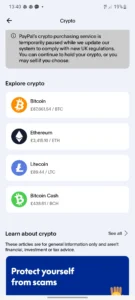
However, access to certain coins, payment methods, and wallet transfers depends on jurisdiction and local regulations. For example, some crypto services through PayPal remain restricted in the UK.
Paying with crypto and PayPal in the UK | Source PayPal
PayPal enables cryptocurrency transfers to and from a select group of external wallets, allowing users to manage assets outside the PayPal ecosystem. The process is integrated into the PayPal interface and can be completed in a few steps. As of August 2025, supported wallets include:
Coinbase: Supports transfers to and from PayPal for asset management, trading, or use on Coinbase’s exchange platform.
OKX: Integrates with PayPal for transfers to OKX’s trading, decentralized finance (DeFi), or wallet services.
Binance: Allows crypto transfers to Binance’s exchange environment for trading or other services.
Kraken: Facilitates transfers from PayPal for spot trading, staking, or secure custody on Kraken’s platform.
Phantom: Supports transfers of Solana-based assets to and from PayPal for use in Solana’s ecosystem.
MetaMask: Enables crypto transfers, interacting with decentralized applications (dApps) and managing Ethereum-based assets.
Exodus: Enables transfers to manage a wide range of cryptocurrencies in a non-custodial wallet.
These integrations allow users to move supported cryptocurrencies (e.g., Bitcoin, Ethereum, Solana, and others) to external wallets for trading, holding, or engaging with decentralized platforms while retaining access to PayPal’s buying, selling, and conversion features.
Note that wallet support may vary by region. For the latest list of supported wallets and regional availability, check PayPal’s official crypto hub or wallet-specific documentation.
Lower Fees: Up to 90% Cheaper Transactions
PayPal argues that businesses lose billions annually to cross-border fees, and that crypto payments could significantly reduce these costs for small enterprises and freelancers worldwide.
High transaction costs limit global commerce. Credit card processing fees typically range from 1.5 to 3.5% for domestic sales and 4 to 7% for international transactions. PayPal’s Pay with Crypto charges a promotional 0.99 percent fee until July 31, 2026, increasing to 1.5 percent afterward. This can cut payment costs by 60 to 90% compared to card payments.
For example, for a $1,000 sale, traditional card fees could be $15 to $35, while PayPal crypto would cost $9.90, saving $5 to $25.
The difference is even greater for cross-border sales. A clothing retailer in Nairobi selling $10,000 monthly to U.S. customers could pay $400 to $700 in card fees. With PayPal crypto, the cost drops to $99, saving $301 to $601, which would be enough to expand inventory by 20% and boost sales.
Speed and Accessibility
Speed drives commerce, and PayPal’s crypto payments aim to settle in minutes, unlike bank transfers, which can take up to seven days.
Merchants access funds quickly, improving cash flow. As a result, PayPal aims to offer customers a checkout process as simple as tapping a digital wallet, making crypto accessible to PayPal’s 436 million users, per Q1 2025 data.
In regions like Sub-Saharan Africa, 60% of adults lack bank accounts, but crypto adoption is rising. The global mobile payment market is projected to grow to USD 18.84 trillion by 2030, highlighting the scale of adoption for digital transaction methods.
Challenges and Considerations To Be Aware Of
While PayPal’s “Pay With Crypto” adds speed and lower costs, adoption depends on overcoming practical and regulatory hurdles. Merchants, consumers, and regulators must balance benefits with risks before this becomes a widely accepted payment option.
Volatility risk: Rapid price changes in cryptocurrencies can affect the value between payment initiation and settlement.
Regulatory uncertainty: Rules differ across jurisdictions, which can restrict available assets or payment features.
Merchant adoption: Some businesses remain hesitant to integrate crypto due to perceived complexity or compliance concerns.
User education: A clear understanding of the payment process is essential to reduce transaction errors and disputes.
Conclusion
PayPal’s “Pay With Crypto” integrates cryptocurrency payments into one of the world’s largest digital payment networks. By supporting over 100 coins, connecting to leading wallets, and offering near-instant settlement, the service opens new options for merchants and consumers in both developed and emerging markets.
The cost advantage is clear. With fees up to 90% lower than card payments, small businesses and freelancers stand to save on every transaction. Coupled with fast settlement and global reach, the system could help more sellers participate in international trade without relying solely on traditional banking.
Challenges remain, from navigating different regulatory environments to addressing volatility risks. However, if adoption continues, PayPal’s approach could help make cryptocurrency payments a practical choice for everyday transactions.
Can merchants receive payouts in local currency when customers pay with crypto?
Yes. PayPal converts crypto to local currency where supported.
Does PayPal set daily or monthly crypto purchase limits?
Purchase limits vary based on verification level and regional rules.
Is Pay With Crypto compatible with subscription services?
Yes. Merchants can accept recurring crypto payments for subscription-based models.
What role does PayPal play in mainstream crypto adoption?
By integrating wallets like Coinbase and MetaMask, PayPal simplifies crypto spending, bridging the gap between niche investors and everyday shoppers.
Disclaimer:
The information provided in this article is for informational purposes only. It is not intended to be, nor should it be construed as, financial advice. We do not make any warranties regarding the completeness, reliability, or accuracy of this information. All investments involve risk, and past performance does not guarantee future results. We recommend consulting a financial advisor before making any investment decisions.
Dr. Lorena Nessi is an award-winning journalist and media technology expert with 15 years of experience in digital culture and communication. Based in Oxfordshire, UK, she combines academic insight with hands-on media practice.
She holds a PhD in Communication, Sociology, and Digital Cultures, and an MA in Globalization, Identity, and Technology.
Lorena has taught at Fairleigh Dickinson University, Nottingham Trent University, and the University of Oxford. She is a former producer for the BBC in London, with additional experience creating television content in Mexico and Japan.
Her research focuses on digital cultures, social media, technology, capitalism, and the societal impact of blockchain innovation.
She has written extensively on digital media and emerging technologies, with her work featured in both academic and media platforms. Her Web3 expertise explores how blockchain technologies shape culture, economics, and decentralized systems.
Outside of work, Lorena enjoys reading science fiction, playing strategic board games, traveling, and chasing adventures that get her heart racing. A perfect day ends with a relaxing spa and a good family meal.


 Easy
Easy