Artificial intelligence is shaping the next decade of technology, but who will own it?
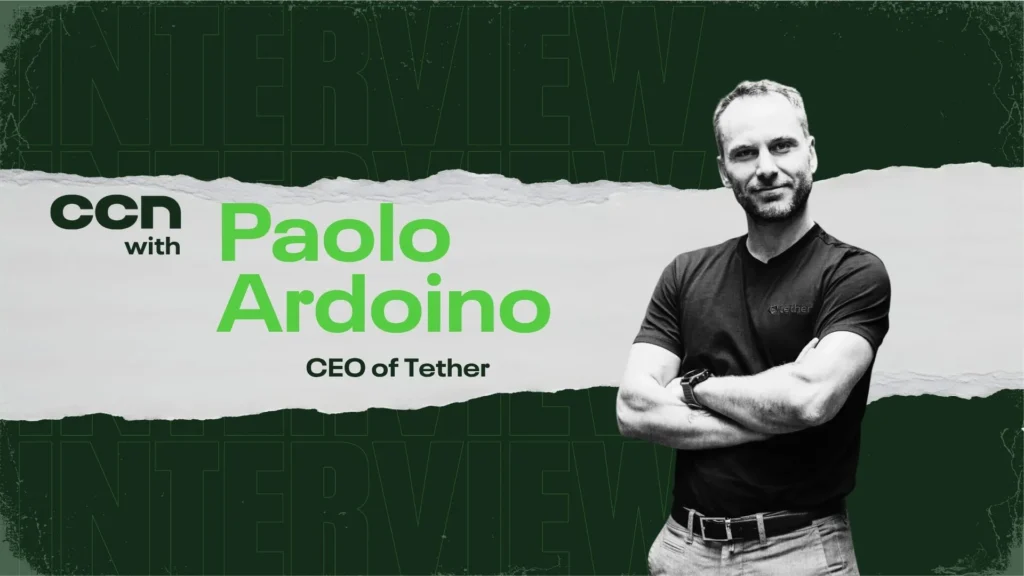
In an exclusive conversation with CCN’s Dr. Lorena Nessi, Paolo Ardoino, CEO of Tether, explores the politics of AI, the danger of centralization, and the long-term vision behind Tether’s decentralized AI projects.
For Ardoino, this isn’t just a technological matter; it’s a philosophical one. The challenge, he says, is to build an AI that doesn’t depend on a handful of companies, servers, or gatekeepers.
How Can AI Avoid Becoming a Tool for Centralization?
Ardoino has warned for years about the risks of AI monopolies, where massive data centers and proprietary models give a few corporations control over global intelligence.
When asked how Tether balances decentralization with the practical need for central leadership, he said the answer lies in building technology that can live without its creators.
“If you build technology that can only survive if you’re around, that’s not good technology,” he said. “You can’t claim it’s decentralized or resilient.”
He pointed to projects like QVAC Workbench and QVAC Genesis I, two open-source initiatives Tether is developing to enable decentralized, peer-to-peer AI.
According to Tether, QVAC’s modular AI architecture adapts and performs across all hardware types, from the simplest to the most advanced. Designed to scale to sextillions of agents, all self-sovereign yet enabled to connect and collaborate as infinite swarms in an unstoppable peer-to-peer network.
“They don’t need our data centers, keys, or permission,” Ardoino explained. “Anyone can take them, build on them, or change them in any direction.”
For Ardoino, open source isn’t just a development model, it’s a moral stance. “That’s the best way to help society move toward freedom and stability,” he said.
How Does Science Fiction Inspire Paolo Ardoino’s Vision for AI?
Ardoino’s vision for AI doesn’t come from corporate strategy manuals; it comes from science fiction. In particular, he cites Isaac Asimov’s short story The Last Question as a significant influence.
In Asimov’s tale, a supercomputer evolves over billions of years, eventually becoming part of the fabric of the universe itself, a being capable of reversing entropy and restarting creation. For Ardoino, that story reflects the ultimate goal of distributed, universal intelligence.
“If we want to create actionable steps that could one day lead to an AI able to answer the most complex question in the universe, how to stop the universe from dying, then AI must become part of the fabric of the universe,” he said.
To him, that means the opposite of centralization. “We can’t have the universe connected to OpenAI data centers,” he added. “That makes no sense.”
Instead, he envisions tiny, local, and efficient AI systems that can run on minimal hardware, even “powered by a potato,” as he put it.
Such AIs could exist everywhere, from phones to sensors to satellites. “They should scale from the smallest thing to the biggest thing,” he said.
Ardoino knows this may sound ambitious, even eccentric, but he sees Tether’s work as the spark for something far greater:
“We’re not saying we’ll solve everything now. But we want to be the spark, like the Univac I of the 1950s, that, over time, will give life to the AI that answers the last question.”
How Is Tether’s Approach Different From Other “Open” AI Projects?
While many tech companies now claim to support open-source AI, Ardoino argues that Tether’s model of openness is structural, not superficial.
He explains that QVAC’s goal is to create a common runtime capable of running AI models across many devices, phones, laptops, and edge computers without reliance on any single cloud infrastructure.
“We’re compatible with the best open-source language models out there,” Ardoino said. “We’re not trying to compete with them. There won’t be one answer; we just want to build a shared execution layer.”
Ardoino is skeptical about tokenizing intelligence.
“Intelligence isn’t fungible,” he said. “It doesn’t make sense to tokenize it.”
But he does believe AI needs access to money, programmable money. That’s where USDT (Tether’s stablecoin) comes in.
“AI agents are rational tools,” he explained. “They’ll choose the most logical way to interact with others, using the most widely used programmable money. Today, that’s USDT, already used by over 500 million people.”
In other words, he sees Tether not just as a payments network for humans, but as the monetary layer for machine-to-machine economies.
Recommended Secure Partners
Paolo Ardoino Envisions an AI Future Powered by Smartphones, Not Data Centers
According to Ardoino, the future of AI will not live in data centers but on simpler devices like phones.
“Good smartphones today can already run 60% to 70% of AI use cases,” he said. “In 30 years, that number will rise to 85%. We’ll reach 95% to 97% in five to ten years.”
This shift toward local AI could mean faster, cheaper, and more private computation. And while many companies race for short-term advantage, Ardoino says Tether takes a longer view.
“Tether doesn’t build to compete tomorrow,” he said. “We build for what the world will look like in ten years.”
What Does It Mean to “Build For The Apocalypse”?
Ardoino referred to his ideas about the “dark times” and “building for the apocalypse.” These ideas are not as ominous as they sound; they are about preparing society for systemic shocks by reinforcing independence.
He described three core principles: resilience, independence, and disintermediation.
Every Tether project, from its stablecoins to AI tools, is designed to preserve communication and financial freedom even in crisis conditions.
“The only way to preempt chaos is to bring stability,” he said. “That means ensuring people have financial freedom and the ability to communicate. Without that, chaos becomes unstoppable.”
In his view, the world’s most significant risks come not from AI but from centralized control of communication and money. Preventing that, he argues, is how humanity avoids the “apocalypse.”
“If we want to reverse chaos, we need to stop it in society first,” he said. “And that begins by keeping peer-to-peer communication alive.”
What Does The Next Decade of AI Look Like?
When asked how he envisions the world in ten years, Ardoino paints a hopeful and cautious picture.
“The future will have a lot of AI, robots, and uncertainty,” he said. “There will be a push toward centralization and a push toward freedom. It’s never black or white.”
He’s a self-proclaimed science fiction fan and welcomes a future of intelligent machines, but only if ownership stays with the people.
“I want to see AI and robots happen,” he said. “But I want people to own them, not corporations.”
But he doubts he’ll ever see it realized.
“I’m not optimistic,” he admits, “but I’ll never stop trying.”
The information provided in this article is for informational purposes only. It is not intended to be, nor should it be construed as, financial advice. We do not make any warranties regarding the completeness, reliability, or accuracy of this information. All investments involve risk, and past performance does not guarantee future results. We recommend consulting a financial advisor before making any investment decisions.

Giuseppe Ciccomascolo began his career as an investigative journalist in Italy, where he contributed to both local and national newspapers, focusing on various financial sectors.
Upon relocating to London, he worked as an analyst for Fitch's CapitalStructure and later as a Senior Reporter for Alliance News. In 2017, Giuseppe transitioned to covering cryptocurrency-related news, producing documentaries and articles on Bitcoin and other emerging digital currencies. He also played a pivotal role in establishing the academy for a cryptocurrency exchange website. Crypto remained his primary area of interest throughout his tenure as a writer for ThirdFloor.

Dr. Lorena Nessi is an award-winning journalist and media technology expert with 15 years of experience in digital culture and communication. Based in Oxfordshire, UK, she combines academic insight with hands-on media practice.
She holds a PhD in Communication, Sociology, and Digital Cultures, and an MA in Globalization, Identity, and Technology.
Lorena has taught at Fairleigh Dickinson University, Nottingham Trent University, and the University of Oxford. She is a former producer for the BBC in London, with additional experience creating television content in Mexico and Japan.
Her research focuses on digital cultures, social media, technology, capitalism, and the societal impact of blockchain innovation.
She has written extensively on digital media and emerging technologies, with her work featured in both academic and media platforms. Her Web3 expertise explores how blockchain technologies shape culture, economics, and decentralized systems.
Outside of work, Lorena enjoys reading science fiction, playing strategic board games, traveling, and chasing adventures that get her heart racing. A perfect day ends with a relaxing spa and a good family meal.


 Easy
Easy