Index funds and Exchange-Traded funds (ETFs) are popular tools for passive investing, offering accessible ways to diversify and grow wealth. These tools are gaining traction in crypto as more people seek efficient ways to access the market.
Crypto index funds and ETFs both offer investors access to a diversified portfolio of cryptocurrencies like Bitcoin (BTC) and Ether (ETH). Index funds track the broader crypto market or specific sectors, while ETFs trade on exchanges throughout the day like regular stocks.
Understanding the differences between crypto index funds and crypto ETFs is key to making informed investment decisions, as each serves unique strategies.
This article compares crypto index funds and ETFs, focusing on their trading mechanisms, pricing, minimum investment, fees, tax efficiency, and reinvestment options.
“A crypto index fund is an investment fund designed to replicate the performance of a specific cryptocurrency market index, such as one tracking major digital assets like Bitcoin and Ethereum”.
Fund managers create the portfolio by holding cryptocurrencies in the same proportions as the index, using a passive management strategy. This strategy can minimize trading activity, reduce costs, and focus on long-term growth.
By simplifying diversification and keeping expenses low, crypto index funds offer an efficient way for investors to access the broader crypto market.
What Is an ETF?
“ETFs, or exchange-traded funds, are investment funds that pool money from investors to buy a collection of assets, such as stocks, bonds, or commodities, as well as digital assets like cryptocurrencies like Bitcoin (BTC), Ethereum (ETH), and Solana (SOL). These funds aim to track the performance of a specific index, sector, or theme.”
ETFs track specific indices or themes and trade on stock exchanges throughout the day, offering the flexibility of stock-like trading.
For example, a Bitcoin ETF allows individuals to invest in Bitcoin indirectly through a regulated market without holding the cryptocurrency itself. Ethereum and Solana ETFs provide similar exposure to these assets.
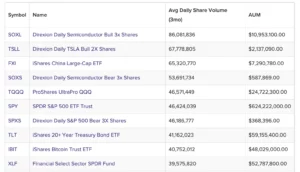
ETFs by trading volume | Source: VettaFI.
As of the end of November 2024, Bitcoin ETFs recorded strong trading volumes, reflecting growing institutional interest, while Solana-focused ETFs continue to gain traction. These instruments simplify access to cryptocurrencies, making them appealing for diversified portfolios.
ETFs are versatile investment tools that serve various purposes:
Long-term investing: ETFs tracking major indices allow individuals to participate in long-term market growth.
Short-term trading: Their stock-like trading features support active strategies.
Diversification: ETFs provide exposure to multiple assets, helping reduce risk.
Key Differences Between Index Funds and ETFs
Index funds and ETFs track market indices and offer diversified investment options, but they differ in structure, trading features, and costs. Understanding these differences can help individuals choose the best option for their financial goals.
Trading mechanism:
Index funds trade once daily at the net asset value (NAV), while ETFs trade on daily exchanges at market prices.
Cost and fees:
Index funds often have slightly higher ratios but now offer low-cost options. Investors avoid trading fees when purchasing directly from the fund provider. ETFs generally provide lower expense ratios but may include brokerage fees for trading.
Index funds avoid fees when individuals purchase them directly from providers. ETFs involve brokerage fees for trades.
Index funds may result in higher taxes due to asset sales for redemptions. ETFs minimize taxes with in-kind creation. In-kind creation happens when ETFs work with financial institutions to swap ETF shares for the actual assets, like stocks or bonds, in the ETF. Instead of selling or buying assets, they exchange them directly.
Liquidity:
ETFs offer higher liquidity due to intra-day trading or at any time during market hours.
Tax efficiency:
ETFs have an edge due to in-kind transactions, which involve exchanging securities directly instead of selling them, helping to reduce taxable events. Index funds, in contrast, may generate more taxes when assets are sold to meet redemptions.
Minimum investment:
Index funds usually require a higher initial investment. However, ETFs allow users to start investing by purchasing a single share, making them more accessible.
Portfolio diversification:
Both options provide diversified exposure to cryptocurrencies.
Crypto ETFs may offer more specific targeting, such as focusing on Bitcoin, Ethereum, or a niche crypto sector.
The table below highlights the key differences between index funds and ETFs, focusing on their trading mechanisms and price determination.
Aspect
Index funds
ETFs
Trading mechanism
Trades once daily at NAV.
Trades anytime during market hours.
Pricing
Based on end-of-day NAV.
Changes throughout trading hours.
Minimum investment
A higher initial investment is required.
Buy single shares, no minimum.
Fees
It may have higher management costs.
Lower costs, but brokerage fees apply.
Tax efficiency
Taxable from fund asset sales.
In-kind transactions reduce taxes.
Dividend reinvestment
Automatic reinvestment by most funds.
Offered by many brokerage platforms.
Benefits of Index Funds
Crypto index funds operate similarly to traditional index funds but are structured to accommodate digital assets’’ unique characteristics, providing diversified exposure to the cryptocurrency market.
Unlike traditional funds, they must navigate cryptocurrencies’ high volatility, continuous trading, and evolving regulatory environment.
Simplicity: Crypto index funds aim for long-term exposure to a basket of cryptocurrencies, following a clear strategy without requiring frequent adjustments.
Ease of use: Many crypto index funds simplify investing by automating portfolio tracking and rebalancing, reducing the need for active monitoring. However, daily NAV pricing may not always apply, as pricing in the crypto market often updates continuously.
Cost-effectiveness: Crypto index funds typically charge lower fees than actively managed crypto portfolios. While direct trading fees may not apply, investors should account for management fees and other fund expenses, which can vary.
Crypto index funds offer similar benefits to traditional index funds but with nuances due to cryptocurrency markets’ dynamic and 24/7 nature.
Benefits of ETFs
ETFs offer flexibility, low entry costs, and tax efficiency, making them appealing to many individuals.
Flexibility: Crypto ETFs trade at market prices throughout the day, allowing for active and short-term trading strategies similar to traditional ETFs.
Low entry cost: Many crypto ETFs have no fixed minimum investment, making them accessible to many investors. However, trading fees or fund expenses might vary depending on the provider.
Tax efficiency: Crypto ETFs may offer tax efficiency in certain jurisdictions, but this depends on how the ETF is structured (e.g., spot-based vs. futures-based). Additionally, tax efficiency might not match the level seen in traditional ETFs due to the evolving regulatory environment in crypto markets.
How To Decide Between Index Funds and ETFs
Deciding between crypto index funds and ETFs depends on various factors, including your goals, risk tolerance, and account type.
Investment goals: Use crypto index funds for long-term exposure to diverse cryptocurrencies or choose crypto ETFs for flexibility in short-term trading strategies.
Risk tolerance: Match your risk appetite and financial goals to the type of fund but consider volatility.
Account type: Determine if your investment is in a taxable or crypto-friendly retirement account like a self-directed IRA.
Budget and convenience: Opt for crypto ETFs if their lower entry costs fit your budget, or consider crypto index funds for simplicity and automated contributions where available.
Common Use Cases for Index Funds and ETFs
Index funds and ETFs cater to different investment strategies and objectives.
Index funds:
Index funds work well for long-term retirement accounts like 401(k)s and IRAs. They provide broad market exposure with low fees, making them ideal for building retirement savings. For example, the Vanguard S&P 500 Index Fund includes 500 large US companies, offering a simple market investment method.
Similar to traditional index funds, crypto index funds track the performance of a basket of cryptocurrencies or blockchain-related assets. These funds expose the broader crypto market without requiring individuals to manage individual coins or tokens.
For example, the Bitwise 10 Crypto Index Fund tracks the performance of the 10 largest cryptocurrencies by market cap, making it a crypto equivalent to traditional index funds like the Vanguard S&P 500 Index Fund.
Both traditional and crypto index funds simplify investing by offering diversification and reducing the need for active management, appealing to those looking for long-term growth.
ETFs:
ETFs facilitate easy adjustments to portfolio allocations. Individuals can efficiently rebalance their portfolios by trading ETFs, ensuring alignment with their objectives and risk tolerance. For example, sector-specific ETFs such as the Technology Select Sector SPDR Fund (XLK) let individuals increase or decrease exposure to the tech industry. Similarly, the Energy Select Sector SPDR Fund (XLE) provides targeted access to the energy sector, making rebalancing straightforward.
Like traditional sector-specific ETFs, cryptocurrency ETFs allow investors to adjust their portfolio allocations within the crypto market. For example:
The ProShares Bitcoin Strategy ETF (BITO) tracks Bitcoin futures, enabling exposure to Bitcoin without direct ownership.
The VanEck Digital Transformation ETF (DAPP) provides access to companies involved in blockchain and cryptocurrency technologies.
These crypto-focused ETFs offer similar benefits. They allow investors to gain exposure to specific areas of the crypto industry, rebalance portfolios, and manage risk more effectively.
They serve as a bridge for those seeking diversification or targeted investment in digital assets within a familiar ETF structure.
Conclusion
Index funds and ETFs serve different purposes. Index funds support long-term growth with steady, low-maintenance strategies. Crypto index funds extend these benefits to digital assets by offering broad exposure to cryptocurrencies without frequent management.
ETFs provide flexibility for active trading and quick portfolio adjustments. They allow trading throughout the day and offer access to specific markets. Crypto ETFs bring similar advantages to cryptocurrency, enabling targeted investments and efficient portfolio rebalancing.
Both tools play a significant role in building diversified portfolios and achieving financial goals across traditional and crypto markets. Understanding their features helps match them to specific strategies effectively.
FAQs
What are the primary advantages of ETFs over index funds?
ETFs offer flexibility as individuals can buy and sell them throughout trading. They provide liquidity through exchange trading, deliver tax efficiency via in-kind transactions that minimize capital gains, and feature lower fees, making them a popular choice for active traders and individuals managing taxable accounts.
Can index funds and ETFs track the same indices?
Index funds and ETFs can track the same indices, such as the S&P 500 or the Nasdaq 100. However, they differ in several ways: trading mechanisms (index funds trade at end-of-day NAV, while ETFs trade throughout the day), cost structures (ETFs often have lower expense ratios but may incur brokerage fees), liquidity (ETFs offer greater flexibility), and tax efficiency (ETFs typically generate fewer taxable capital gains).
Are ETFs riskier than index funds?
ETFs are not riskier by nature but can have more price swings because they trade throughout the day. Index funds avoid this since they only trade at the end-of-day price.
Can I invest in both index funds and ETFs?
Yes. Combining both can diversify a portfolio and balance long-term growth with short-term flexibility. This approach helps meet a range of financial goals efficiently.
Which is better for tax efficiency: index funds or ETFs?
ETFs are better for tax efficiency because they use in-kind transactions. This process exchanges securities directly instead of selling them, which avoids triggering taxable events. Index funds often sell securities to pay investors, leading to more taxable capital gains. This difference helps users decide which option aligns with their investment goals and tax preferences.
Disclaimer:
The information provided in this article is for informational purposes only. It is not intended to be, nor should it be construed as, financial advice. We do not make any warranties regarding the completeness, reliability, or accuracy of this information. All investments involve risk, and past performance does not guarantee future results. We recommend consulting a financial advisor before making any investment decisions.
Dr. Lorena Nessi is an award-winning journalist and media technology expert with 15 years of experience in digital culture and communication. Based in Oxfordshire, UK, she combines academic insight with hands-on media practice.
She holds a PhD in Communication, Sociology, and Digital Cultures, and an MA in Globalization, Identity, and Technology.
Lorena has taught at Fairleigh Dickinson University, Nottingham Trent University, and the University of Oxford. She is a former producer for the BBC in London, with additional experience creating television content in Mexico and Japan.
Her research focuses on digital cultures, social media, technology, capitalism, and the societal impact of blockchain innovation.
She has written extensively on digital media and emerging technologies, with her work featured in both academic and media platforms. Her Web3 expertise explores how blockchain technologies shape culture, economics, and decentralized systems.
Outside of work, Lorena enjoys reading science fiction, playing strategic board games, traveling, and chasing adventures that get her heart racing. A perfect day ends with a relaxing spa and a good family meal.


 Easy
Easy