Hyperliquid Labs is registered in Singapore and contributes to the decentralized Hyperliquid blockchain. Here’s what MAS has said about its regulatory status. | Credit: CCN.com
Share
Key Takeaways
Hyperliquid’s HIP-4 introduces binary outcome contracts that settle to 0 or 1 USDH, allowing traders to speculate on events such as CPI releases or Bitcoin price levels without leverage or liquidations.
Unlike standalone prediction platforms, HIP-4 contracts operate inside the same account and execution engine as Hyperliquid’s spot and perpetual futures markets.
HIP-4 combines YES and NO orders into a single shared order book, allowing liquidity from both sides of a market to interact simultaneously.
The protocol emphasizes permissionless market deployment, on-chain settlement transparency, and zero fees to open positions as key differentiators from centralized or curated prediction market platforms.
On May 2, 2026, Hyperliquid activated HIP-4 on mainnet, launching a product type that no major decentralized exchange had successfully integrated before: fully collateralized, on-chain outcome contracts sitting inside the same account where traders already run perpetual futures and spot positions.
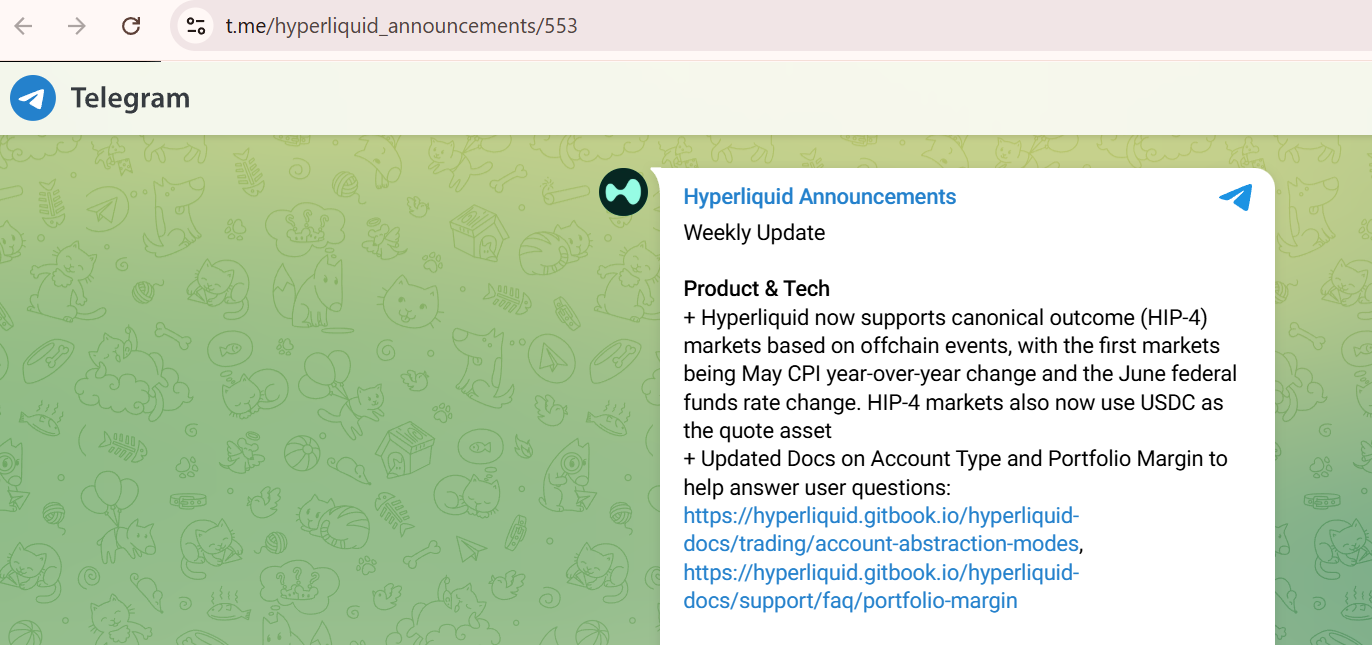
Over 6 million contracts changed hands on launch day alone. Within weeks, the platform had listed its first US macroeconomic event market, allowing traders to take positions on the May 2026 year-over-year CPI print, which settled on June 10 against official Bureau of Labor Statistics data.
LATEST: ⚡ Hyperliquid validators can now deploy and settle real-world outcome markets natively on-chain, reducing reliance on external oracles under the HIP-4 upgrade. pic.twitter.com/5sEsx5grOR
Outcome-based trading on Hyperliquid is not a bolt-on feature. It is the fourth in a deliberate sequence of protocol upgrades, each one expanding the surface area of what can be traded on a single execution engine.
Understanding HIP-4 means understanding both the mechanics of how contracts work and why the architecture beneath them matters for anyone who wants to use them.
HIP-1 Through HIP-3: Building to HIP-4
Hyperliquid’s improvement proposal framework has followed a logical progression.
HIP-1 introduced fungible token standards for native spot trading.
HIP-2 bootstrapped on-chain liquidity for those tokens.
HIP-3, which launched on mainnet on October 13, 2025, opened perpetual futures to permissionless builder deployment, allowing anyone with 500,000 HYPE staked to deploy a perp market for any asset with a valid oracle feed. HIP-3 has already driven open interest across builder-deployed markets past $1 billion, with trade.xyz capturing over 90% of that figure through tokenized stocks and commodities.
Where HIP-3 perpetuals have no expiry, incorporate funding rates, and rely on margined positions that can be liquidated, HIP-4 outcome contracts are structured as dated, fully collateralized, non-margined instruments that settle strictly to either zero or one at expiry, eliminating the need for funding payments, liquidation mechanisms, or margin calls altogether.
Although both standards operate in parallel on the same HyperCore infrastructure and share the same matching engine and settlement layer, they represent fundamentally different financial primitives designed for distinct trading use cases.
What Outcome Contracts Actually Are
Every HIP-4 outcome contract represents a question with a binary answer:
Traders interact with two tokens for each market: YES and NO. Each token’s price floats between 0.001 and 0.999 throughout the market’s life. The price at any moment is, structurally, the market’s implied probability of the event occurring.
A YES token trading at 0.72 means the market collectively prices a 72% probability of the event happening.
At settlement, the oracle resolves the event. If it occurs, YES tokens settle to 1 USDH each and NO tokens settle to 0.
If it does not occur, the reverse applies. There are no intermediate values. Every position resolves to its full or zero payout.
The payoff arithmetic is simple and transparent. A trader who buys YES at 0.60 USDH per contract and holds to settlement either receives 1 USDH per contract if correct, a gain of 0.40 USDH, or loses the full 0.60 USDH entry cost if wrong.
A trader who buys NO at 0.40 USDH per contract (the complement of a YES price of 0.60) either receives 1 USDH if the event does not occur or loses the 0.40 USDH if it does.
Positions can also be closed before settlement at the prevailing market price, allowing traders to lock in gains or cut exposure without waiting for resolution.
Merged Order Books: Why Liquidity Works Differently Here
One of HIP-4’s most technically significant design choices is the merged order book. YES and NO tokens for the same market do not have separate liquidity pools. They share a single book.
This matters because of how the pricing relationship works. Buying YES at price P is mathematically equivalent to selling NO at price 1-P.
Hyperliquid’s matching engine recognizes this equivalence and matches orders across both sides simultaneously. An order to buy YES at 0.65 can be matched either against a trader selling YES at 0.65 or against a trader buying NO at 0.35, since both express the same probability level from opposite directions.
The result is that effective liquidity is twice that of a split-book design. Standalone prediction platforms like Polymarket need to bootstrap liquidity independently on both sides of each market.
Hyperliquid’s merged book means any new outcome market immediately has access to the full depth of both YES and NO order flow combined, resolved under price-side-time priority rather than simple price-time priority.
Hyperliquid processed $219 billion in trading volume in March 2026 alone, and the existing user base of 1.4 million active traders is the cold-start advantage that standalone prediction market platforms cannot replicate. HIP-4 does not need to build its audience from scratch.
Four Steps: How Every Market Works From Creation to Settlement
Understanding outcome contracts at the trading level requires understanding the lifecycle of every market.
Step
Action
Purpose
1
Deployment
Builder launches market with staked HYPE collateral
2
Opening Auction
Initial price discovery and fair order matching
3
Continuous Trading
Traders buy and sell YES/NO contracts freely
4
Settlement
Oracle resolves outcome and contracts pay out
Step one, deployment: A builder stakes 1,000,000 HYPE tokens to deploy an outcome market. That stake is slashable and burned by validators if the deployer manipulates the oracle, introduces invalid state transitions, or causes extended downtime. The builder defines a schema covering the market title, resolution time, resolution source, authorized oracle updater, and an optional challenge window. One staked slot supports a rolling series of markets, meaning the stake amortizes across many events over time rather than applying to a single contract.
Step two, opening auction: Each new market begins with a roughly 15-minute single-price clearing auction. Traders submit limit orders during this window, but no execution occurs until the auction closes at the price that maximizes matched volume. Unfilled auction orders roll into continuous trading. This design prevents front-running at market open and gives early participants fair entry pricing.
Step three, continuous trading: Following the auction, the market trades on Hyperliquid’s central limit order book with the same execution quality as any other product on the platform. Traders can enter, exit, scale, or reverse positions at any time before the resolution deadline. Prices reflect simultaneous live probability assessments from all market participants.
Step four, settlement: When the event resolves, the authorized oracle posts the final outcome, triggering an immediate halt in trading and the cancellation of all open orders. Positions are then settled automatically in USDH, Hyperliquid’s native stablecoin, with YES holders receiving 1 USDH per contract if the event occurs and 0 if it does not, while NO holders receive the inverse payout structure.
The entire process, from opening auction to settlement, runs on-chain with full transparency. Every order, fill, and position is publicly visible, unlike Polymarket‘s off-chain order matching or Kalshi’s centralized infrastructure.
HyperCore will support outcome trading (HIP-4). Outcomes are fully collateralized contracts that settle within a fixed range. They are a general-purpose primitive that are useful for applications such as prediction markets and bounded options-like instruments. There has been…
The first HIP-4 market deployed was a daily binary outcome based on Bitcoin’s mark price. Since the mainnet launch, the scope has expanded rapidly.
On May 25, 2026, Hyperliquid launched its first US macroeconomic event market using HIP-4 outcome contracts, covering the May 2026 year-over-year CPI print, in a fully collateralized, no-liquidation format that settles on June 10 against official Bureau of Labor Statistics data.
The category of events that qualify for HIP-4 contracts is broad. Any event with a definable binary outcome and a reliable settlement oracle is viable, including crypto price levels, Federal Reserve rate decisions, macroeconomic data releases, sports results, and election outcomes.
A builder who recycles a single staked slot can cover macroeconomic releases such as CPI prints, FOMC decisions, and jobs reports on a rolling basis, making the platform a natural destination for traders who want to express macro views without routing through external prediction protocols or centralized brokers.
HIP-4 charges zero fees to open positions, directly targeting Polymarket and Kalshi for on-chain prediction market volume.
That fee structure is an aggressive competitive choice given that Polymarket and Kalshi both charge transaction fees on every order.
How to Start Trading Outcome Markets on Hyperliquid
For existing Hyperliquid users, the barrier is low. Outcome contract positions sit inside the same account interface as perpetuals and spot holdings. No new wallet setup, no new bridge, no separate platform.
Fund an account in USDH, Hyperliquid’s native stablecoin, which serves as the collateral and settlement currency for all HIP-4 contracts.
Navigate to the outcome markets section of the Hyperliquid interface, which lists live markets alongside their current YES and NO prices, open interest, and time to settlement.
Select a market and review the event definition, resolution source, and settlement date before entering any position.
To go long on an event occurring, buy YES tokens at the current ask price. To take the opposing position, buy NO tokens. Size positions by the number of contracts, where each contract requires the full entry price as collateral upfront. There is no leverage available and no margin to manage; the full collateral for each contract is locked at entry and returned at settlement based on the outcome.
Positions can be closed at any time during continuous trading by selling the token back into the order book. Profit and loss at close equals the difference between the entry and exit prices multiplied by the contract size. At settlement, positions held to expiry receive the full 1 USDH or 0 USDH per contract based on resolution.
The zero-liquidation-risk design opens the door to a different type of trader. Perpetual futures attract leverage-hungry participants. Outcome markets, by contrast, could attract users seeking exposure to event-based risk without the complexity of managing margin positions.
Hyperliquid vs Polymarket vs Kalshi
Three meaningful structural differences separate Hyperliquid (HIP-4) from its established competitors.
Features
Hyperliquid (HIP-4)
Polymarket
Kalshi
Composability
Integrated with spot and perp trading on one platform
Standalone prediction market
Standalone regulated platform
Market Creation
Permissionless with HYPE staking
Curated listings
Centrally approved listings
Settlement
Fully on-chain and publicly verifiable
Off-chain order matching
Centralized infrastructure
Regulatory Model
Decentralized protocol design
Limited by regional restrictions
CFTC-regulated platform
First, composability. Polymarket and Kalshi are standalone platforms. A trader running a macro thesis cannot natively hedge a Polymarket position against a Kalshi rate decision market and a Hyperliquid BTC perpetual in the same margin account. HIP-4 positions sit alongside every other Hyperliquid product, meaning a trader can express a correlated view across outcome contracts and perpetuals without moving funds between platforms.
Second, permissionless deployment. Polymarket does not allow direct user market creation without going through a curation process. Kalshi operates under CFTC regulation with centralized listing decisions. HIP-4’s builder model allows any entity meeting the 1,000,000 HYPE staking requirement to deploy markets without seeking permission from a central authority. Notably, Kalshi’s head of crypto co-authored the HIP-4 proposal, acknowledging that on-chain architecture offers structural advantages the CFTC-regulated model cannot replicate.
Third, settlement transparency. Resolution on HIP-4 occurs through an authorized oracle posted on-chain, with an optional challenge window during which disputed outcomes can be contested. The entire settlement process is publicly verifiable by any network participant.
Risks Worth Understanding
Outcome contracts carry distinct risks that differ from perpetuals. Position sizing is fully exposed: a trader who buys YES contracts at 0.70 USDH and holds them to settlement either wins 0.30 USDH per contract or loses the full 0.70 USDH per contract. There is no stop-loss mechanism that reduces the downside below the entry cost once the event resolves.
Oracle risk is material. Settlement depends entirely on the authorized oracle posting an accurate result. Markets with complex resolution conditions or disputed real-world outcomes carry higher oracle risk than markets resolving to clean, machine-readable data, such as official BLS releases or Bitcoin’s mark price.
Hyperliquid’s underlying core code remains closed source, meaning no one outside the core team can verify what runs behind the interface. That limitation applies to HIP-4 markets as much as to any other product on the platform.
Competition from rivals including Aster is beginning to erode Hyperliquid’s broader volume share, and outcome markets remain early-stage with no established track record of oracle reliability across diverse event types.
Low-liquidity markets during the opening phase may exhibit wide spreads, affecting entry and exit pricing. As always, no market structure eliminates the possibility of total position loss.
HIP-4 is Hyperliquid’s new framework for trading outcome-based contracts onchain. These contracts allow users to speculate on whether a specific event will happen, with positions settling to either 0 or 1 USDH at expiration
How are HIP-4 outcome contracts different from perpetual futures?
Outcome contracts are fully collateralized and non-margined, meaning traders cannot be liquidated or use leverage. Perpetual futures, by contrast, rely on margin, funding rates, and liquidation mechanisms.
What kinds of events can be traded using HIP-4?
Markets can cover crypto price targets, macroeconomic releases, Federal Reserve decisions, sports outcomes, elections, and other binary events with verifiable settlement data.
What are the main risks of trading HIP-4 markets?
Key risks include total loss of position value if the prediction is wrong, oracle-related settlement risks, low liquidity in new markets, and reliance on Hyperliquid’s closed-source core infrastructure.
Disclaimer:
The information provided in this article is for informational purposes only. It is not intended to be, nor should it be construed as, financial advice. We do not make any warranties regarding the completeness, reliability, or accuracy of this information. All investments involve risk, and past performance does not guarantee future results. We recommend consulting a financial advisor before making any investment decisions.
Dr. Guneet Kaur is a senior editor at CCN.com and a Science Fellow at Exponential Science. She is a fintech and blockchain expert with extensive experience in digital finance education, blockchain ecosystems, and cryptocurrency markets. She has worked with global media such as Cointelegraph, as well as education and blockchain platforms, to design and lead strategic content and learning initiatives. As an educator and assessor for top-tier executive programs, she bridges real-world fintech trends with academic insight.
Dr. Kaur is also a published researcher and peer reviewer across fintech and data science journals, including Financial Innovation Journal and International Journal of Big Data Intelligence and Applications. Her work spans data-driven analysis, Web3 innovation, and technical content development. With a strong foundation in both industry and academia, she translates complex financial technologies into practical applications, empowering learners, professionals, and institutions across the rapidly evolving digital finance landscape.


 Easy
Easy