Onchain gambling generated $14 billion in Q1 2026 despite a broader crypto market downturn, driven by returning users, stablecoin adoption, and growing retail participation. | Credit: CCN.com
Share
Key Takeaways
Kalshi users win more often than day traders, options, or sports bettors, per WSJ and company data.
The top 0.1% capture most of the profits; the majority lose, but the platform offers better odds than traditional trading.
Kalshi raised $1 billion at a $22 billion valuation with exploding sports volumes driving mainstream adoption.
Prediction markets are reshaping how people bet on real-world events, from elections to sports outcomes.
Platforms like Kalshi let users trade yes-or-no contracts on everything from basketball games to political races.
But a fresh look at profitability data has sparked debate: do Kalshi traders really beat traditional day traders?
New insights from a Wall Street Journal report and Kalshi’s own analysis suggest many do.
While most users still lose money overall, Kalshi participants appear to fare better than those chasing profits in stocks, options, futures, or sportsbooks.
Try Our Recommended Crypto Exchanges
Sponsored
Disclosure
We sometimes use affiliate links in our content, when clicking on those we might receive a commission at no extra cost to you. By using this website you agree to our terms and conditions and privacy policy.
The Wall Street Journal recently examined trading patterns on major prediction markets, including Kalshi and rival Polymarket.
Their findings paint a familiar picture for anyone who has studied speculative trading: a small group of sharp operators captures the lion’s share of gains.
At the same time, the majority ends up in the red.
On Polymarket, for instance, just 0.1% of accounts accounted for 67% of all profits.
The typical user lost between $1 and $ 100, and the bottom 10% averaged losses of around $4,000 each.
Kalshi pushed back on early interpretations of the data.
Most traders keep their profiles private, which can skew public snapshots.
In response, Kalshi shared its own internal analysis with the Journal.
According to company spokeswoman Elisabeth Diana, the platform sees roughly 2.9 unprofitable users for every profitable one based on the most recent month of activity.
That ratio may shift as the user base grows, but it underscores a key point: losses are common, yet the odds look more favorable here than in many other high-risk arenas.
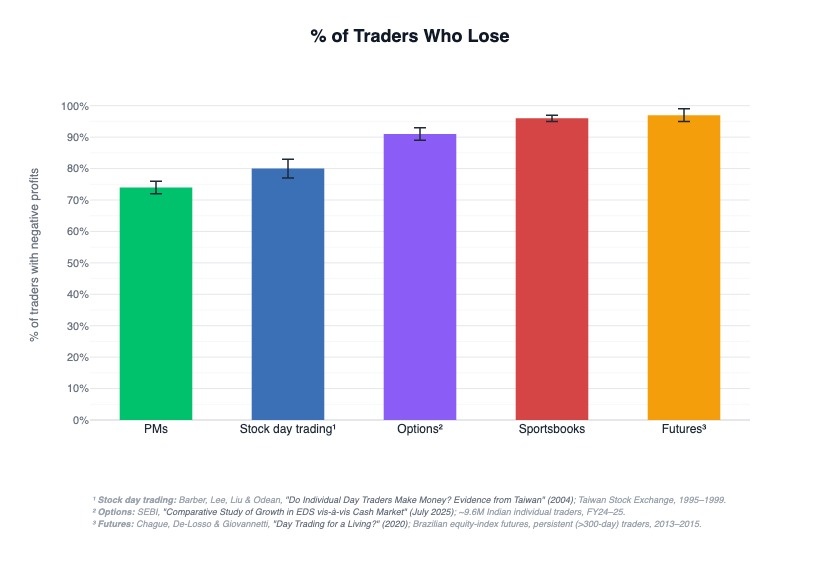
Crucially, Kalshi’s data shows its traders win more often overall than participants in day trading, options, futures, or traditional sportsbooks.
This marks the first time the company has released such figures publicly.
Diana noted that the same wealth concentration patterns appear across many financial markets.
The key difference? When analyzed properly, prediction markets deliver better results for the average participant than alternatives.
The WSJ included these points but framed the story around the high number of losers to keep it attention-grabbing.
Kalshi argues this mirrors how early coverage treated day trading or real estate speculation years ago.
Which Kinds of Traders Make the Most Profit
Not all traders are created equal.
On platforms like Kalshi and similar ones, a clear divide separates casual bettors from sophisticated players.
High-frequency traders who use algorithms, big-data streams, and rapid bid adjustments dominate the winner’s circle.
These pros might place dozens of trades per minute and tweak positions dozens of times per second.
They treat prediction markets like a data-driven edge game rather than pure chance.
Casual users, by contrast, often jump on the first price they see or chase long-shot “yes” contracts priced around 50%.
WSJ analysis of thousands of Kalshi mention markets found these simple bets paid out only about 40% of the time.
That translates to an average 11% loss per wager for retail-style traders who buy at face value, worse than many Vegas slot machines according to University of Nevada research.
Kalshi traders’ profitability. Credit: WSJ.
The profit concentration mirrors broader trends in trading.
Top performers on prediction platforms rely on speed, information advantages, and disciplined strategies.
They avoid emotional bets and focus on mispriced probabilities.
Kalshi’s own analysis reinforces that while the majority of users lose money, the platform’s structure gives more people a fighting chance than day trading does.
Studies on day traders consistently show grim outcomes: roughly 70-97% lose money over time, with only about 1% achieving consistent net profits after fees.
Many quit within months.
Options and futures traders face similar headwinds, with high commissions and leverage amplifying losses for the unprepared.
Sportsbook users, often cited in comparisons, fare even worse on average because of built-in house edges.
Kalshi traders, the data suggests, benefit from a more transparent pricing mechanism and shorter event timelines that reduce overnight risk.
Sports contracts now drive the bulk of activity, offering frequent, data-rich opportunities that reward research over hype.
The Surge in Popularity of Betting Platforms Like Kalshi
Prediction markets have exploded in recent years, fueled by regulatory clarity, mobile apps, and mainstream appeal.
Kalshi, a CFTC-regulated exchange, has led the charge in the United States. Trading volumes have skyrocketed.
In April 2026 alone, Kalshi posted record-taker volume exceeding $5 billion in one dataset and up to $14 billion in broader reports, outpacing rivals like Polymarket.
Sports and exotic combination contracts now account for roughly 80 to 90% of its activity, shifting the platform from politics-heavy roots to a sports-betting powerhouse.
This growth reflects broader trends. Overall prediction market volume across major platforms jumped more than 400% year-over-year in late 2025, with billions traded monthly on events ranging from NBA playoffs to economic indicators.
Young traders, many of whom are former options day traders seeking simpler yes-or-no wagers, have flocked to these sites.
The format feels accessible: no complex derivatives, just clear outcomes resolved quickly.
Investor confidence has followed.
Kalshi recently closed a Series F funding round, raising $1 billion at a $22 billion valuation, led by Coatue Management with participation from Sequoia, Andreessen Horowitz, Paradigm, and others.
This doubles its valuation from $11 billion just months earlier in December 2025 and marks an 11-fold increase from a $2 billion valuation in mid-2025.
Total capital raised now exceeds several billion dollars across rounds. The money is funding product expansion, liquidity improvements, and user acquisition as the platform pushes into more states and event categories.
Competitors have noticed. Robinhood and Coinbase have rolled out their own prediction features, while traditional sportsbooks feel the pressure.
Kalshi’s rise has even dented some sportsbook stocks as bettors migrate to regulated event contracts with potentially better odds and transparency.
Awareness remains relatively low overall, with only about one in five Americans familiar with prediction markets, but usage among active traders has surged dramatically.
Why This Matters for Traders
The data from the WSJ report and Kalshi’s response offer a nuanced view.
Yes, most Kalshi users lose money, just as most day traders do.
But the platform’s internal numbers suggest a meaningful edge: higher win rates relative to stocks, options, futures, and sportsbooks.
Sophisticated, data-driven traders thrive by exploiting inefficiencies, while casual participants must approach with caution and strong risk management.
As these platforms mature, expect tighter regulation, better tools for retail users, and continued innovation in contract design.
Kalshi’s rapid valuation climb and volume records signal that prediction markets are here to stay, blending elements of investing, betting, and information discovery.
For those considering a trade, the lesson is clear: knowledge and discipline separate the few winners from the many who fund the house and the pros.
Whether Kalshi traders truly outperform day traders in the long term will depend on ongoing data, but early evidence suggests that skill pays off more often than in traditional arenas.
The betting world is evolving fast, and smart participants are already positioning themselves ahead of the curve.
Prashant Jha is a seasoned crypto journalist based in Delhi, India, with a Bachelor’s Degree in Computer Science Engineering. Passionate about the evolving world of blockchain and cryptocurrencies, he has been a dedicated voice in the industry since 2018. Prashant’s expertise lies in regulatory reporting, where he unravels complex legal and financial developments with clarity and precision. Before joining CCN in 2024, he honed his craft at Cointelegraph, establishing himself as a trusted name in crypto journalism.
His coverage spans major industry events, including the high-profile collapses of FTX, Three Arrows Capital (3AC), and LUNA, offering readers insightful analyses of their regulatory and market implications. Prashant’s technical background enables him to bridge the gap between intricate blockchain technology and its real-world applications, making his work accessible to novices and experts.
Beyond his professional pursuits, Prashant is an avid music enthusiast, often exploring diverse genres to unwind. A sports lover, he has a particular passion for cricket and frequently engages in discussions about the game. His multifaceted interests and sharp journalistic instincts make him a valuable contributor to CCN, where he continues shaping the crypto landscape's narrative.