How much crypto should you hold? Learn why Charles Schwab warns even small Bitcoin or Ethereum allocations can significantly increase portfolio risk and volatility. | Credit: CCN.com
Share
Key Takeaways
There is no “correct” crypto allocation as the right amount depends on users’ risk tolerance, investment goals, and beliefs about crypto’s future performance.
Small crypto positions can significantly increase portfolio risk due to the extreme volatility of assets like Bitcoin and Ethereum.
Crypto risk contribution is disproportionately high, as even a 1-3% allocation can account for a large share of total portfolio volatility.
Bitcoin may improve portfolio returns, according to Bitwise research, but this comes with higher volatility and drawdown risk.
The question of how much cryptocurrency to hold in an investment portfolio has become one of the most debated topics in modern finance.
As digital assets like Bitcoin and Ethereum have moved from fringe speculation to mainstream consideration, both retail and institutional investors are grappling with a deceptively simple problem: what is the “right” allocation?
Recent research and guidance from Charles Schwab suggest that the answer is far from straightforward. In fact, one of the most important takeaways is counterintuitive; even very small allocations to crypto can have an outsized impact on portfolio risk. At the same time, competing research from firms like Bitwise argues that modest Bitcoin exposure can systematically improve returns.
So which is it? Should investors embrace crypto as a portfolio enhancer, or treat it cautiously as a high-risk satellite allocation?
This article explores both perspectives, unpacking the two primary frameworks for crypto allocation, return-based allocation and risk-based allocation, while highlighting why small positions may matter far more than investors expect.
How Much Crypto Should You Hold in a Portfolio?
One of the most important insights from Schwab’s research is that there is no universal rule for how much crypto an investor should hold. Unlike traditional assets such as stocks and bonds, cryptocurrencies lack long-term valuation anchors, stable cash flows, or widely agreed-upon return expectations.
Instead, allocation decisions depend heavily on individual factors:
A 5% allocation can dominate risk contribution in conservative portfolios.
This leads to a critical distinction:
Allocation size doesn’t mean risk contribution
In traditional portfolios, assets like bonds contribute less risk per dollar invested. Crypto flips this dynamic as it contributes more risk per dollar than almost any other asset class.
Two Proven Strategies for Crypto Portfolio Allocation
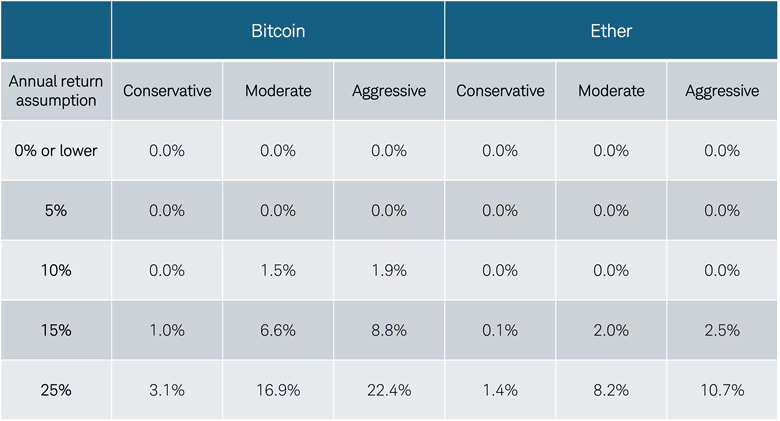
However, if expected returns drop below 10%, Schwab’s analysis suggests that crypto may not warrant any allocation.
This approach is highly sensitive to beliefs:
If one expects 25% returns, allocation could jump to 17%.
If one expects 10% returns, allocation might fall to 1-2%.
In other words, investor opinion determines his allocation more than the data does.
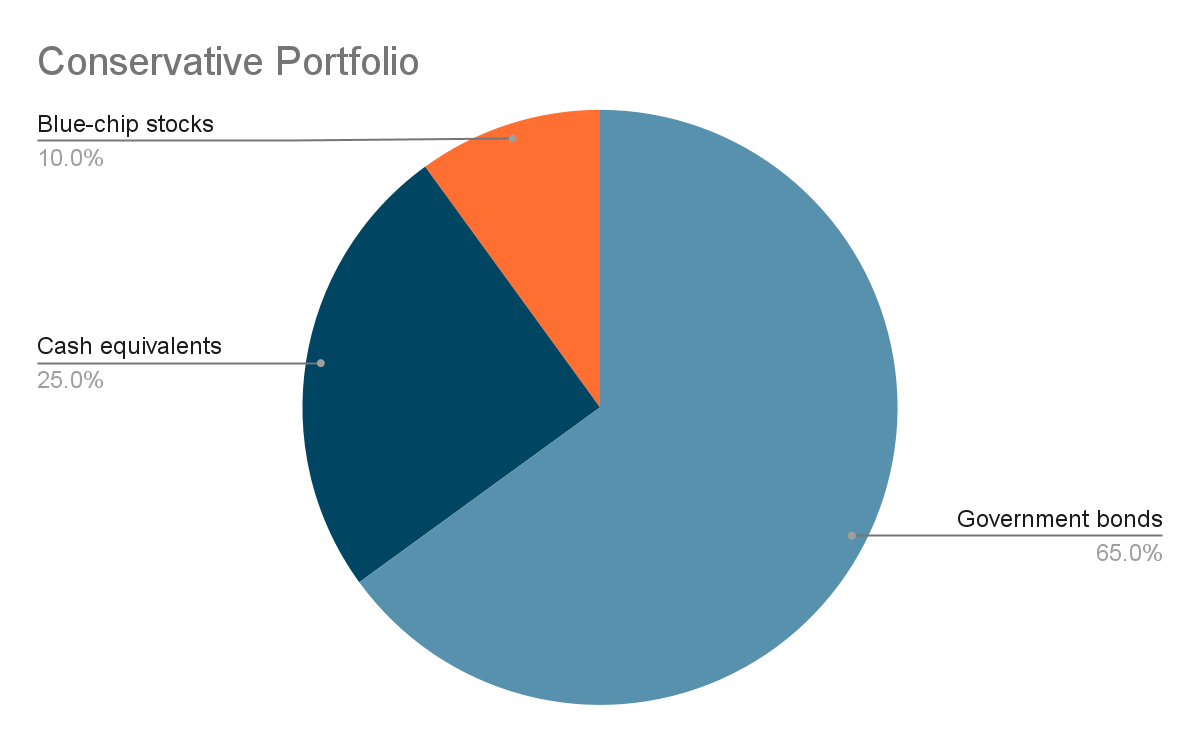
A conservative portfolio allocation example. | Credit: CEX.IO University
2. The Risk-Budgeting Approach
The second method flips the question entirely. Instead of asking: “How much crypto should I hold to maximize returns?” It asks: “How much risk am I willing to take for crypto to contribute?”
This approach focuses on risk contribution, not allocation size.
Example: To limit crypto to 10% of total portfolio risk, Schwab estimates:
Conservative portfolio: 1.2% Bitcoin and 0.9% Ethereum
Moderate portfolio: 2.8% Bitcoin and 2.0% Ethereum
Aggressive portfolio: 4.0% Bitcoin and 2.9% Ethereum
The takeaway is striking: It doesn’t take much crypto to reach meaningful risk exposure.
Return-Based Crypto Allocation: How Expected Returns Shape Your Portfolio
While Schwab emphasizes risk, other research highlights crypto’s potential benefits.
Bitwise CIO Matt Hougan has argued that adding Bitcoin to traditional portfolios can consistently improve returns.
Key findings from Bitwise research include:
100% probability of improved returns over 3-year periods
This doesn’t make them invalid investments, but it does mean they require careful sizing.
Recommended Crypto Allocation: How Much Bitcoin or Ethereum To Own?
There is no single answer, but the research suggests a realistic range.
Based on risk awareness:
0%-1%: Minimal impact, very conservative
1%-3%: Noticeable risk contribution
3%-5%: Meaningful portfolio driver
5% or over: High conviction, high volatility exposure
The key principle is: Focus less on allocation size and more on risk contribution.
Crypto has introduced a new dimension to portfolio construction, one where small positions can have disproportionate effects.
Charles Schwab’s analysis highlights a critical truth: Even tiny allocations to highly volatile assets can reshape portfolio risk.
At the same time, research from firms like Bitwise shows that these same allocations may enhance returns over time.
The real question, then, is not simply how much crypto to hold, but:
How much volatility can one tolerate?
How much downside can one endure?
And how strongly do investors believe in crypto’s long-term role?
For most investors, the answer will likely lie in modest, carefully managed allocations, paired with disciplined rebalancing and a clear understanding of the risks involved.
In crypto investing, size matters, but impact matters more.
There is no universal rule, but most research suggests small allocations (1%-5%) are typical for diversified portfolios. The right amount depends on your risk tolerance, investment goals, and belief in crypto’s long-term potential.
Why can small crypto allocations significantly impact portfolio risk?
Cryptocurrencies like Bitcoin and Ethereum are extremely volatile compared to stocks and bonds. Because of this, even a 1%-3% allocation can contribute a disproportionately large share of total portfolio risk, making them more impactful than their size suggests.
Is Bitcoin a good diversification tool in a portfolio?
Bitcoin has historically shown low correlation with traditional assets, which can improve diversification. Some research suggests it may enhance returns in small allocations, but it also increases volatility and drawdowns.
What is the safest way to add crypto to a portfolio?
A common approach is to start with a small allocation (1%-3%), use regulated investment products where possible, and rebalance regularly. Investors should also ensure they understand custody, security, and tax implications.
Disclaimer:
The information provided in this article is for informational purposes only. It is not intended to be, nor should it be construed as, financial advice. We do not make any warranties regarding the completeness, reliability, or accuracy of this information. All investments involve risk, and past performance does not guarantee future results. We recommend consulting a financial advisor before making any investment decisions.
Giuseppe Ciccomascolo began his career as an investigative journalist in Italy, where he contributed to both local and national newspapers, focusing on various financial sectors.
Upon relocating to London, he worked as an analyst for Fitch's CapitalStructure and later as a Senior Reporter for Alliance News. In 2017, Giuseppe transitioned to covering cryptocurrency-related news, producing documentaries and articles on Bitcoin and other emerging digital currencies. He also played a pivotal role in establishing the academy for a cryptocurrency exchange website. Crypto remained his primary area of interest throughout his tenure as a writer for ThirdFloor.


 Easy
Easy