Bitcoin price is stuck as $24B in options expire. Learn how a gamma flush could break the range and why December 26 is a key turning point. | Credit: CCN.com
Share
Key Takeaways
Bitcoin ETFs are generally considered the most efficient structure for investors in 2025, due to their lower fees, superior liquidity, and tighter tracking of Bitcoin’s spot price.
Digital Asset Trusts (DATs) remain relevant for long-term holders who prefer simple tax reporting and legacy trust frameworks.
A significant 2025 IRS/Treasury ruling now allows both DATs and ETFs to earn staking rewards without losing grantor-trust tax status.
Investors are advised to consider fees, liquidity, NAV tracking, staking mechanics, custody providers, and tax documentation when deciding between DATs and ETFs.
With institutions pouring into crypto, Bitcoin price volatility increasing, and new U.S. crypto regulations reshaping the industry in 2025, investors are asking one core question: Which is better for Bitcoin investing between DATs and ETFs?
Both options allow exposure to Bitcoin without requiring private key management or self-custody, but they differ in terms of fees, liquidity, tax treatment, staking capabilities, and long-term performance.
This article breaks down the most up-to-date crypto investment insights to help investors choose the most efficient structure for today’s rapidly evolving digital asset market.
Understanding DATs vs. Bitcoin ETFs: How They Work, Custody and Taxation
Digital Asset Trusts (DATs) Explained
DATs were the earliest mainstream way to gain exposure to Bitcoin without directly owning BTC. They remain popular among long-term crypto investors.
Key DAT characteristics include:
Structured as grantor trusts offering simplified tax reporting.
Shares represent a direct claim on the Bitcoin held.
Some trades occur at premiums or discounts to NAV, which impacts returns.
The result: yield is no longer a niche feature: it’s a defining competitive edge shaping the next generation of Bitcoin investment products.
What investors must evaluate in yield-bearing Bitcoin products:
Validator selection and decentralization.
Annualized reward expectations.
Slashing risk and reliability.
Withdrawal policies.
Custodial safeguards.
How rewards impact fund NAV.
Which Is Better for Different Bitcoin Investors?
Short-term traders and institutional desks overwhelmingly prefer Bitcoin ETFs. Driven by priorities such as institutional crypto trading, Bitcoin liquidity, and low-fee crypto ETFs, these ETFs offer exactly what these investors need: the deepest liquidity, the lowest fees, tight NAV tracking, and seamless integration into existing portfolios.
Yield-focused investors, on the other hand, now have more choices than ever.
For those seeking crypto yield, Bitcoin staking rewards, and passive crypto income, the decision between a DAT and an ETF depends entirely on the product’s staking strategy. These investors look closely at validator quality, custody standards, reward-sharing policies, slashing protection, and the fees deducted from staking returns.
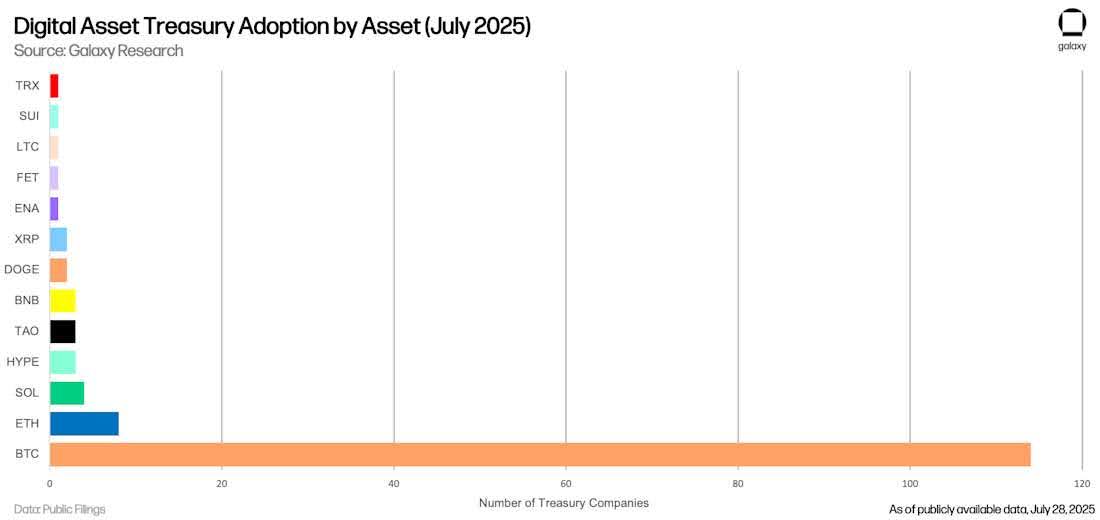
Digital asset treasury adoption by asset. | Credit: Galaxy Research
Long-term buy-and-hold investors take a different approach, often choosing between DATs and ETFs based on crypto tax efficiency and reporting simplicity.
DATs appeal to investors who prefer a traditional trust structure and straightforward annual tax statements. At the same time, ETFs offer lower management fees, better liquidity, and, after the 2025 tax guidance, an increasingly similar tax treatment to trusts.
Ultimately, institutions seeking maximum regulatory clarity continue to rely on ETFs as their primary vehicle for regulated crypto exposure.
For pension funds, banks, insurers, and corporate treasuries, SEC-regulated Bitcoin ETFs remain the gold standard for compliant, large-scale crypto investing.
Each structure has its strengths, and in today’s evolving market, the “best” choice depends entirely on the investor’s goals, risk appetite, and operational needs.
How to Evaluate the Best Bitcoin Investment Products
Investors should evaluate Bitcoin investment products across five key dimensions:
Which Structure Is More Efficient for Bitcoin in 2025 and Beyond?
For most investors, Bitcoin ETFs are generally the more efficient choice. They offer lower fees, higher liquidity, and tight NAV tracking, making them ideal for traders and institutions seeking cost-effective, accurate exposure to Bitcoin.
ETFs also benefit from stronger regulatory oversight and broad institutional adoption, which further enhances confidence and market stability. Emerging capabilities like staking integration now allow ETFs to generate yield, adding another layer of appeal for yield-conscious investors.
However, Digital Asset Trusts (DATs) still have their strengths. Many investors value their familiar trust structure, simple tax reporting, and long-standing presence in the market, making them a natural fit for long-term holders. Following the 2025 IRS guidance, DATs have become competitive in yield generation, narrowing the gap with ETFs and giving long-term investors additional options.
The final verdict: For most investors, especially those searching for terms like “best Bitcoin investment 2025,” “Bitcoin ETFs vs trusts,” or “most efficient crypto investment structure”, Bitcoin ETFs deliver the optimal combination of liquidity, cost efficiency, regulatory clarity, and performance.
At the same time, DATs remain a valuable option for long-term allocators who prioritize simplicity, tax efficiency, and trust familiarity, particularly now that both structures can offer potential staking rewards.
What is the main difference between a Digital Asset Trust (DAT) and a Bitcoin ETF?
A Digital Asset Trust (DAT) is a grantor trust that holds Bitcoin on behalf of investors and trades like a traditional trust. A Bitcoin ETF is a regulated fund that tracks the price of Bitcoin and trades on stock exchanges. The key differences include fees, liquidity, NAV tracking, taxation, and redemption mechanisms, with ETFs generally offering better liquidity and lower costs.
Why do DATs sometimes trade at premiums or discounts to Bitcoin?
DATs lack a real-time creation and redemption mechanism, causing supply and demand imbalances. This can push the share price above (premium) or below (discount) the value of the Bitcoin they hold. ETFs avoid this issue thanks to authorized participants who keep the price aligned with NAV.
Do Bitcoin ETFs have lower fees than DATs?
Yes. Bitcoin ETFs typically have significantly lower management fees, often driven down by competition among major issuers. DATs historically had higher fees due to older structures and limited alternatives.
Do DATs or ETFs have better tax treatment?
Both typically qualify as grantor trusts, meaning investors recognize gains and losses as if they held Bitcoin directly. The recent IRS ruling ensures staking rewards do not jeopardize grantor-trust status for either structure.
Disclaimer:
The information provided in this article is for informational purposes only. It is not intended to be, nor should it be construed as, financial advice. We do not make any warranties regarding the completeness, reliability, or accuracy of this information. All investments involve risk, and past performance does not guarantee future results. We recommend consulting a financial advisor before making any investment decisions.
Giuseppe Ciccomascolo began his career as an investigative journalist in Italy, where he contributed to both local and national newspapers, focusing on various financial sectors.
Upon relocating to London, he worked as an analyst for Fitch's CapitalStructure and later as a Senior Reporter for Alliance News. In 2017, Giuseppe transitioned to covering cryptocurrency-related news, producing documentaries and articles on Bitcoin and other emerging digital currencies. He also played a pivotal role in establishing the academy for a cryptocurrency exchange website. Crypto remained his primary area of interest throughout his tenure as a writer for ThirdFloor.


 Easy
Easy