ChatGPT Reveals Bitcoin’s Next Targets: $74K Breakout or $67K Dip Before CPI Data
Share
Key Takeaways
While Bitcoin is currently stabilizing around $70,000, ChatGPT forecast for the second quarter points toward a breakout.
Fidelity’s backtesting shows that for a traditional 60/40 portfolio, moving from 0% to a 3% allocation in Bitcoin offers the most dramatic improvement in risk-adjusted returns.
The research challenges the traditional view of volatility as purely negative.
While Bitcoin is often called “Digital Gold,” 2026 data shows they are increasingly serving different roles.
As we cross the threshold into the second quarter of 2026, the digital asset environment has shifted from a speculative frontier to a mandatory institutional battleground. For years, the narrative surrounding Bitcoin was defined by “if” and “when.” Today, that has been replaced by a much more pointed question posed by some of the world’s largest asset managers: “Why not?”
With Bitcoin currently oscillating in the $65,000-$70,000 range, the market is at a psychological crossroads. On one side, we have AI-driven forecasts suggesting a massive breakout is imminent; on the other, institutional giants like Fidelity are issuing a clarion call for investors to abandon the safety of a “zero-weight” position.
This article explores the confluence of AI price modeling and institutional research, breaking down why Q2 2026 may be the moment Bitcoin finally detaches from its “alternative” label and cements itself as a portfolio staple.
Fidelity’s Ultimatum: Why ‘Zero’ is the New Risk
For a decade, maintaining a 0% allocation to Bitcoin was the “safe” play for conservative money managers. In early 2026, Fidelity Digital Assets flipped that script. Their latest research, The Question Every Institutional Investor Needs to Answer, suggests that in a world of debased currencies and struggling 60/40 portfolios, a zero-allocation requires a more rigorous defense than a 3% one.
Fidelity’s data highlights a staggering reality: Bitcoin has been the top-performing asset in 11 out of the last 15 years. While its volatility is legendary, its risk-adjusted returns (Sharpe and Sortino ratios) have consistently outperformed traditional equities and bonds over 5- and 10-year horizons.
“The central question is no longer whether bitcoin deserves consideration in a portfolio, but rather: What is your current bitcoin allocation, and why?” Fidelity Digital Assets Research said.
Unlike stocks, which historically “take the escalator up and the elevator down,” Bitcoin often exhibits what Fidelity calls “Good Volatility.” Historical data shows more “fat-tailed” monthly returns to the upside than the downside. For an institutional investor, this means volatility isn’t just risk: it’s an opportunity to harvest gains through disciplined rebalancing.
ChatGPT’s Q2 2026 Outlook: The Road to $150K?
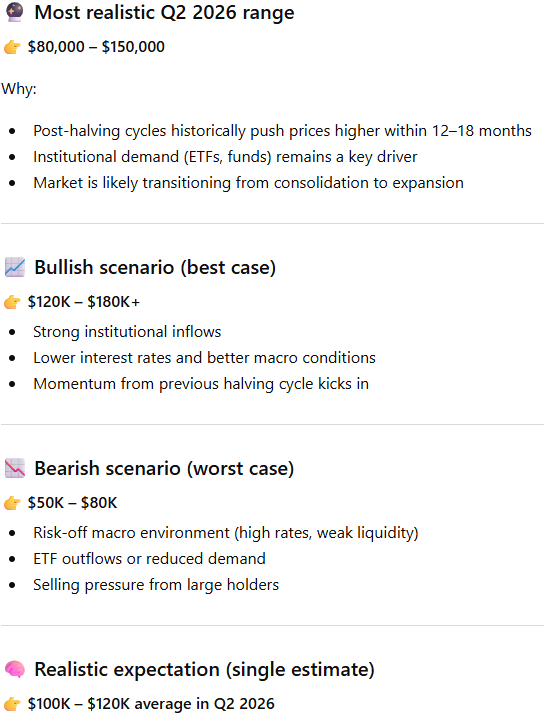
While institutional reports provide the “why,” AI modeling provides the “how much.” According to recent projections from ChatGPT, the baseline for Bitcoin in Q2 2026 suggests a transition from consolidation to aggressive expansion.
ChatGPT forecast on Bitcoin price for the second quarter. | Credit: ChatGPT
The AI analysis suggests that while the $65,000-$90,000 range represents a conservative floor, the true potential for the quarter lies significantly higher.
Scenario
Price Range
Primary Drivers
Realistic Range
$80,000 – $150,000
Post-halving momentum, steady ETF inflows.
Bullish (Best Case)
$120,000 – $180,000+
Lower interest rates, macro liquidity surge.
Bearish (Worst Case)
$50,000 – $80,000
ETF outflows, “risk-off” macro environment.
The AI’s “Realistic Expectation” of $100,000-$120,000 as a Q2 average is rooted in the 2024 halving cycle. Historically, Bitcoin reaches its cycle peak roughly 12 to 18 months after a halving event. As we move through the first half of 2026, we are entering that “sweet spot” where supply scarcity meets peak demand.
Macro Engine: M2 Supply and Monetary Inflation
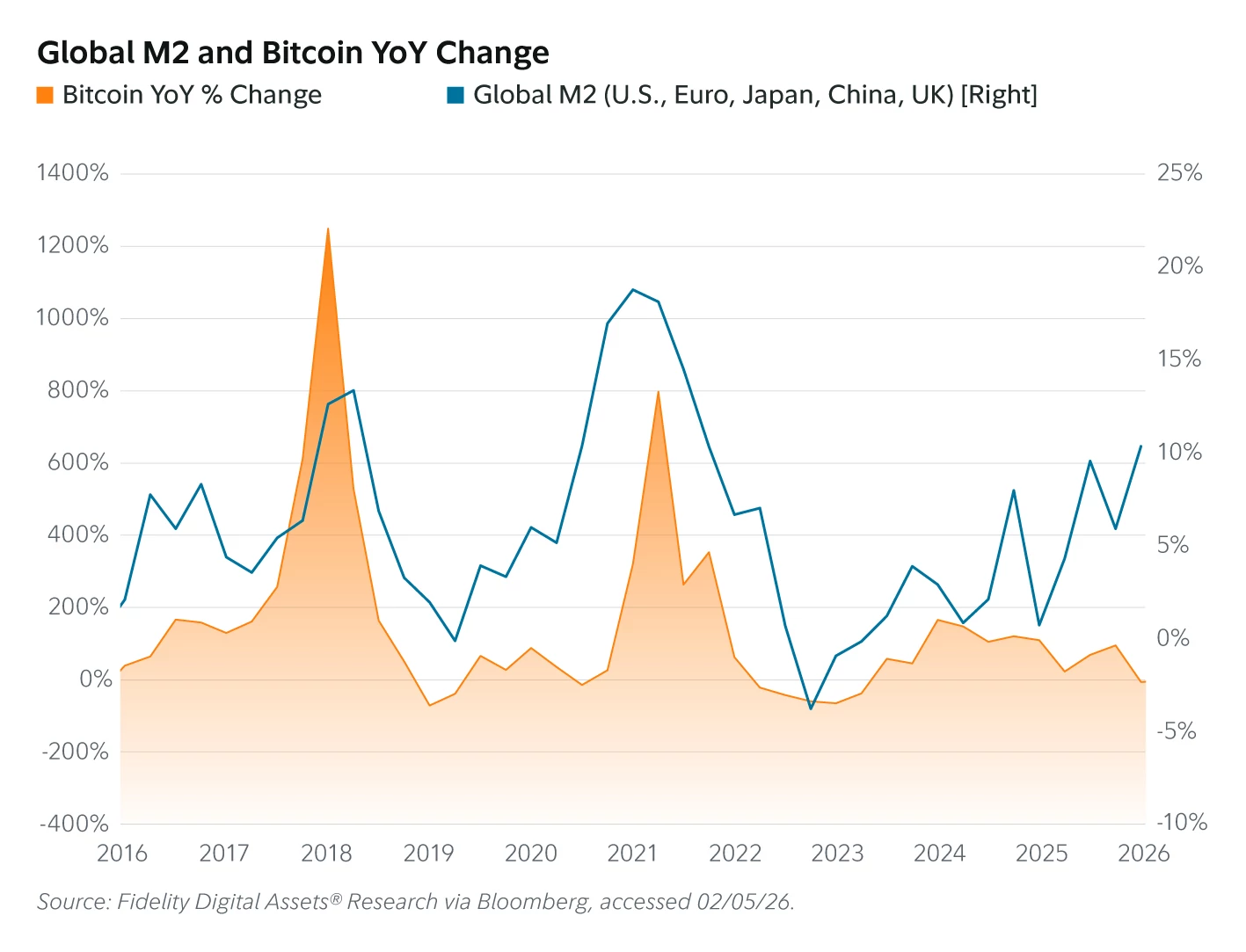
Fidelity’s “Get Off Zero” call isn’t just based on price action; it’s based on the fundamental debasement of fiat currency. Their research found a 0.87 R-squared correlation between Bitcoin’s price and the Global M2 money supply over the last 15 years.
Global M2 and Bitcoin annual change. | Credit: Fidelity via Bloomberg
When the money supply expands (monetary inflation), Bitcoin has historically acted as a sponge for that excess liquidity.
Monetary Inflation: The literal expansion of the money supply.
Asset Price Inflation: The downstream effect where stocks, real estate, and Bitcoin rise in nominal value.
Fidelity argues that because Bitcoin has a hard cap of 21 million, it is the only asset with “absolute scarcity” that can be verified in real-time. Unlike gold, which can be mined more aggressively if prices rise, Bitcoin’s supply schedule is immune to human intervention.
Bitcoin vs. Gold: A Symbiotic Relationship
A common argument for maintaining a zero-allocation to Bitcoin is that “Gold already does that job.” Fidelity’s research challenges this, noting that while both are monetary goods, they are supported by different market participants and exhibit low correlation.
Feature
Gold
Bitcoin
Scarcity
Relative (more can be mined)
Absolute (21 million cap)
Portability
Heavy / Physical
Digital / Instant
Liquidity
High (but slow settlement)
24/7 (instant settlement)
10-Yr Return
Strong
Highest of all assets
Fidelity suggests that adding Bitcoin to a portfolio that already contains Gold can actually enhance risk-adjusted returns because the two assets “take turns” outperforming each other over 90-day periods.
Portfolio Construction: How Much is “Enough”?
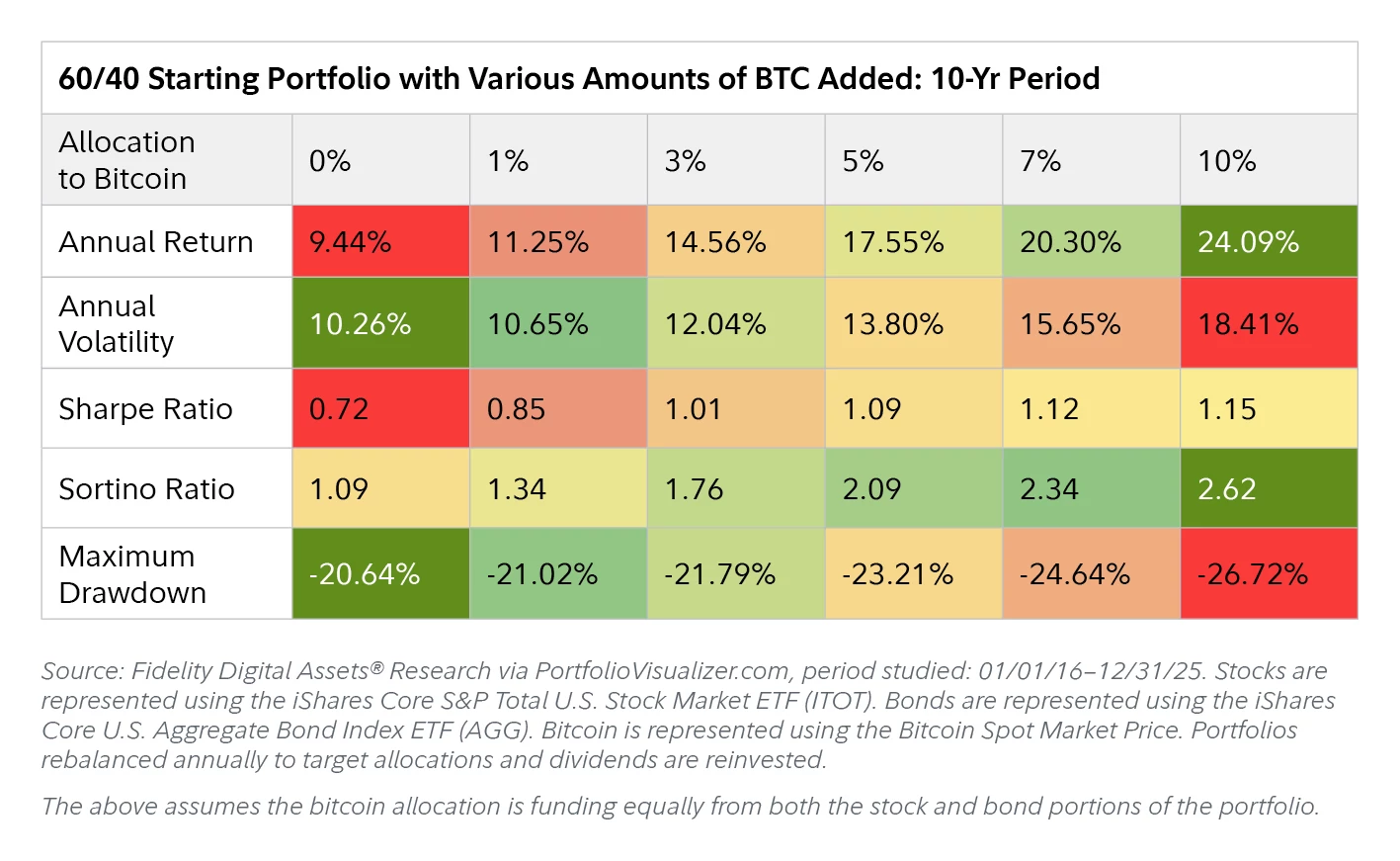
If the goal is to “get off zero,” the next logical hurdle is position sizing. Fidelity’s backtesting of a traditional 60/40 portfolio (60% Stocks, 40% Bonds) reveals that even a tiny “tilt” toward Bitcoin can change the math of a portfolio.
Fidelity found that the most significant improvement in the Sharpe Ratio (a measure of return per unit of risk) occurred when moving from a 0% allocation to a 3% allocation.
Even a tiny “tilt” toward Bitcoin can change the math of a portfolio. | Credit: Fidelity
Surprisingly, the maximum drawdowns for these portfolios did not increase as much as one might expect. This is due to two factors:
Low Correlation: Bitcoin doesn’t always move in lockstep with the S&P 500.
Annual Rebalancing: Selling “high” to return to the target allocation naturally harvests Bitcoin’s volatility and locks in gains.
While many investors pull from their “equity bucket” to fund Bitcoin, Fidelity notes an increasing trend of investors looking to replace a portion of their bond allocation. In an era of low real yields (nominal returns minus inflation), bonds are increasingly seen as a “drag” on portfolios, making Bitcoin’s asymmetric upside more attractive.
“Reality Check”: Volatility is the Feature, Not the Bug
Despite the bullishness of AI and the endorsement of Fidelity, investors must remain grounded. Bitcoin remains a high-velocity asset. As the AI forecast notes, it is entirely possible for Bitcoin to hit $130,000 and drop back to $80,000 within the same quarter.
The “Get Off Zero” thesis is not an invitation to gamble; it is an invitation to evolve. In the eyes of institutional researchers, Bitcoin has matured. It is no longer a venture-capital-style bet on a “maybe” technology; it is a liquidity-sensitive, macro-correlated, digital monetary good.
As we look toward the remainder of Q2, the convergence of AI-predicted price targets ($80,000-$150,000) and institutional mandates (Get Off Zero) creates a powerful tailwind. Bitcoin is no longer fighting for legitimacy; it is fighting for a seat at the head of the table.
For the individual investor or the institutional fund manager, the data suggests that the riskiest allocation in 2026 is no longer Bitcoin: it’s nothing.
“Getting Off Zero” is a call for institutional investors to move away from a 0% Bitcoin allocation. Fidelity argues that because Bitcoin has been the best-performing asset in 11 of the last 15 years, a zero-weight position is no longer the “safe” default. Instead, managers must now provide a data-driven rationale for why they are excluding an asset with such high risk-adjusted returns.
Is Bitcoin still considered a hedge against inflation in 2026?
Yes, but with a nuance. Fidelity distinguishes between Consumer Price Inflation (CPI) and Monetary Inflation (M2). While Bitcoin can be volatile during CPI spikes, it shows a 0.87 correlation with Global M2 money supply growth. In 2026, Bitcoin is viewed less as a “cost of living” hedge and more as a “currency debasement” hedge.
How do ETFs change the price outlook for Q2?
Unlike previous cycles driven by retail “FOMO,” the 2026 outlook is anchored by Spot ETFs. These vehicles provide “continuous liquidity” and a steady bid from institutional “buy-and-hold” programs. ChatGPT notes that sustained ETF inflows are the #1 requirement for hitting the bullish $150K+ targets.
What is the recommended "starter" allocation for a traditional portfolio?
Fidelity’s research points to a 1% to 3% allocation as the “sweet spot.” Moving from 0% to 3% historically provides the most significant boost to a portfolio’s Sharpe Ratio (return per unit of risk) without significantly increasing the “Maximum Drawdown” (the worst-case loss).
Disclaimer:
The information provided in this article is for informational purposes only. It is not intended to be, nor should it be construed as, financial advice. We do not make any warranties regarding the completeness, reliability, or accuracy of this information. All investments involve risk, and past performance does not guarantee future results. We recommend consulting a financial advisor before making any investment decisions.
Giuseppe Ciccomascolo began his career as an investigative journalist in Italy, where he contributed to both local and national newspapers, focusing on various financial sectors.
Upon relocating to London, he worked as an analyst for Fitch's CapitalStructure and later as a Senior Reporter for Alliance News. In 2017, Giuseppe transitioned to covering cryptocurrency-related news, producing documentaries and articles on Bitcoin and other emerging digital currencies. He also played a pivotal role in establishing the academy for a cryptocurrency exchange website. Crypto remained his primary area of interest throughout his tenure as a writer for ThirdFloor.


 Easy
Easy