Enterprise blockchain has spent much of the past decade searching for its breakthrough moment.
After years of pilots, proofs of concept, and industry consortia that struggled to gain traction, distributed ledger technology (DLT) is quietly moving into production environments where it is processing real transactions, powering supply chains, and increasingly becoming part of the infrastructure behind artificial intelligence.
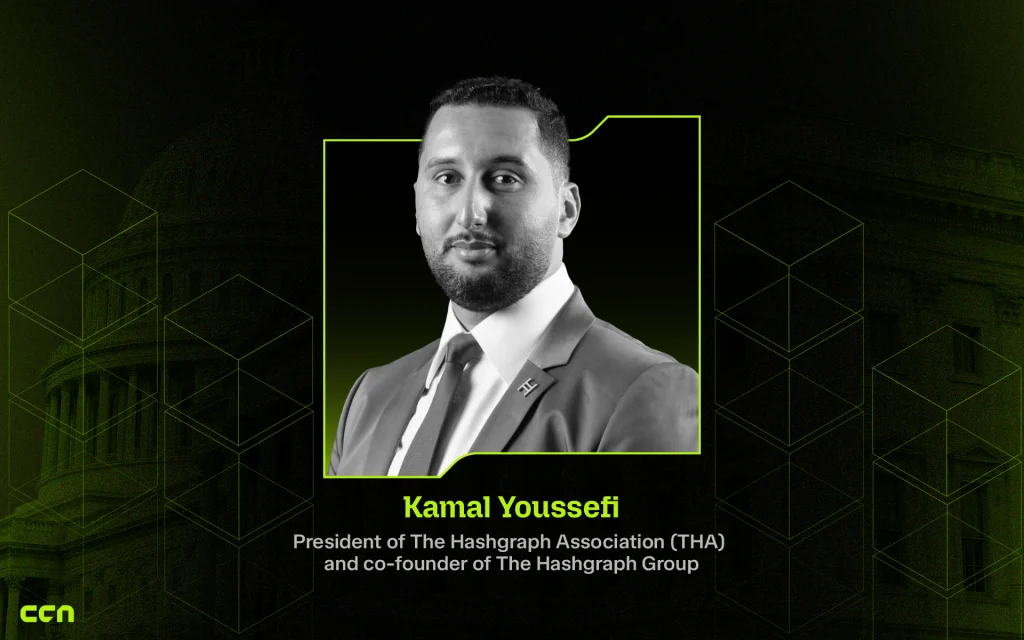
According to Kamal Youssefi, President of The Hashgraph Association, the clearest sign that enterprise adoption has arrived is that users no longer notice the technology at all.
“The clearest sign of mature adoption is when the technology becomes invisible,” Youssefi said. “If you’re still explaining the underlying tech to end users, you haven’t reached production scale.”
From Pilot Projects to Production Infrastructure
That shift is becoming increasingly visible across sectors such as logistics, trade finance, and customs processing, where blockchain infrastructure is being embedded directly into existing enterprise systems rather than operating as standalone experiments.
One example is Teleport, the logistics arm of Capital A Group, which handled 167 million parcels across the Asia-Pacific region last year.
The company is now developing an AI-powered customs documentation platform built on Hedera, a distributed ledger network governed by a council of major global organizations.
The project highlights how enterprise blockchain adoption has evolved. Rather than focusing on cryptocurrency-related use cases, companies are using DLT to address operational challenges that require auditability, compliance, and cross-border coordination.
For enterprises, however, technology alone is rarely enough.
Why Governance Has Become Blockchain’s Competitive Advantage
Youssefi argues that governance and accountability have become the decisive factors separating successful blockchain initiatives from those that failed during the industry’s earlier wave of experimentation between 2017 and 2019.
Many enterprise blockchain projects struggled because governance structures either concentrated power within a single organization or required competing companies to agree on every significant decision. Both models proved difficult to sustain.
Hedera has attempted to solve that problem through its Governing Council, which distributes decision-making authority among organizations spanning technology, consulting, academia, logistics, and manufacturing.
Recent additions such as FedEx and McLaren Racing have further expanded the network’s institutional footprint.
The governance model reflects a broader trend emerging across enterprise DLT adoption: institutions increasingly want infrastructure that combines decentralization with clear accountability.
That balance is becoming even more important as regulators around the world begin introducing formal frameworks for digital assets and tokenized systems.
Regulation Is Finally Becoming an Enabler
For years, regulatory uncertainty discouraged large-scale enterprise adoption. Financial institutions often hesitated to deploy blockchain-based infrastructure because they lacked clarity on how tokenized assets would be classified or whether distributed systems could satisfy compliance obligations.
According to Youssefi, that dynamic is beginning to change.
Jurisdictions including the European Union, United Kingdom, Singapore, and the United Arab Emirates have all introduced regulatory frameworks that provide greater certainty around digital assets and blockchain applications.
As a result, institutions can now evaluate DLT projects against defined legal standards rather than speculation about future enforcement actions.
This shift is particularly benefiting public permissioned networks, where infrastructure operators are known and accountable while retaining many of the transparency benefits associated with distributed ledgers.
Tokenization and Digital Identity Need Legal Foundations
The regulatory shift could have significant implications beyond finance, particularly in areas such as digital identity and tokenization.
Many governments continue to rely on fragmented identity systems and paper-based asset registries that create inefficiencies and increase the risk of fraud. Blockchain-based identity and tokenization platforms could help modernize those systems, but Youssefi argues that legal recognition remains the critical hurdle.
“If a government can’t tell you whether a tokenized land title holds up in court the same way a paper deed does, nobody will use it,” he said.
He also stressed the importance of interoperability, warning that countries risk recreating existing inefficiencies if they develop isolated digital identity systems that cannot communicate across borders.
For tokenization and digital identity to succeed, governments will need common standards, legal clarity, and implementation partners that understand both the technology and regulatory requirements.
AI Is Creating a New Use Case for Distributed Ledgers
While digital identity and tokenization represent major opportunities, Youssefi believes artificial intelligence may ultimately become one of the strongest drivers of distributed ledger adoption.
As AI systems begin making decisions that affect commerce, logistics, and financial services, organizations face growing questions about verification, accountability, and trust.
How can businesses verify that an AI agent is authorized to act? How can regulators audit decisions made by autonomous systems? And how can AI agents transact with one another without relying on centralized intermediaries?
According to Youssefi, distributed ledgers offer a potential solution by creating neutral and immutable records of AI activity.
“When an AI makes a consequential decision, regulators need to reconstruct its reasoning and the data it relied on,” he explained. “An immutable ledger removes the possibility of modifying that record afterward.”
As AI becomes increasingly integrated into enterprise operations, auditability and trust may become just as important as computational performance.
The Rise of Machine-to-Machine Economies
The convergence of AI and blockchain is also laying the foundation for machine-to-machine economies, where autonomous systems conduct transactions without human involvement.
Factories could automatically purchase materials, sensors could sell data directly to AI models, and delivery robots could pay tolls in real time. Supporting those interactions requires infrastructure capable of handling massive transaction volumes at minimal cost and near-instant settlement speeds.
According to Youssefi, traditional payment rails are ill-suited for this future because machine-generated transactions are often extremely small in value but occur at very high frequency.
Infrastructure that can process thousands of low-cost transactions per second while maintaining security and finality could become a critical component of the emerging autonomous economy.
Education and Developer Growth Remain Key Challenges
Despite growing enterprise traction, challenges remain.
Youssefi points to education as one of the industry’s biggest obstacles. Many policymakers and even technical professionals continue to associate distributed ledger technology primarily with cryptocurrency speculation, overlooking its potential as enterprise infrastructure.
Developer adoption presents another challenge. While Hedera has gained significant enterprise interest, its developer ecosystem remains smaller than those of networks such as Ethereum and Solana. Expanding that community will be critical if the industry hopes to unlock the next generation of applications.
After years of hype cycles and false starts, enterprise blockchain may finally be entering a more mature phase. Whether that momentum accelerates could depend less on digital assets and more on the emerging demands of AI, automation, and increasingly interconnected global systems.
As enterprises search for trusted infrastructure capable of supporting autonomous systems and cross-border digital economies, distributed ledger technology may be finding its most compelling use case yet.
The information provided in this article is for informational purposes only. It is not intended to be, nor should it be construed as, financial advice. We do not make any warranties regarding the completeness, reliability, or accuracy of this information. All investments involve risk, and past performance does not guarantee future results. We recommend consulting a financial advisor before making any investment decisions.

Giuseppe Ciccomascolo began his career as an investigative journalist in Italy, where he contributed to both local and national newspapers, focusing on various financial sectors.
Upon relocating to London, he worked as an analyst for Fitch's CapitalStructure and later as a Senior Reporter for Alliance News. In 2017, Giuseppe transitioned to covering cryptocurrency-related news, producing documentaries and articles on Bitcoin and other emerging digital currencies. He also played a pivotal role in establishing the academy for a cryptocurrency exchange website. Crypto remained his primary area of interest throughout his tenure as a writer for ThirdFloor.


 Easy
Easy