Meet the Top 101 in Crypto
Interview
Complexity Icon Easy
6 min read

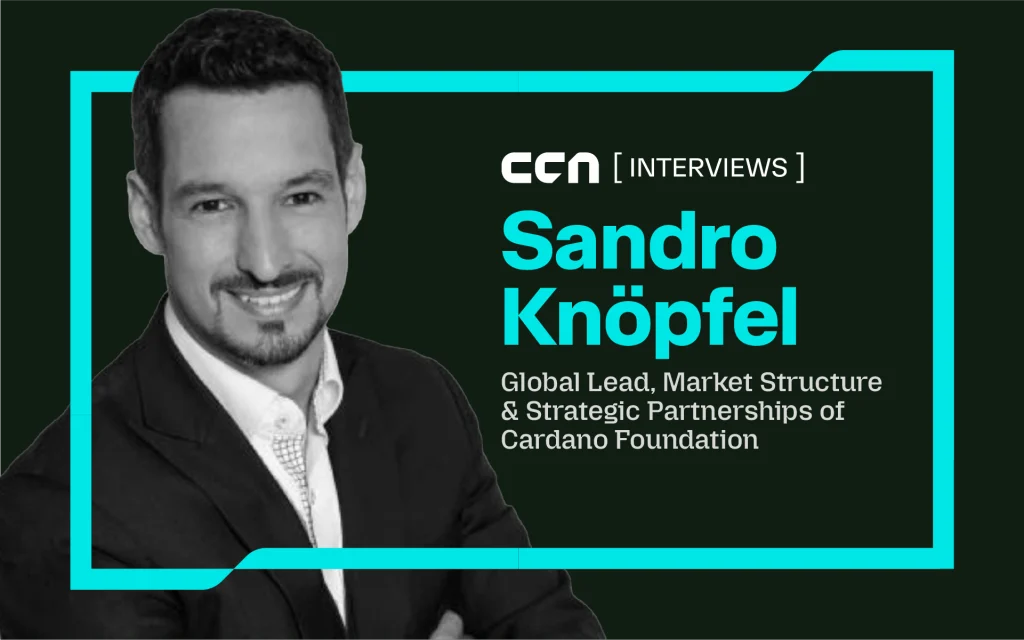
Cardano Foundation’s Sandro Knöpfel Says Tokenized Finance Will Succeed When Blockchain Becomes Invisible

Published 25 May 2026
Giuseppe Ciccomascolo
Authors

As tokenization narratives dominate institutional crypto conversations, the race to bring real-world assets (RWAs) on-chain is increasingly framed as a battle over scale, regulation, and infrastructure.

Yet according to Sandro Knöpfel, Global Lead Market Structure and Strategic Partnerships at the Cardano Foundation, the industry is still focusing too heavily on blockchain technology itself instead of the operational realities institutions face when integrating tokenized assets into existing financial systems.

Speaking with CCN, Knöpfel argued that the next phase of tokenized finance will not be won by the most technically advanced protocol alone, but by platforms capable of embedding blockchain infrastructure into global capital markets without disrupting the regulatory and operational standards institutions already depend on.

The Real Bottleneck Isn’t Technology

While projections for tokenized RWAs reaching multi-trillion-dollar valuations continue to fuel optimism across the crypto sector, Knöpfel believes people often misunderstand the core challenge.

“The technology side has matured quite heavily,” he said. “The bigger question is integration.”

According to Knöpfel, tokenized assets cannot simply exist as blockchain-native products detached from traditional financial infrastructure. Every tokenized security or financial instrument carries legal rights, liabilities, compliance obligations, and lifecycle requirements that must align with existing market systems.

That creates a far more complicated challenge than simply putting assets on-chain.

“How can we bring tokenized assets into existing systems while considering the entire lifecycle of a product?” Knöpfel asked. “That’s one of the biggest challenges institutions face today.”

His comments reflect a broader institutional shift away from speculative tokenization narratives toward infrastructure-focused discussions around settlement, custody, governance, interoperability, and regulatory accountability.

Why the US Remains Central to Tokenization

Knöpfel also pushed back against narratives suggesting the United States risks falling behind in tokenized finance.

Despite years of regulatory uncertainty, he believes the US remains structurally dominant because of its position at the center of global capital markets.

“The US always had a special standing in the global economy,” he said. “It has capital market dominance.”

Recent regulatory developments are reinforcing that position. Knöpfel pointed specifically to the SEC’s non-action relief involving the DTCC, describing it as a strong signal for institutional tokenization efforts.

For Knöpfel, the importance of institutions like DTCC cannot be overstated.

“When you have the engine room of financial markets involved, it enables a very big move in the US,” he said.

Rather than treating tokenization as a parallel system competing with Wall Street, Knöpfel argues that blockchain is steadily moving into the infrastructure layer of traditional finance.

Europe’s Regulatory Model May Not Be a Weakness

The growing divergence between Europe’s regulatory-heavy approach and the more market-driven US model has sparked debate across the crypto industry, with critics arguing that excessive regulation risks slowing innovation.

Knöpfel disagrees with the idea that Europe’s regulatory clarity is inherently a disadvantage.

Instead, he sees the US and EU models as complementary.

The United States, he argued, benefits from a historically innovation-first culture that accelerated the rise of Silicon Valley and large-scale technology ecosystems. Europe, meanwhile, provides stronger institutional trust frameworks that appeal to traditional financial players.

“You need both,” he said. “You need innovation-driven environments, but also trust and regulatory certainty for institutional adoption.”

Ultimately, Knöpfel expects both approaches to converge into more globalized standards for tokenized finance.

“If we believe in global infrastructure, we also need to think in terms of global frameworks,” he said.

Institutions Focus on Governance and Reliability

As blockchain adoption moves deeper into institutional finance, the nature of risk assessment is also changing.

The Cardano Foundation recently contributed to a capital markets risk mitigation framework alongside traditional financial market infrastructure firms. It worked with DTCC, Euroclear, and Clearstream.

Knöpfel said institutions evaluating blockchain infrastructure now focus heavily on governance risk, operational resilience, predictability, and third-party dependencies.

“In public permissionless blockchains, you don’t have the SLAs institutions are used to,” he explained.

That creates new questions around accountability, network reliability, consensus mechanisms, and long-term governance structures.

The shift represents a major evolution from earlier crypto market cycles, where speed, experimentation, and speculative growth often outweighed concerns around formal governance and institutional-grade reliability.

Cardano’s Long-Term Approach Is Gaining Recognition

Cardano has historically differentiated itself through its emphasis on formal methods, peer-reviewed research, and long-term infrastructure development. It’s an approach critics previously argued came at the expense of speed and ecosystem growth.

Knöpfel believes the market environment is now changing in Cardano’s favor.

“Hype used to heavily drive the past,” he said. “Now predictability and reliability are becoming much more important.”

He pointed to Cardano’s work around auditability and verifiable legal entity identifiers (vLEIs). This includes on-chain attestations involving auditing firm Grant Thornton, as examples of the type of infrastructure institutions increasingly value.

“If you are not auditable and predictable, it becomes very difficult for institutions to integrate,” he said.

As institutional participation expands, Knöpfel expects resilient and compliance-friendly blockchain infrastructure to attract more attention than speculative narratives alone.

Blockchain’s Endgame May Be Invisibility

Perhaps Knöpfel’s most notable observation centered on what true blockchain adoption may ultimately look like.

For him, success will arrive not when blockchain dominates headlines, but when users stop talking about it entirely.

“Blockchain succeeds when it becomes invisible infrastructure,” he said.

Rather than existing as a standalone industry, Knöpfel envisions blockchain operating quietly beneath financial systems, AI networks, identity frameworks, and payment rails. This is similar to how internet protocols underpin modern applications without users actively noticing them.

He pointed to emerging Cardano projects integrating blockchain with AI systems. Here, blockchain functions as a trust and identity layer while remaining largely invisible to end users.

“You can deploy AI agents with identity, verifiable credentials, and payment rails,” he said. “But users don’t see the blockchain itself.”

That, according to Knöpfel, is what mainstream adoption will ultimately look like. Not a world where blockchain replaces traditional finance. But one where it becomes embedded deeply enough into financial infrastructure that users no longer distinguish it from the systems it powers.

Disclaimer: The information provided in this article is for informational purposes only. It is not intended to be, nor should it be construed as, financial advice. We do not make any warranties regarding the completeness, reliability, or accuracy of this information. All investments involve risk, and past performance does not guarantee future results. We recommend consulting a financial advisor before making any investment decisions.
Giuseppe Ciccomascolo

Giuseppe Ciccomascolo began his career as an investigative journalist in Italy, where he contributed to both local and national newspapers, focusing on various financial sectors.

Upon relocating to London, he worked as an analyst for Fitch's CapitalStructure and later as a Senior Reporter for Alliance News. In 2017, Giuseppe transitioned to covering cryptocurrency-related news, producing documentaries and articles on Bitcoin and other emerging digital currencies. He also played a pivotal role in establishing the academy for a cryptocurrency exchange website. Crypto remained his primary area of interest throughout his tenure as a writer for ThirdFloor.

Survey Icon
Help us improve
1 of 4
Is this your first time here?
What brought you here today?
What are you most interested in?
Would you be interested in:
Thank you icon
Thank you for your feedback!
DMCA.com Protection Status