Grayscale Files for First US Spot Zcash ETF - Will ZEC Hit $1,000? ChatGPT Thinks So
Share
Key Takeaways
Grayscale’s Zcash ETF filing signals mainstream acceptance of privacy-focused cryptocurrencies and could boost institutional interest in ZEC.
Zcash’s 2025 milestones strengthened investor confidence, with VanEck recognition, exchange relistings, and rising shielded transaction use.
ZEC could target $1,000 if ETF demand grows, but volatility and regulatory scrutiny remain key risks.
Privacy coins are entering a new era, balancing confidentiality with compliance as the crypto market matures.
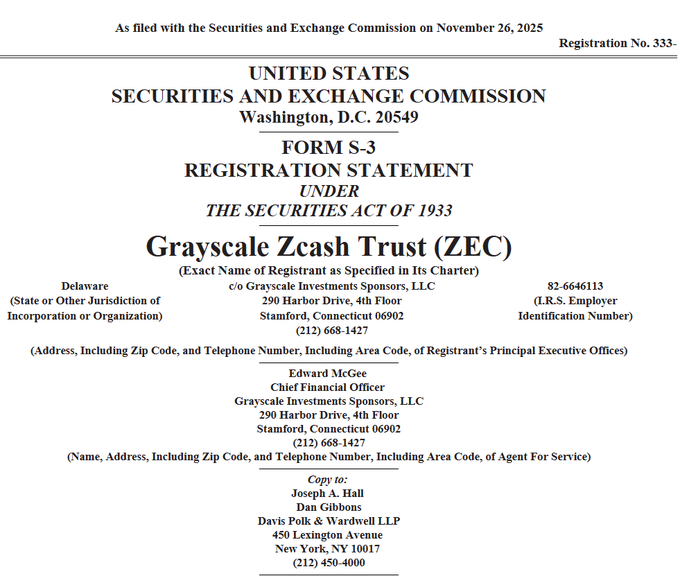
On November 26, 2025, Grayscale Investments formally filed with the U.S. Securities and Exchange Commission (SEC) to convert its existing Zcash Trust into a spot ETF.
What might have looked like just another regulatory form was actually a defining moment, signaling that privacy-focused cryptocurrency Zcash (ZEC) could be stepping out of the shadows and onto Wall Street’s main stage.
Grayscale filed for launching the first ZEC ETPs. | Source: @CraigSalm on X.
Try Our Recommended Crypto Exchanges
Sponsored
Disclosure
We sometimes use affiliate links in our content, when clicking on those we might receive a commission at no extra cost to you. By using this website you agree to our terms and conditions and privacy policy.
For years, Zcash (ticker: ZEC) has lived in Bitcoin’s shadow – a clever, technically advanced project, but rarely in the headlines. Its core idea was bold: a blockchain that gives you the option to keep your transactions private through zero-knowledge cryptography, rather than exposing everything for the world to see.
But privacy coins were never regulators’ favorite. They were labeled as “risky,” “opaque,” even “dangerous.” That reputation kept many institutions far away.
So Grayscale’s ETF filing changes everything. It’s not just about listing another crypto, it’s about bringing a privacy coin into the regulated, institutional world. It’s a message that privacy and compliance don’t have to be enemies anymore.
Zcash Was Already Gaining Ground — 2025’s Milestones That Mattered
Before the ETF filing, Zcash had quietly been racking up several wins in 2025 that altered its trajectory, suggesting this moment is more than hype, but part of a broader shift.
On-chain privacy adoption: Zcash’s recent upgrades and structural improvements have significantly increased the share of “shielded” (privacy-enabled) ZEC in circulation. As of late 2025, a substantial portion of all ZEC transactions are happening through these shielded pools, proof that privacy on Zcash isn’t just a tagline, it’s being actively used.
Exchange relistings and renewed liquidity: After years of being quietly sidelined, several major exchanges have re-listed ZEC or announced plans to do so. Each new listing has boosted trading volume and accessibility. In fact, one relisting alone triggered a rapid rally as traders and funds rushed to regain exposure.
Changing regulatory and institutional context: Around the world, privacy concerns are back in the spotlight, from corporate data leaks to national surveillance debates. Within that environment, Zcash’s optional-privacy and compliance-compatible model has started to look like the perfect middle ground: a “privacy-plus-legitimacy” framework that institutions can live with.
According to Calvin Ayre, there is room for both privacy coins and transparent networks in the crypto ecosystem, but he questions the need for most people to embrace what he calls the “give me anonymity or give me death” mentality.
He points out that VanEck’s CEO Jan van Eck recently suggested Bitcoin’s price decline might be linked to users seeking “the better privacy of Zcash,” yet, ironically, ZEC itself also fell and has only partially recovered.
Ayre acknowledges that privacy-focused assets can serve an important role, particularly for individuals living under repressive regimes, but he believes that widespread blockchain adoption will depend on regulation and transparency. In his words, those who refuse to accept oversight “will remain on the fringes” and he wants no part of that.
From Whispers to a Roar: Could Zcash (ZEC) Actually Hit $1,000?
ZEC had already been quietly heating up this year, climbing more than 1,000% in 2025 before this ETF bombshell even dropped. Investors who’d written it off as a relic suddenly found themselves dusting off old wallets.
Traders love a good story, and this one had all the ingredients: scarcity (ZEC’s halving cycle is tightening supply), a powerful narrative (privacy is back in fashion), and now, a blue-chip sponsor giving it legitimacy.
The whispers turned to roars: Could Zcash actually hit $1,000?
Why Zcash (ZEC) Reaching $1,000 Doesn’t Sound So Crazy — But Still Might Be
Let’s break that down.
As of Nov. 27, 2025, ZEC trades around the $500 mark, already an eye-popping rebound from where it was a year ago. If institutional money starts flowing in through an ETF, it’s not impossible to imagine a doubling of price. The ETF opens the door to hedge funds, retirement accounts, and big investors who would never touch a cold wallet or a DeFi exchange.
And Zcash has something unique to offer: controlled privacy, the ability to transact publicly or privately, as needed. In a world where data breaches, financial surveillance, and digital-ID laws are on the rise, that flexibility suddenly looks like a feature, not a bug.
But, and this is a big “but,” markets don’t climb in straight lines. Every crypto bull run has its corrections, and ZEC’s rise has already been spectacular. There’s a good chance investors will see pullbacks, maybe even harsh ones, before any new all-time highs.
So yes, $1,000 ZEC is possible. But it’ll be a volatile road getting there.
Bigger Picture: What Zcash’s Rise Means for Crypto
This isn’t just a Zcash story. It’s a turning point for how privacy coins are perceived in mainstream finance.
If the SEC gives the green light to a ZEC ETF, it will signal that the line between “privacy coin” and “regulatory compliance” is softening. That could open the door for similar products tied to Monero, Dash, or future privacy-layer protocols.
In short: the taboo around privacy in crypto may finally be fading.
And Grayscale, the same firm that helped push Bitcoin and Ethereum ETFs into the mainstream, could once again be the one leading the charge.
November 2025: Bitcoin vs Zcash – A Tale of Two Cryptos
As November 2025 comes to an end, the contrast between Bitcoin (BTC) and Zcash (ZEC) is striking. One is consolidating after a long rally, while the other is surging on renewed attention, institutional recognition, and ETF momentum.
Bitcoin (BTC): The Calm Giant
Bitcoin traded mostly between $88,000 and $89,000 throughout November. After a strong year, the world’s largest cryptocurrency entered a period of consolidation with a moderate 30 to 35 percent correction from its October highs. Investors focused on profit-taking while watching for new economic and policy signals.
Despite the cooldown, Bitcoin remains the benchmark of the crypto market. Its dominance is still above 45 percent, and most analysts consider the pullback to be a healthy pause. In other words, Bitcoin is steady and resilient, not weak.
Zcash (ZEC): The Volatile Challenger
While Bitcoin slowed down, Zcash (ZEC) became one of the standout performers of November. The privacy-focused cryptocurrency started the month near $410, climbed past $700, and briefly reached $740 before settling near $500 to $520 toward the end of the month.
This represents a massive monthly gain compared with most major digital assets. Traders pointed to the combination of scarcity, strong narrative, and speculative demand as the main drivers behind the surge.
BTC vs ZEC: The Story Behind the Numbers
The performance difference between the two coins highlights a key point about market behavior. Bitcoin, as the mature and widely adopted cryptocurrency, is moving in a controlled and predictable pattern. Zcash, on the other hand, is showing high volatility, which reflects both growing excitement and increased risk.
This comparison also signals a shift in investor interest. Bitcoin continues to represent stability and long-term value. Zcash, however, is becoming the symbol of innovation and the growing demand for privacy in digital finance. As regulatory clarity improves and ETF products move closer to approval, ZEC is finding new relevance among serious investors.
What This Means for Investors
November 2025 paints a clear picture of how the crypto landscape is evolving. Bitcoin remains the standard for digital value and institutional trust. Zcash, meanwhile, is proving that privacy-driven assets can capture market attention and deliver major gains.
For investors, this month showed two sides of the same ecosystem. Bitcoin offers stability and maturity. Zcash offers speed, innovation, and a glimpse of the next phase of cryptocurrency adoption.
ChatGPT’s Take: The Privacy Renaissance
According to ChatGPT, Zcash has always been one of those projects that was ahead of its time. It built world-class cryptography before most of the market even knew what “zero-knowledge proofs” meant. But timing matters in crypto and now, finally, the world might be ready for what ZEC offers.
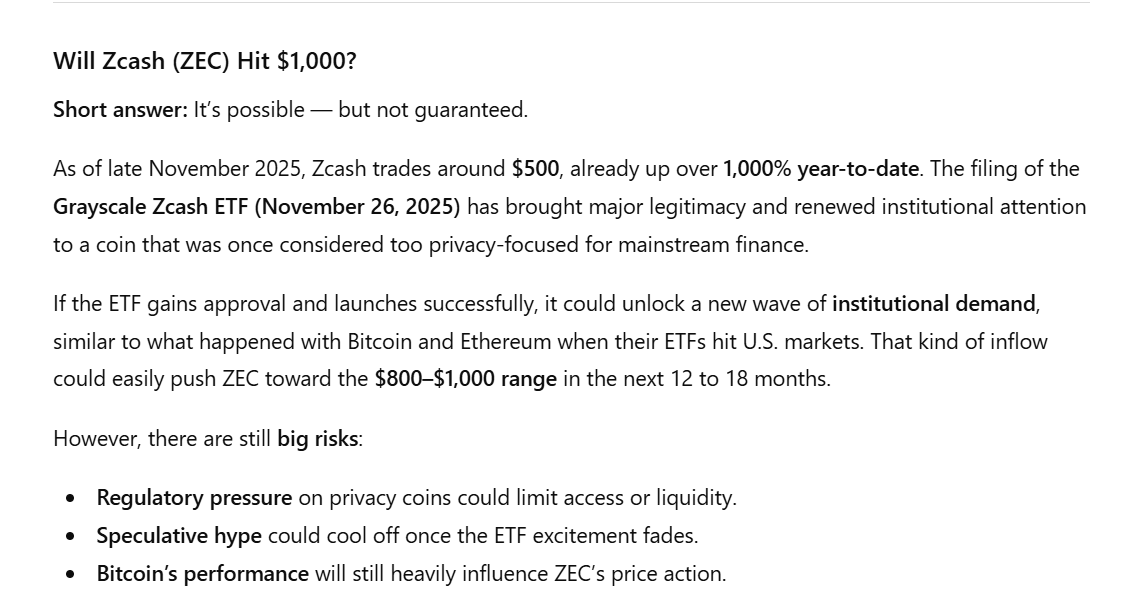
According to ChatGPT, Zcash has a realistic shot at reaching $1,000 within 18 months. | Source: ChatGPT
If this ETF gets approved, ChatGPT sees two likely outcomes:
Short-term hype, where ZEC spikes wildly, fueled by excitement and speculative FOMO.
Long-term legitimacy, as institutional investors quietly accumulate and treat ZEC not as a meme coin, but as a serious digital asset with real privacy utility.
Will it hit $1,000? Possibly, but not overnight. ChtaGPT called it a 12- to 18-month horizon, assuming regulatory clarity, strong ETF demand, and continued narrative support for privacy in digital finance.
But even if it never hits that round number, this moment, Grayscale’s filing, marks something bigger: a cultural shift. Privacy in crypto is no longer something to hide; it’s becoming something to invest in.
And that’s a story worth paying attention to.
Investing in Crypto: The Rewards Are High, But So Are the Risks
Investing in cryptocurrencies like Zcash (ZEC) offers exciting opportunities, especially when major institutional moves, such as Grayscale’s ETF filing, bring new legitimacy to the space. However, every potential reward comes with risk, and crypto remains one of the most volatile asset classes on earth.
Unlike traditional markets, crypto assets trade around the clock and are influenced by a mix of speculation, sentiment, and regulation. A single policy change, exchange hack, or market rumor can send prices soaring or crashing overnight. Even with ETF approval or institutional backing, investors should remember that volatility is inherent to the nature of digital assets.
Another key risk lies in regulatory uncertainty. Privacy coins, in particular, sit at the intersection of innovation and scrutiny. Governments are still figuring out how to balance user privacy with the need to prevent money laundering and illicit finance. Future regulations could either open the door wider for assets like ZEC or restrict them entirely.
Then there’s the technological risk. Cryptocurrencies rely on open-source code and community governance. Network vulnerabilities, forks, or technical bugs can impact both prices and investor confidence.
The golden rule for any crypto investor still applies: Never invest more than you can afford to lose, and always do your own research.
Long-term investors should view crypto exposure as one part of a diversified portfolio, not a replacement for traditional investments. The rise of Zcash and the push for regulated privacy ETFs show that the market is maturing, but it’s still a young, unpredictable frontier.
The Grayscale Zcash ETF is a proposed exchange-traded fund that would allow investors to gain regulated exposure to Zcash (ZEC) through traditional financial markets. Instead of buying and storing ZEC directly, investors could purchase ETF shares that represent holdings of the underlying cryptocurrency.
Why is the ETF filing significant for Zcash?
The ETF filing marks a major step toward institutional acceptance of privacy-focused assets. It shows that regulators and large financial institutions are beginning to see privacy coins like Zcash as legitimate investments rather than unregulated risks.
Could Zcash (ZEC) actually reach $1,000?
While ZEC has already risen over 1,000% in 2025, reaching $1,000 would likely depend on sustained institutional demand, ETF approval, and broader adoption of its privacy features. Market volatility means it is possible, but not guaranteed.
How does Zcash differ from Bitcoin?
Zcash and Bitcoin share similar proof-of-work foundations, but Zcash offers optional privacy through zero-knowledge proofs. This allows users to choose between transparent and shielded transactions, balancing privacy and regulatory compliance.
Disclaimer:
The information provided in this article is for informational purposes only. It is not intended to be, nor should it be construed as, financial advice. We do not make any warranties regarding the completeness, reliability, or accuracy of this information. All investments involve risk, and past performance does not guarantee future results. We recommend consulting a financial advisor before making any investment decisions.
Giuseppe Ciccomascolo began his career as an investigative journalist in Italy, where he contributed to both local and national newspapers, focusing on various financial sectors.
Upon relocating to London, he worked as an analyst for Fitch's CapitalStructure and later as a Senior Reporter for Alliance News. In 2017, Giuseppe transitioned to covering cryptocurrency-related news, producing documentaries and articles on Bitcoin and other emerging digital currencies. He also played a pivotal role in establishing the academy for a cryptocurrency exchange website. Crypto remained his primary area of interest throughout his tenure as a writer for ThirdFloor.


 Easy
Easy