cashZ Explained: New Zcash Wallet From Cryptographers Who Exited Electric Coin Company
Share
Key Takeaways
Zcash architecture offers stronger present-day quantum resilience than Bitcoin and ETH.
Cypherpunk’s multimillion-dollar purchase reinforces institutional interest in the ZEC coin.
Analysis shows an inverse head-and-shoulders pattern, with targets raised toward $1,020.
For several months, privacy has become one of the most prominent narratives in the crypto ecosystem, with Zcash (ZEC) positioned at the forefront of the movement.
The focus on encrypted transactions and zero-knowledge technologies has pushed privacy coins back into mainstream discussion.
As a result, ZEC, Dash (DASH), and Monero (XMR) have outperformed many other cryptos.
At the same time, quantum computing has emerged as another central theme. In this case, the model is increasingly keeping Bitcoin (BTC) and, more recently, Ethereum (ETH) maximalists on alert.
While actual quantum threats may still be years away, the conversation has intensified. However, there have been claims that Zcash is positioning itself as one of the few networks actively preparing for that era.
However, with its advanced privacy technology, Zcash addresses today’s quantum risks. What does this imply for the future price of ZEC?
How Quantum Computing Threatens Crypto
Quantum computing isn’t a huge problem yet. But once it reaches sufficient scale, it could undermine the cryptographic foundations of nearly every major blockchain.
Most networks today, including Bitcoin, Ethereum, and numerous others, utilize public-key cryptography systems such as ECDSA and SHA-256.
Quantum algorithms such as Shor’s algorithm could eventually break these systems, allowing attackers to forge signatures, steal funds, or manipulate transactions.
Get These Top Crypto Casino Offers Now!
Sponsored
Disclosure
We sometimes use affiliate links in our content, when clicking on those we might receive a commission at no extra cost to you. By using this website you agree to our terms and conditions and privacy policy.
In essence, quantum computers could compromise the very trust layer that blockchains rely on.
A significant concern is that older adults are especially vulnerable. Any blockchain address that has ever broadcast a transaction has already revealed its public key, making it a future target. This includes:
Because their public keys are already visible on-chain, quantum attackers would need less effort to derive private keys and take control of those funds.
Shifting the entire ecosystem to quantum-safe cryptography is possible, but it is a dauntingly challenging task. It requires:
New quantum-resistant signature schemes
Hard forks across major networks
Wallet and key migrations
Broad coordination among developers, miners, validators, wallet providers, and exchanges
For systems as large and decentralized as Bitcoin and Ethereum, these changes are slow, complex, and potentially risky.
Yet without them, the long-term security of modern blockchains could be fundamentally at risk from future quantum breakthroughs.
But how does Zcash try to escape all of this?
Zcash Tries to Stay Ahead
Zcash is widely regarded as a privacy coin. However, its design also provides it with stronger cryptographic protection than many mainstream blockchains.
Using zk-SNARKs, shielded addresses, and zero-knowledge proofs, Zcash hides critical transaction data, making it more resistant to quantum-era attacks than chains like Bitcoin or Ethereum, where public keys are exposed once a transaction is sent.
Interestingly, Ethereum co-founder Vitalik Buterin admitted to this earlier this week. His statement drove some notable personalities to highlight how the Zcash coin is ahead.
One of those who did that is Mert Mumtaz, CEO of Solana-based Helius. For context, Mumtaz has been at the forefront of shilling ZEC before its price went parabolic.
“Zcash privacy quantum resistant between” The Helius CEO posted on X.
Furthermore, this advantage appears to be one of the key reasons Zcash has emerged as the highest-valued privacy coin by market cap.
For most of the third quarter, Monero held the top position. However, shifting market sentiment, partly driven by Zcash’s perceived quantum resilience, has altered things.
As of today, ZEC’s market cap stands at $10.96 billion, significantly higher than XMR’s $6.77 billion.
This reversal highlights the shift in the market confidence toward Zcash, particularly as discussions about quantum security and advanced cryptographic readiness intensify.
Shielded transactions hide public keys, preventing attackers from pre-scanning addresses.
Quantum adversaries cannot easily target ZEC accounts, since crucial data stays encrypted.
The protocol aligns better with current quantum threat models than BTC or ETH.
Active research is already exploring post-quantum proof systems for future upgrades.
These features place Zcash ahead of major chains in terms of present-day quantum security. However, there are still areas where Zcash is not quantum-resistant.
Where the Coin Is Not Quantum-Proof
Despite its strengths, Zcash is not fully protected against long-term quantum advances:
Zk-SNARKs rely on cryptographic assumptions that powerful quantum computers may eventually be able to break.
Unshielded Zcash addresses still expose public keys, similar to other blockchains.
Post-quantum signature schemes are not yet implemented in the protocol.
Even today’s “quantum-resistant” designs may fail against future-generation quantum machines.
Developers Reveal Long-Term Plan
Despite these rising risks, Sean Bowe, one of Zcash’s core developers, revealed that the project has been preparing for the quantum era far longer than most realize.
In a recent statement, Bowe argued that Bitcoin may already be too late in addressing the looming quantum threat, given the scale and complexity of the upgrades required to secure its cryptographic foundations.
Zcash, however, appears to be in a far stronger position. According to Bowe, Zcash’s underlying cryptography does not need a complete overhaul to remain secure in a post-quantum environment.
Instead, only some folding schemes would need to be swapped out.
“After the Tachyon upgrade, our architecture won’t even need to change for post-quantum soundness; some folding schemes will just need to be swapped out, and we have years to select the best one,” Bowe highlighted.
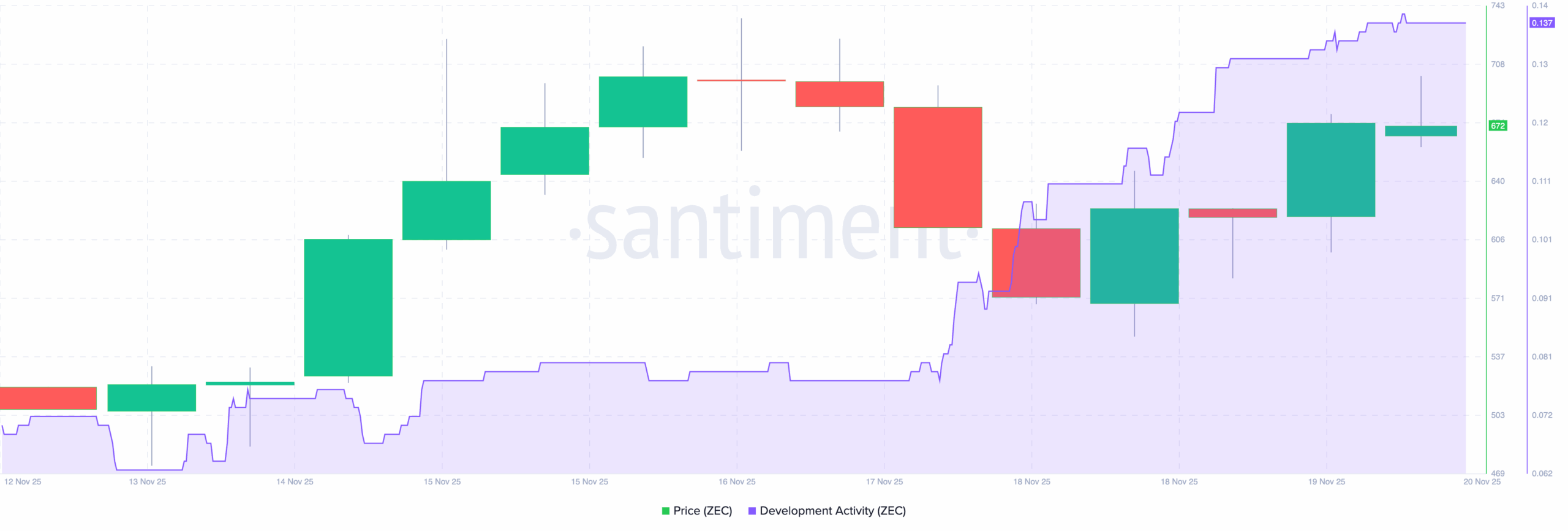
CCN’s analysis of Santiment data indicates that Zcash’s development activity is continuing to rise.
This steady growth reflects the active work being done to improve its zero-knowledge infrastructure and prepare the network for long-term resilience.
Increasing development activity is especially important as the industry focuses more on quantum computing threats.
With Zcash requiring only minor adjustments to remain secure, ongoing upgrades strengthen its position as the most future-ready privacy coin.
Higher Market Value Possible
For the coin holders, rising development activity translates into stronger sentiment and healthier price performance. If the trend continues, it could help sustain upward pressure on the ZEC price.
In the meantime, buying pressure around ZEC has continued to rise. One notable example is Cypherpunk, the firm founded by the Winklevoss brothers, which recently announced the purchase of 29,869 ZEC.
The firm spent $18 million on the accumulation at an average price of roughly $603 per coin.
Large-scale purchases like this strengthen market sentiment. If more come in, the Zcash coin price could see an extended rally, possibly taking it toward $1,000.
ZEC Price Prediction
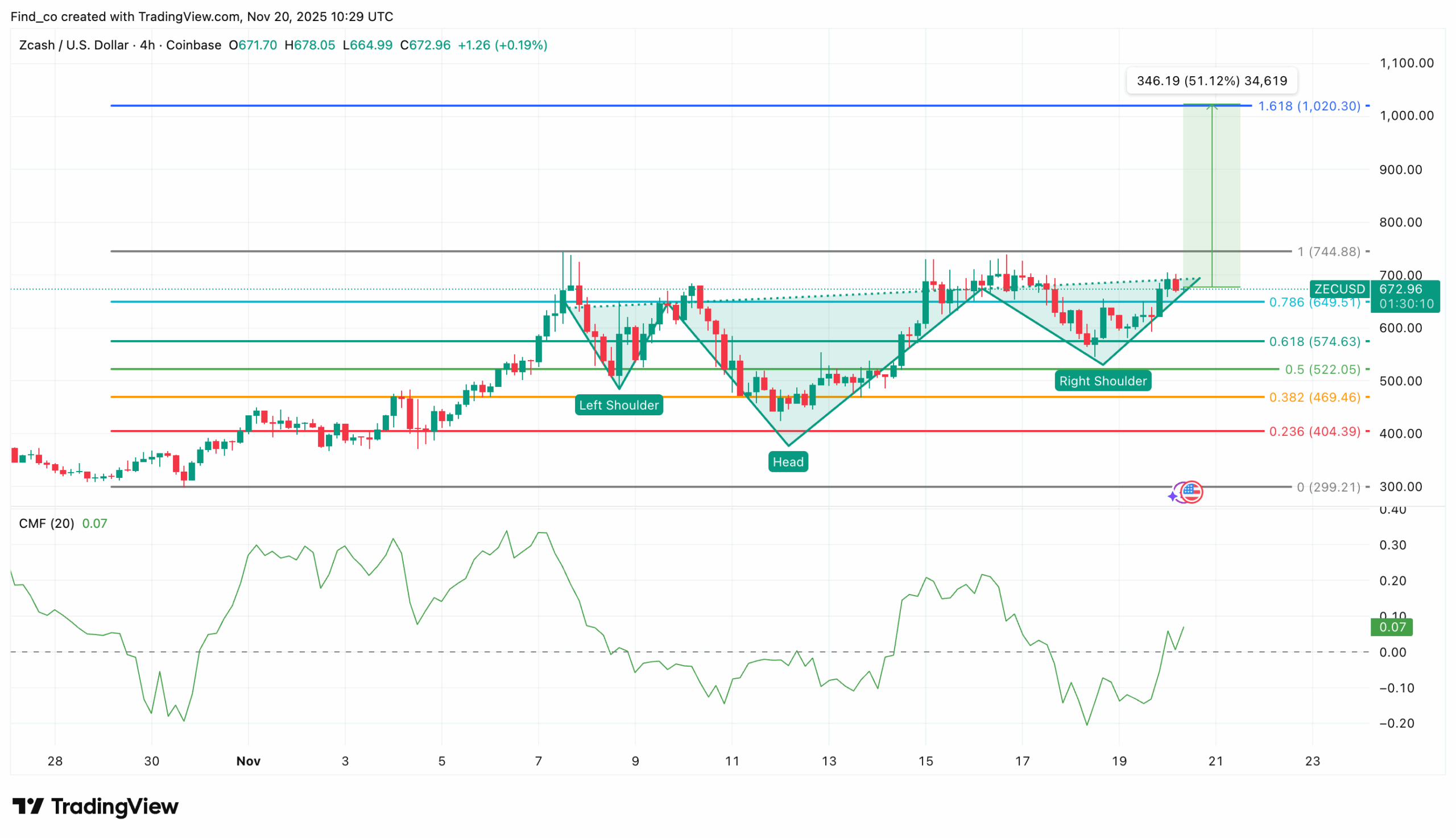
From a technical standpoint, the 4-hour chart indicates that Zcash’s price has formed a clear inverse head-and-shoulders pattern.
This signals a potential bullish reversal from its recent decline.
Furthermore, the coin has already broken above the neckline at $649.51, confirming the pattern and strengthening the case for upward continuation.
At the same time, the Chaikin Money Flow (CMF) has moved above the zero line, indicating rising buying pressure. With the CMF position, ZEC is likely to challenge the next resistance at $744.88.
A successful breakout above this level could send the price rallying toward $1,020 in the short term.
However, if ZEC’s price fails to hold above the neckline, this bullish setup may be invalidated. In that scenario, the price could pull back toward $574.63 as sellers regain control.
Disclaimer:
The information provided in this article is for informational purposes only. It is not intended to be, nor should it be construed as, financial advice. We do not make any warranties regarding the completeness, reliability, or accuracy of this information. All investments involve risk, and past performance does not guarantee future results. We recommend consulting a financial advisor before making any investment decisions.
Victor Olanrewaju is a crypto analyst and reporter at CCN with deep roots in on-chain research and technical analysis. His crypto journey began in 2017, but it was the 2020 Uniswap airdrop that sparked a full-time pivot into the space.
With a foundation in copywriting, Victor honed his craft creating high-converting content for leading crypto brokers — most notably an XRP price prediction that ranked #1 on Google during the 2021 bull run.
He later joined AMBCrypto in 2022, where he combined storytelling with technical and on-chain analysis to cover key market narratives.
In 2024, he expanded his expertise at BeInCrypto, collaborating with analysts and using tools like Glassnode, Santiment, and IntoTheBlock to break down Bitcoin and altcoin trends.
At CCN, Victor covers the top cryptocurrencies, memecoins, macro shifts, blending real-time insights with deep-dive metrics.
He holds a Bachelor’s degree in Physics from the University of Ibadan, equipping him to simplify complex data for a wide audience. Follow his work or connect on LinkedIn or X.