P2P.org’s Parshakov explains how Ethereum’s Fusaka upgrade boosts staking efficiency, rollup capacity, and prepares for Glamsterdam. | Credit: CCN.com
Share
Ethereum’s Fusaka upgrade, the network’s latest step toward the major upgrade, is going live on Wednesday, sparking an industry-wide discussion about its impact on scalability, staking, and future blockchain economics.
For institutional players running validators or large-scale staking operations, the changes introduced by Fusaka could have long-lasting effects on cost structures, infrastructure demands, and risk management.
To break down what Fusaka means in practice, CCN spoke with Artemiy Parshakov, Vice President of Institutions at P2P.org, one of the world’s largest non-custodial staking providers.
P2P.org secures more than $10 billion in staked assets and supports major institutions as they navigate Ethereum’s evolving staking environment.
How PeerDAS Revolutionizes Validator Operations in Blockchain Networks
A central element of Fusaka is PeerDAS (EIP-7594), a new approach to data availability that allows nodes to verify blob data by checking only small, random samples rather than downloading complete datasets.
Parshakov explains the significance clearly:
“PeerDAS significantly reduces per-node data handling demands while enabling much higher blob throughput. For institutions, that means more predictable bandwidth profiles and more efficient infrastructure.”
This matters particularly for large staking platforms that traditionally needed massive data-processing capacity to keep pace with Ethereum’s rollup-driven activity. PeerDAS lightens that burden and does so without sacrificing security.
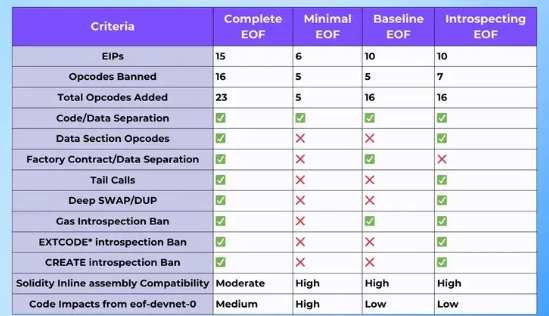
Fusaka upgrade in detail. | Credit: ipsilon/Datawallet
Combined with the validator consolidation introduced during the Pectra upgrade, which enables operators to manage larger ETH positions with fewer individual validators, Fusaka forms a cleaner and more manageable operating environment for compliance-focused institutional players.
“Fusaka is about efficiency,” Parshakov says. “It helps institutions streamline operations without giving up redundancy or decentralization.”
Try Our Recommended Crypto Exchanges
Sponsored
Disclosure
We sometimes use affiliate links in our content, when clicking on those we might receive a commission at no extra cost to you. By using this website you agree to our terms and conditions and privacy policy.
How Higher Data Capacities Improve Rollup Scalability and Future Stability
Beyond validator operations, Fusaka widens performance capacity for Ethereum’s rollup ecosystem by lifting the block gas limit to 60 million and preparing the network for larger blob volumes.
This could have a significant impact on user-facing applications.
One of the most important additions is EIP-7918, which introduces a base reserve price for blob fees. This reduces the fee volatility that rollup sequencers often struggle with, a stabilizing force for high-volume apps.
“This gives rollups a more stable foundation to grow,” Parshakov notes. “As blob capacity increases with future Blob-Parameter-Only forks, we expect higher-volume applications across DeFi, NFTs, enterprise settlement, gaming, and social apps over the next 6-12 months.”
The expectation is that rollups, already the dominant layer for high-speed activity, will become cheaper, smoother, and more enterprise-friendly.
Are Institutional Investors Dominating Fusaka? Parshakov Disputes the Claim
Fears that efficiency-focused upgrades will centralize the validator landscape are nothing new in the Ethereum community. But Parshakov argues that Fusaka does the opposite.
“PeerDAS actually makes participation easier for smaller operators,” he says.
Reducing bandwidth and storage pressure makes running a personal or small-team node more realistic.
Institutions, meanwhile, continue to enjoy benefits from economies of scale, primarily through consolidation, but the two trends are not mutually exclusive.
“These optimizations complement, rather than undermine, decentralization,” Parshakov says. “Ethereum’s validator set remains globally distributed, client-diverse, and permissionless.”
Platforms like P2P.org, which operate non-custodial infrastructure, help bridge the gap by offering institutional-grade tooling while maintaining open access for the broader staking ecosystem.
Why Ethereum’s Long-Term Fundamentals Are Getting Stronger
Asked about Fusaka’s broader impact on Ethereum’s fundamentals, and potentially ETH’s price, Parshakov offers a balanced perspective.
“Fusaka is an infrastructural upgrade, not a monetary one,” he says. “Its direct purpose is improving Ethereum’s capacity, predictability, and rollup economics.”
But infrastructure upgrades do shape sentiment. Lowering blob fee volatility, increasing throughput, and improving staking operations all enhance Ethereum’s appeal to institutions making long-term strategic decisions.
Over the next 12 to 24 months, Parshakov views Fusaka as a foundation for renewed investor confidence.
“Fusaka strengthens Ethereum at the settlement and data-availability layers,” he says. “Stronger scalability and more predictable fees could reinforce investor confidence in ETH’s long-term utility and ecosystem growth.”
How P2P.org Guarantees Smooth Transition and Zero Downtime
“Our infrastructure has already been tested for compatibility, and we’ve worked closely with Ethereum client developers to validate every aspect of the transition,” Parshakov confirms.
“Institutional clients can expect seamless support for validator consolidation, zero downtime during the upgrade, and optimized configurations designed to maximize both economic efficiency and operational simplicity.”
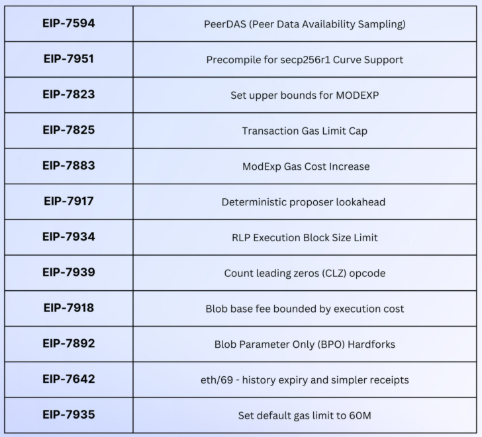
Key EIPs to be aware of ahead of the Fusaka upgrade. | Credit: GACryptoO X profile
Security remains a critical focus, with P2P.org maintaining full SOC 2 compliance. This ensures that large stakeholders can rely on institutional-grade protections throughout the upgrade process.
With Fusaka almost live, Ethereum turns its focus to Glamsterdam, expected in 2026. This is an upgrade set to introduce more visible improvements like lower rollup fees, faster confirmations, and new developer tools.
For Parshakov and the institutional clients he supports, Fusaka is not the finish line: it is the runway.
Ethereum’s roadmap is about steady, staged improvements that scale safely. Fusaka seems to maintain that momentum.
Fusaka is Ethereum’s latest network upgrade, designed to improve efficiency, increase block gas limits, and prepare the blockchain for the larger Glamsterdam upgrade in 2026. It introduces technical improvements like PeerDAS, a new data availability system for nodes.
What is PeerDAS (EIP-7594) and why does it matter?
PeerDAS allows nodes to verify data by sampling small portions instead of downloading full datasets. This reduces storage and bandwidth needs, making validator operations more predictable and cost-efficient. It benefits both large institutions and smaller node operators.
Will Fusaka make Ethereum more centralized?
No. While large institutions benefit from validator consolidation and economies of scale, PeerDAS lowers barriers for smaller operators. Ethereum’s validator set remains globally distributed, diverse, and permissionless.
Will Fusaka directly impact the price of ETH?
Fusaka is primarily an infrastructural upgrade, not a monetary policy change. While it strengthens Ethereum’s long-term fundamentals such as scalability, reliability, and fee predictability, immediate price effects are uncertain and depend on broader market conditions.
Giuseppe Ciccomascolo began his career as an investigative journalist in Italy, where he contributed to both local and national newspapers, focusing on various financial sectors.
Upon relocating to London, he worked as an analyst for Fitch's CapitalStructure and later as a Senior Reporter for Alliance News. In 2017, Giuseppe transitioned to covering cryptocurrency-related news, producing documentaries and articles on Bitcoin and other emerging digital currencies. He also played a pivotal role in establishing the academy for a cryptocurrency exchange website. Crypto remained his primary area of interest throughout his tenure as a writer for ThirdFloor.


 Easy
Easy