zkSync Atlas Upgrade: How It Transforms Ethereum Scalability and Why Vitalik Buterin Praised It.
Share
Key Takeaways
Atlas introduces performance benchmarks exceeding 15,000 transactions per second, enabling Ethereum to rival traditional payment networks in speed and capacity.
With one-second finality, Ethereum transactions can now settle almost instantly, unlocking new possibilities for high-frequency DeFi trading, Web3 gaming, and micropayments.
By connecting layer-1 and layer-2 liquidity, Atlas eliminates capital fragmentation and creates a fluid, interoperable DeFi ecosystem across all ZKsync-powered networks.
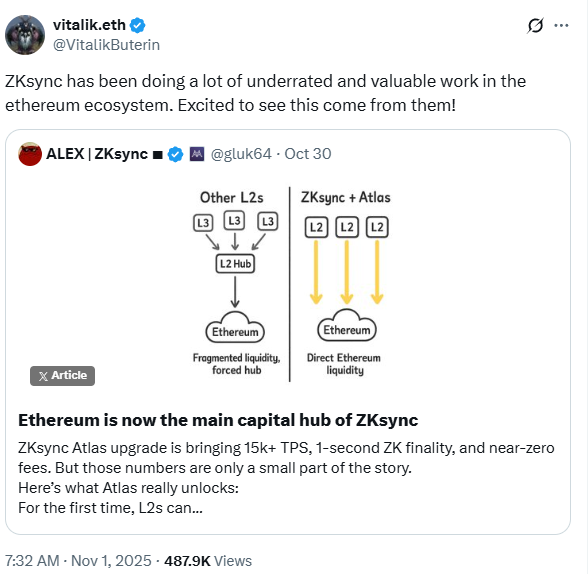
Vitalik Buterin praised the Atlas upgrade as “underrated and valuable,” recognizing its role in advancing Ethereum’s roadmap toward efficient, secure, and scalable layer-2 infrastructure.
Ethereum’s long-standing challenge has been scaling without sacrificing security or decentralization. The ZKsync Atlas upgrade from Matter Labs marks a pivotal moment in solving that problem.
By combining zero-knowledge technology with a revolutionary liquidity-sharing framework, Atlas pushes Ethereum closer to real-time financial performance. It enables faster, cheaper, and more connected blockchain transactions, bridging the gap between innovation and usability.
With over 15,000 TPS, near-instant finality, and unified liquidity across L1 and L2, Atlas signals a major leap toward Ethereum’s vision of becoming the world’s decentralized financial backbone.
What Is ZKsync Atlas Upgrade and Why It Matters for Ethereum
The ZKsync Atlas upgrade is a landmark update to Matter Labs’ ZKsync layer-2 network, designed to massively enhance Ethereum’s scalability, liquidity, and transaction efficiency.
Atlas integrates cutting-edge zero-knowledge proof (ZK-rollup) technology with a new liquidity architecture that directly connects layer-1 (Ethereum) and layer-2 ecosystems, eliminating the long-standing problem of fragmented liquidity between rollups.
The upgrade enhances ZKsync’s ZK Stack with a new high-performance sequencer and the Airbender proof system. Airbender is a next-generation RISC-V zkVM designed to generate zero-knowledge proofs for transactions with sub-second finality.
This means faster, cheaper, and more efficient applications on the network. The upgrade also makes ZKsync better suited for enterprise and institutional use cases that demand high speed and scalability.
By combining these upgrades, ZKsync Atlas positions Ethereum as a real-time capital hub rather than just a slow settlement layer, a vision closely aligned with Ethereum’s long-term roadmap.
“For the first time, layer-2s can rely on Ethereum itself as the real-time liquidity hub for institutional capital,” noted ZKsync Co-founder and CEO Alex Gluchowski on X.
ZKsync Atlas Upgrade Features That Redefine Ethereum Performance
The ZKsync Atlas upgrade represents a major leap forward for Ethereum scalability, combining advanced zero-knowledge technology with a redesigned liquidity framework.
It introduces breakthrough improvements in speed, cost, and capital efficiency, turning Ethereum into a seamless, real-time financial layer where transactions finalize almost instantly and assets move freely across the network
1. High-Speed Transaction Throughput
ZKsync Atlas is engineered to reach 15,000 TPS, which is a dramatic leap from Ethereum’s base layer capacity. This enables smoother decentralized application (dApp) performance and reduces network congestion during high-traffic events.
2. One-Second Transaction Finality
Atlas enables sub-second transaction confirmation, providing a user experience similar to centralized exchanges while retaining Ethereum’s decentralization and security guarantees. This makes it ideal for DeFi trading, gaming, and real-time payments.
3. Ultra-Low Transaction Fees
Using zero-knowledge rollup compression, ZKsync Atlas minimizes gas consumption. The result is near-zero transaction fees, opening Ethereum’s ecosystem to micro-transactions and global low-cost financial applications.
4. Unified Liquidity Across Ethereum Layer-1 and Layer-2
One of the biggest breakthroughs in ZKsync Atlas is its liquidity unification model. Instead of maintaining separate liquidity pools on each L2 chain, Atlas allows all rollups built on ZKsync to access Ethereum’s core liquidity pool directly.
This approach solves capital fragmentation, improves efficiency, and boosts asset mobility across the entire Ethereum ecosystem.
How Atlas Makes Ethereum Composable and Enterprise-Ready
The ZKsync Atlas upgrade transforms Ethereum into a truly composable and enterprise-ready blockchain, bridging the gap between innovation and real-world usability.
Composable means Ethereum’s apps and smart contracts can now connect and interact effortlessly, like digital Lego blocks that fit perfectly together. Instead of isolated DeFi platforms, NFT projects, or games running separately, Atlas allows them to share data, liquidity, and functionality across L1 and L2 networks. This creates a smoother, more collaborative ecosystem where developers can build complex applications faster and with fewer barriers.
Enterprise-ready means Ethereum can now support the speed, stability, and cost-efficiency that large businesses and institutions demand. With 15,000+ transactions per second, near-zero fees, and instant settlement, Atlas gives enterprises the confidence to use Ethereum for everything from real-time payments to tokenized assets and supply-chain automation, without the performance limits that once held blockchain back.
In essence, ZKsync Atlas upgrades Ethereum from a developer playground into a scalable, interconnected financial network capable of powering both open-source innovation and enterprise-level adoption worldwide.
“Atlas turns ZKsync into a real extension of Ethereum’s settlement layer, not a parallel island,” Gluchowski emphasized.
Why the ZKsync Atlas Upgrade Is Critical for Ethereum’s Growth
The ZKsync Atlas upgrade significantly enhances Ethereum’s performance by reducing latency, gas fees, and confirmation times, solving long-standing bottlenecks that limited mainstream adoption.
These improvements enable Ethereum to handle global-scale dApp usage while preserving decentralization and network security.
Ethereum scalability and user experience: Atlas dramatically reduces latency, transaction costs, and block confirmation times, all of which have historically hindered Ethereum’s mainstream adoption. With these improvements, Ethereum can support massive global dApp usage without compromising decentralization.
Liquidity interoperability and DeFi integration: By linking L1 and L2 liquidity, ZKsync Atlas enables frictionless capital movement between DeFi protocols, decentralized exchanges (DEXs), and applications. This helps Ethereum evolve into a real-time financial infrastructure capable of supporting institutional-grade use cases and tokenized real-world assets (RWAs).
Institutional and developer adoption: The Atlas framework is built to scale both retail and enterprise operations. With its low latency and improved composability, developers can deploy faster, cheaper, and more scalable dApps while institutions can tap into Ethereum’s liquidity without high fees or delays.
Vitalik Buterin’s Praise for ZKsync Atlas: “Underrated and Valuable”
Ethereum co-founder Vitalik Buterin publicly commended ZKsync’s Atlas upgrade, calling the project’s work “underrated and valuable.”
Vitalik Buterin praises ZKsync. | Source: @VitalikButerin on X.
His remarks highlight several key points:
Acknowledgment of technical depth: Vitalik’s praise recognizes the ZKsync team’s long-term contributions to Ethereum scalability through solid engineering rather than hype.
Alignment with Ethereum’s vision: The Atlas upgrade supports Ethereum’s transformation into a scalable, decentralized, real-time settlement layer, a direction Vitalik has championed for years.
Liquidity breakthrough: Buterin values the architectural innovation that allows multiple L2s to tap into shared Ethereum liquidity, solving one of the biggest bottlenecks in multi-chain ecosystems.
Validation of ZK-rollups: Vitalik has often emphasized that zero-knowledge rollups are the future of Ethereum scaling, and ZKsync Atlas confirms that vision with real, measurable performance gains.
ZKSync’s native token, ZK, surged more than 50% after Buterin endorsed a message highlighting Ethereum’s incorruptibility and long-term resilience. His show of support not only boosted market confidence in ZKsync’s ecosystem but also reinforced its alignment with Ethereum’s foundational values of security and decentralization.
Institutional Adoption of ZKsync
Here are several high-profile institutions that have publicly committed to deploying or experimenting with ZKsync’s infrastructure, demonstrating the protocol’s growing traction in regulated and enterprise environments:
Deutsche Bank: The bank is building a layer-2 solution on ZKsync’s “Elastic Chain” stack as part of its Project Dama 2 initiative. This deployment is intended to support regulated, tokenized-asset use cases and maintain compliance oversight.
UBS: UBS completed a proof-of-concept for its “Key4 Gold” product on ZKsync, exploring how zero-knowledge rollups can scale gold-linked tokens while preserving privacy and settlement speed.
Consortium via Project Guardian: Deutsche Bank’s deployment is linked with Project Guardian, which includes 27 financial institutions (such as Citibank, HSBC, BNY Mellon) exploring tokenization and blockchain-based settlement. ZKsync is cited as the underlying infrastructure for the L2 build.
With the Atlas upgrade, institutional adoption of ZKsync is expected to accelerate. By delivering sub-second finality, unified liquidity, and enterprise-grade scalability, Atlas removes many of the technical barriers that once limited traditional finance players from using Ethereum.
Banks, fintechs, and asset managers can now explore tokenization, real-time settlements, and cross-chain operations on ZKsync with the speed and reliability they require.
Future of Ethereum Scaling with ZKsync Atlas
The ZKsync Atlas upgrade is more than a technical milestone, it’s a strategic evolution for Ethereum.
By combining ZK-rollup technology, unified liquidity, and real-time transaction speeds, Atlas could turn Ethereum into the world’s most efficient decentralized capital network.
Vitalik Buterin’s endorsement signals strong confidence that ZKsync’s innovations are not only credible but foundational to Ethereum’s next decade of growth.
What makes ZKsync Atlas different from previous Ethereum scaling upgrades?
Unlike standard layer-2 updates focused purely on throughput, Atlas combines performance optimization with liquidity unification, allowing all ZKsync rollups to draw directly from Ethereum’s main liquidity pool. This removes friction and boosts efficiency across the ecosystem.
How does ZKsync Atlas achieve near-zero transaction fees?
Atlas uses zero-knowledge rollup compression, bundling thousands of transactions into a single proof verified on Ethereum. This drastically reduces gas consumption per transaction, cutting costs to fractions of a cent.
Why did Vitalik Buterin praise the ZKsync Atlas upgrade?
Vitalik commended the upgrade for its technical depth and ecosystem value, noting that ZKsync’s innovations align perfectly with Ethereum’s long-term scaling vision. He highlighted Atlas as a meaningful step toward a real-time, global capital network built on Ethereum.
How will ZKsync Atlas affect developers and institutions?
Developers gain faster, cheaper deployment environments for dApps, while institutions can access deep Ethereum liquidity with minimal latency. The result is a more composable, enterprise-ready blockchain infrastructure that supports both retail and institutional adoption.
Disclaimer:
The information provided in this article is for informational purposes only. It is not intended to be, nor should it be construed as, financial advice. We do not make any warranties regarding the completeness, reliability, or accuracy of this information. All investments involve risk, and past performance does not guarantee future results. We recommend consulting a financial advisor before making any investment decisions.
Onkar Singh has three years of experience as a digital finance content creator. Throughout his career, he has collaborated with various DeFi projects and crypto media outlets. In his leisure time, he enjoys fitness activities at the gym and watching movies across different genres. Balancing his professional and personal interests, Onkar continues to contribute to the digital finance landscape while pursuing his hobbies.


 Easy
Easy