What Happens to Ethereum (ETH) After the Fusaka Upgrade?
Share
Key Takeaways
The Fusaka network upgrade is scheduled to activate on the Ethereum mainnet at slot 13,164,544 on December 3, 2025 at 21:49:11 UTC.
Fusaka’s key feature is Peer Data Availability Sampling (PeerDAS), which dramatically increases Layer 2 data capacity, leading to far lower transaction fees and higher network throughput.
Excluded proposals like EIP 7907 and EOF are expected to appear in the 2026 Glamsterdam upgrade.
BitMine’s 97K ETH purchase and long-term treasury strategy.
Ethereum’s Fusaka upgrade is expected on December 3, 2025, at 21:49:11 UTC, marking a hard fork designed to make the network faster, cheaper, and more secure.
Building on the Pectra upgrade in May 2025, which introduced account abstraction and validator improvements, Fusaka focuses on efficiency, scalability, and resilience.
Its centerpiece, Peer Data Availability Sampling (PeerDAS), dramatically expands data capacity for Layer 2 rollups, enabling potential L2 fee cuts of 40-60% while the gas limit rises to 150 million units.
The upgrade sets the stage for Glamsterdam in 2026, and it follows Devconnect in Buenos Aires, which took place on November 17–22, 2025.
As the upgrade approached, the community highlighted expectations for stronger network performance. Traders pointed to the previous upgrade’s 58% price jump and noted that Fusaka brings wider L2 scaling and faster transactions, which reinforced the positive sentiment building before activation.
ETHEREUM: FUSAKA UPGRADE INCOMING.
The last upgrade pumped $ETH +58%. Fusaka drops Dec 3rd and it’s even bigger.
L2 scaling, tx speed, network performance: all levelled up. The chain is evolving.
BitMine Immersion Technologies (BMNR) also acquired 97K ETH as part of its long-term plan to expand its corporate treasury in Ethereum, stake holdings for yield, and build a position it expects to appreciate over time.
This article explains what Fusaka changes, why it matters for users, developers, and investors, and how it paves the way for Ethereum’s next hard fork, Glamsterdam.
What Is the Fusaka Upgrade?
The Fusaka Upgrade is a hard fork, meaning all nodes must adopt the new rules to stay on the main network.
It brings 11 Ethereum Improvement Proposals (EIPs), including EIP‑7825, raises the gas limit to 150 million units, and will move through a July 2025 devnet, followed by two public testnets in September and October to ensure stability ahead of the December mainnet launch.
Following a structured 30‑day rollout plan, Fusaka avoids the delays that affected earlier forks and is a key milestone of Ethereum’s “Surge” phase, focused on scaling the network through higher transaction capacity, targeting higher throughput and stronger security. As a result it sets the stage for future upgrades.
The Road to Fusaka: Market Signals, Large ETH Purchases and BitMine’s Treasury Strategy
Growing anticipation around the Fusaka upgrade shaped market behavior in the months leading up to the release. Several signals showed renewed confidence in Ethereum’s long-term outlook before the technical changes went live.
BitMine’s decision to buy large amounts of ETH formed part of a broader pattern of accumulation by both corporate and institutional holders.
Whale accumulation: Large ETH holders increased their balances as anticipation grew. Several major wallets added sizable amounts of ETH, which strengthened the view that the upgrade would support future growth.
Institutional inflows: Spot ETH investment products recorded fresh inflows as funds positioned for potential post-upgrade improvements in network activity and scalability.
Market recovery: ETH regained price strength after a period of consolidation. The improved market backdrop aligned with rising expectations for Fusaka’s impact on transaction efficiency and Layer 2 growth.
BitMine’s strategy: BitMine bought a large amount of ETH ahead of Fusaka as part of its long-term treasury plan. The company aims to build a significant ETH position, buy during market dips, and stake holdings for yield while betting on a long-term supercycle.
This broader set of events created a favorable environment for the Fusaka upgrade. The momentum that formed in the months before activation helps explain why many viewed Fusaka as more than a technical release and instead as a catalyst for renewed interest in Ethereum.
This context sets the stage for understanding what Fusaka changes at the protocol level and why the upgrade became a key moment for Ethereum’s roadmap.
Fusaka’s Timeline
The Fusaka upgrade represents one of Ethereum’s most ambitious steps in its Surge phase, combining scalability, security, and client readiness milestones.
While the timeline is well‑structured, developers are balancing new feature deployment with risk management, especially as gas limit adjustments and advanced EIPs like PeerDAS and Verkle trees undergo rigorous testing.
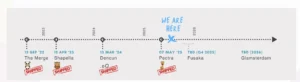
Ethereum’s Upgrades’ Timeline | Source: Ethereum Foundation Blog
The following points highlight the essential considerations shaping Fusaka’s rollout.
Devnet 2 Launch – June 23, 2025: Fusaka Devnet 2 launches, replacing Berlinterop Devnet 2, to test 11 finalized EIPs, including EIP-7825 (security/scalability enhancements).
ACDE #216 Call – July 17, 2025: Core developers confirm a 30-day rollout cadence for client releases, testnet forks, and mainnet activation to ensure audits and ecosystem readiness.
Devnet 3 Launch – July 23–24, 2025: Fusaka Devnet 3 launches to test EIP-7825, engine_getblob API, PeerDAS, and Verkle trees. Stabilization efforts begin, continuing through August.
ACDC #161 Call – July 24, 2025: Developers review Devnet 3 performance, address client issues (e.g., Lodestar rate-limiting), and target release candidates by August 31.
Devnet 3 Stabilization – August 4, 2025: Ongoing debugging of client and maximal extractable value workflows (MEV) to prepare for release candidates.
Glamsterdam Planning – August 4, 2025: Discussions for the next upgrade (Glamsterdam) begin, with a consensus-layer EIP decision scheduled for ACDC #162 , an All Core Developers Consensus call, on August 7.
Release Candidates – August 31, 2025: Client release candidates targeted to support the upcoming public testnet phase.
Holesky Testnet – September, 2025: Second public testnet to validate network stability, testing EIPs, PeerDAS, and the gas limit increase to 150 million units.
Sepolia Testnet – September, 2025: First public testnet to stress-test Fusaka’s features, including EIP-7825 and the gas limit increase.
Hoodi Testnet – October, 2025: Third public testnet to finalize testing of EIP-7825, PeerDAS, and Verkle trees, followed by client hardening and audits to ensure mainnet readiness.
Mainnet Launch – December 3, 2025: Fusaka activates on mainnet, implementing EIPs, increasing the gas limit to 150 million, and deploying PeerDAS and Verkle trees to enhance scalability and reduce node requirements. Launch will be after Devconnect in Buenos Aires (November 17–22).
With the timeline in place, the focus turns to the core elements that define Fusaka. Each change contributes to Ethereum’s push for faster transactions, stronger security, and a network that can support future scaling milestones.
The following section highlights the key upgrades that make Fusaka a pivotal step in Ethereum’s evolution.
How Fusaka Supercharges Ethereum’s Layer-2 Rollups and Slashes Fees
Fusaka marks an important step in Ethereum’s Surge phase, combining new features that improve speed, security, and network efficiency. This upgrade not only delivers stronger layer-2 support and lower fees but also sets the stage for future protocol changes, including the planned Glamsterdam upgrade in 2026.
Efficiency and Scalability With PeerDAS
What it is: PeerDAS allows validators to sample partial blob data instead of processing the entire dataset, making it easier to provide data for Layer 2 rollups.
Impact: Expands transaction capacity for Layer 2 solutions by up to ten times and lowers user fees while advancing Ethereum’s danksharding roadmap.
Why it matters: Makes Ethereum more competitive with high-throughput chains like Solana and strengthens the foundation for decentralized finance (DeFi) and application growth.
EIP 7825: Attack Resilience
What it is: Introduces a transaction gas limit cap of 16,777,216 units to reduce spam and help protect nodes from targeted attacks.
Impact: Increases network stability and security, though core developers, including Vitalik Buterin, have noted that some DeFi applications may need to adjust.
Why it matters: Maintains Ethereum’s reliability for both institutional and retail users during periods of heavy activity.
Gas Limit Increase to 150 Million
What it is: Raises the gas limit from about 30 million to 150 million units per block, allowing more transactions to be processed.
Impact: Helps reduce congestion and transaction fees but may slow block propagation and increase storage use, making careful testnet validation essential.
Why it matters: Improves Layer 1 performance without breaking compatibility for existing smart contracts.
Eleven EIPs and Notable Exclusions
What it is: Fusaka introduces eleven EIPs, led by PeerDAS and EIP 7825, while excluding EIP 7907 (contract code size increase) and the EVM Object Format (EOF).
Impact: Keeps the upgrade on schedule by delaying complex features that could slow testing and risk launch timing.
Why it matters: Maintains a predictable release path while leaving room for deferred features to appear in Glamsterdam.
Verkle Trees for State Management
What it is: A new storage structure that reduces the space required for node data and makes verification faster.
Impact: Lowers the hardware demand on validators and promotes wider network participation.
Why it matters: Supports decentralization and lays the groundwork for Ethereum’s future plans.
Testing Process and Rollout
What it is: A staged rollout starting with July 2025 devnets, followed by two public testnets in September and October, including stress tests on Holesky and Sepolia.
Impact: Confirms client stability, tests the higher gas limit, and identifies any remaining performance or MEV issues.
Why it matters: Ensures that the network and ecosystem are fully prepared for the mainnet launch expected in December 3, 2025.
Looking Ahead: Glamsterdam and Devconnect
What it is: The next major upgrade, Glamsterdam, is planned for 2026 and may focus on faster 6 second block times, further gas limit increases, and deferred EIPs like 7907 and Ethereum Virtual Machine Object Format (EOF).
Impact: Devconnect in Buenos Aires from November 17 to 22, 2025, will be a key checkpoint for community and developer coordination.
Why it matters: It signals Ethereum’s continued progress toward higher throughput and a predictable upgrade cycle, giving the ecosystem confidence in its long-term roadmap.
Fusaka’s Final Impact: Lower Fees, L2 Scaling, and the Path Forward
Fusaka is a major step in Ethereum’s Surge phase, targeting faster transactions, lower fees, and stronger security. With PeerDAS, EIP 7825, Verkle Trees, and a planned gas limit increase, the network moves closer to supporting wider Layer 2 adoption and a more resilient Layer 1.
The rollout followed a deliberate timeline, with developers progressing from devnets to public testnets ahead of the December 2025 mainnet activation. To maintain stability, they excluded more complex proposals such as EIP 7907 and EOF, keeping the focus on upgrades that could be integrated safely without adding excessive risk.
Glamsterdam in 2026 will expand on Fusaka’s foundation with goals that include faster block times, higher throughput, and the integration of deferred features. Together, these upgrades show Ethereum’s steady path toward a more scalable and secure ecosystem.
EIP 7825 adds a transaction gas cap to reduce spam and protect nodes from attack scenarios.
Why may the Fusaka upgrade have influenced BitMine’s ETH purchase?
BitMine bought a large amount of ETH ahead of the Fusaka upgrade because the update strengthens Ethereum’s long-term outlook. Fusaka improves scalability and reduces congestion, which can support wider network use and increase future demand for ETH.
BitMine plans to expand its corporate treasury, buy during market dips, and invest for a possible supercycle, so the expected impact of Fusaka aligns with its long-term accumulation strategy.
Which EIPs were excluded from the Fusaka upgrade?
EIP 7907 and the EVM Object Format (EOF) were deferred to avoid slowing down the rollout.
What are Verkle Trees and why are they important?
Verkle Trees reduce node storage needs and improve state verification, supporting network decentralization.
Disclaimer:
The information provided in this article is for informational purposes only. It is not intended to be, nor should it be construed as, financial advice. We do not make any warranties regarding the completeness, reliability, or accuracy of this information. All investments involve risk, and past performance does not guarantee future results. We recommend consulting a financial advisor before making any investment decisions.
Dr. Lorena Nessi is an award-winning journalist and media technology expert with 15 years of experience in digital culture and communication. Based in Oxfordshire, UK, she combines academic insight with hands-on media practice.
She holds a PhD in Communication, Sociology, and Digital Cultures, and an MA in Globalization, Identity, and Technology.
Lorena has taught at Fairleigh Dickinson University, Nottingham Trent University, and the University of Oxford. She is a former producer for the BBC in London, with additional experience creating television content in Mexico and Japan.
Her research focuses on digital cultures, social media, technology, capitalism, and the societal impact of blockchain innovation.
She has written extensively on digital media and emerging technologies, with her work featured in both academic and media platforms. Her Web3 expertise explores how blockchain technologies shape culture, economics, and decentralized systems.
Outside of work, Lorena enjoys reading science fiction, playing strategic board games, traveling, and chasing adventures that get her heart racing. A perfect day ends with a relaxing spa and a good family meal.


 Intermediate