Home / Education / Crypto / Investing / Startale CEO Sota Watanabe: ‘Crypto Is No Longer Bitcoin or Ethereum — It’s About Tokenizing Traditional Markets’
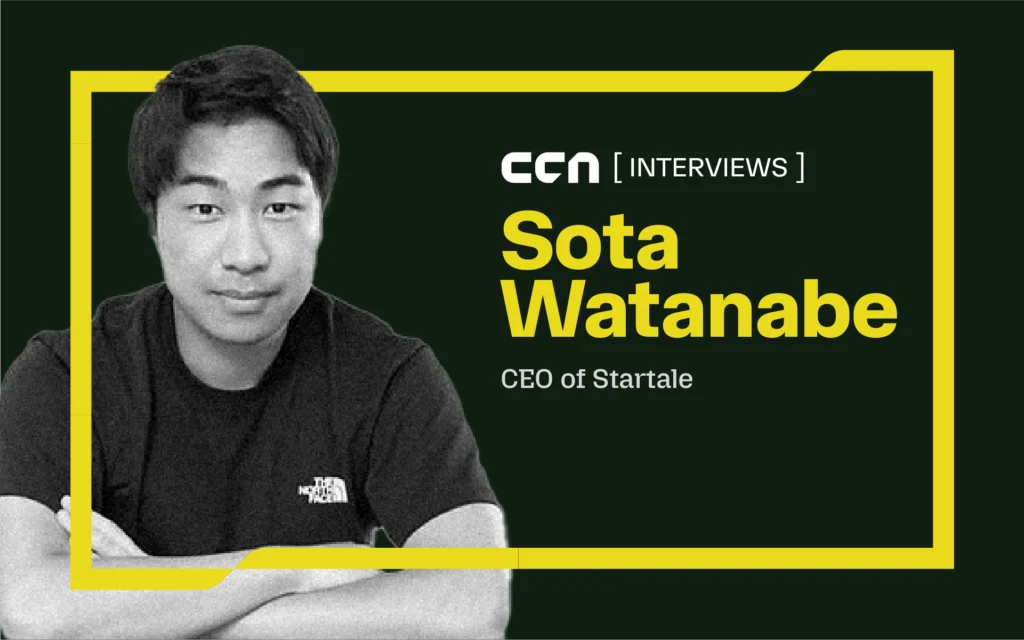
Startale CEO Sota Watanabe says crypto is moving beyond Bitcoin and Ethereum toward tokenizing traditional markets as institutional adoption accelerates. | Credit: CCN.com
Share
As institutional adoption accelerates and tokenization gains momentum, Sota Watanabe, CEO of Startale Group, backed by major institutions including Sony and SBI Holdings, outlined a vision where blockchain fades into the background, much like the internet today.
In a conversation with CCN’s Giuseppe Fabio Ciccomascolo, Watanabe discussed the next phase of Web3 adoption, stablecoins, tokenization, and why Japan may quietly become one of crypto’s most important markets.
“We would like to realize an environment where users use blockchain without knowing blockchain but getting the benefits,” Watanabe told CCN, highlighting what he sees as the true path to mass adoption.
Blockchain Without Blockchain
According to Watanabe, onboarding the next billion users isn’t about better wallets or faster chains, it’s about abstraction.
“Right now, if you use blockchain, you need to understand private keys, transactions, balances, and different chains,” he explained. “But people use the internet without understanding TCP/IP or HTTP. That’s the world we want to realize.”
This philosophy underpins Startale’s broader strategy, particularly its entertainment-focused layer-2 project Soneium.
Rather than competing as another general-purpose chain, Watanabe argues that specialization, combined with distribution, is the real differentiator.
“General-purpose layer-2s are eventually going to be non-sustainable. We’re focusing on entertainment. Thanks to Sony and other big companies, we have a unique distribution channel to connect blockchain experiences to ordinary people beyond crypto.”
Regulation and Privacy: The Two Barriers to Mass Adoption
Despite growing momentum, Watanabe believes Web3 still faces two critical hurdles: regulation and privacy.
“The first one is regulation and second one is privacy,” he said, noting that clearer rules, particularly in the US, could unlock institutional participation.
“When regulation becomes clear, a lot of financial institutions and beyond will come on-chain.”
Privacy, meanwhile, remains essential for enterprise adoption.
“Public blockchain is the future, but on open networks, privacy matters. Otherwise, big companies won’t want to disclose customer information.”
Japan’s Quiet Web3 Push
While the U.S. dominates crypto headlines, Japan may be building one of the most structured Web3 ecosystems.
Watanabe highlighted that Japan officially adopted Web3 as a national strategy in 2022, with regulators now moving toward treating crypto as a financial asset by 2027-2028.
“If crypto is categorized as financial products, tax will be reduced from up to 55% to 20%, and a lot of institutional players will come on-chain,” Watanabe said.
The shift could mark a major turning point for institutional adoption in Asia.
Stablecoins and the Rise of On-Chain Finance
Startale is also focusing heavily on stablecoins, particularly a Japanese yen-based token.
Watanabe argues that a scalable JPY stablecoin could fundamentally reshape on-chain finance.
“JPY is one of the most trusted currencies globally; institutions borrow JPY at low rates and swap to USD for yield. This is happening off-chain today and we want to bring it on-chain.”
This, he said, would help decentralize risk and create a more resilient global crypto economy.
Real Crypto Revolution? Tokenized Markets
Perhaps Watanabe’s most striking claim was that crypto’s future extends far beyond Bitcoin or Ethereum.
“When ordinary people talk about crypto, they talk about Bitcoin price. But the reality is crypto is revolutionizing traditional finance.”
He added:
“When we talk about crypto, it’s no longer Bitcoin or Ethereum. It’s about tokenizing traditional markets — oil, gold, indexes, and more.”
Still, Watanabe also cautioned that tokenized stocks, despite hype, remain early.
“People talk about tokenized stock, but many don’t understand the differences between synthetic assets, custody-based tokens, and fully on-chain issuance and many concepts are still missing.”
Collaboration Over Competition
Unlike Silicon Valley’s startup-driven innovation model, Japan relies heavily on partnerships.
“Collaboration matters in Japan instead of fighting each other,” Watanabe said, explaining why Startale works closely with major enterprises.
“Sony and SBI have distribution. We have technology. Together, we want to build a world where people use blockchain without knowing blockchain.”
Startale’s $10 Billion Ambition
Looking ahead, Watanabe set an ambitious goal: turning Startale into a $10 billion company within five years.
His strategy centers on vertical integration, spanning infrastructure, apps, stablecoins, and developer tools.
“Companies that only build one layer don’t make sense anymore. We’re building vertically from chains to apps to stablecoin to wallet.”
If successful, Startale aims to become one of the first fully integrated Web3 ecosystems emerging from Asia.
The Bigger Picture
From entertainment-focused blockchains to tokenized markets and national-level regulation, Watanabe’s vision suggests Web3’s next growth phase may look very different from the last.
Bitcoin may dominate headlines, but according to Startale’s CEO, the real transformation is happening quietly behind the scenes.
And if Watanabe is right, the next wave of adoption won’t come from crypto natives, but from users who never realize they’re using blockchain at all.
Disclaimer:
The information provided in this article is for informational purposes only. It is not intended to be, nor should it be construed as, financial advice. We do not make any warranties regarding the completeness, reliability, or accuracy of this information. All investments involve risk, and past performance does not guarantee future results. We recommend consulting a financial advisor before making any investment decisions.
Giuseppe Ciccomascolo began his career as an investigative journalist in Italy, where he contributed to both local and national newspapers, focusing on various financial sectors.
Upon relocating to London, he worked as an analyst for Fitch's CapitalStructure and later as a Senior Reporter for Alliance News. In 2017, Giuseppe transitioned to covering cryptocurrency-related news, producing documentaries and articles on Bitcoin and other emerging digital currencies. He also played a pivotal role in establishing the academy for a cryptocurrency exchange website. Crypto remained his primary area of interest throughout his tenure as a writer for ThirdFloor.


 Easy
Easy