Cryobrick promises simple Bitcoin storage using feature phones, but the reality is more complex, highlighting key risks and misconceptions. | Credit: CCN.
Share
Key Takeaways
Bitcoin always exists on the blockchain. Devices like phones or wallets only store private keys that give you access to your funds.
While using an old-style phone feels intuitive, the actual setup involves technical steps that can confuse beginners.
Keeping a device offline reduces online attack risks, but it doesn’t protect against setup mistakes, malware introduced earlier, or human error.
The original Nokia 3310 cannot support Bitcoin tools. Only some newer feature phones may work, and even then, compatibility is limited
Bitcoin has always had a strange relationship with physical objects. People talk about holding Bitcoin, storing it in wallets, even losing it when devices break. Yet none of those things are literally true. Bitcoin does not sit inside a phone, a USB device, or a vault. It exists on a distributed ledger, and what you actually control is a set of private keys that prove ownership.
That gap between perception and reality is exactly why ideas like Cryobrick catch attention so quickly. The thought of hiding access to digital wealth inside something as ordinary and unremarkable as a Nokia style feature phone feels both clever and reassuring. It suggests simplicity in a space that often feels overly technical and fragile.
But the reality behind that idea is more complex. Cryobrick is not magic, and a Nokia 3310 is not suddenly a secure Bitcoin vault just because someone says it can be. To understand what is really going on, you have to separate the underlying technology from the story built around it.
What Cryobrick Claims
Cryobrick presents itself as a form of air gapped Bitcoin storage that uses feature phones instead of traditional hardware wallets. The pitch revolves around a few core ideas:
● Private keys are generated and stored on a phone that never connects to the internet
● Transactions are signed offline, reducing exposure to online attacks
● The device looks like a normal phone, offering a degree of plausible deniability
● The setup is cheaper than dedicated hardware wallets
At a high level, this sounds like a radical rethink of Bitcoin security. In reality, it is an adaptation of an existing model.
The system Cryobrick relies on is called offline signing. One device prepares a transaction while connected to the internet. Another device, kept offline, signs it using private keys. The signed transaction is then returned to an online system for broadcasting.
This model already exists in tools used by advanced Bitcoin users. Cryobrick’s twist is applying it to inexpensive feature phones rather than purpose built devices.
What Storing Bitcoin on a Phone Actually Means
One of the biggest sources of confusion in this discussion is language.
You are not storing Bitcoin on a Nokia 3310 or any other device. What you are storing is:
● A private key
● Or more commonly, a seed phrase that can regenerate those keys
These keys are what allow you to control Bitcoin recorded on the blockchain. If you lose the device but still have your seed phrase, you can recover your funds. If you lose the keys, your Bitcoin is effectively gone, regardless of what device you used.
So when Cryobrick talks about turning a phone into storage, what it really means is turning it into a key management and transaction signing device.
Reality of Using a Nokia 3310
The phrase “Nokia 3310” is doing a lot of work in the marketing narrative.
There are two very different interpretations:
● The original 2000 era Nokia 3310
● The newer 2017 reboot and similar feature phones
The original device does not have the capability to run modern wallet software. It cannot realistically function as a Bitcoin signing device.
Some newer feature phones, however, can. Projects like BitcoinMRE show that certain models, including devices similar to the 2017 Nokia 3310, may support offline signing applications. Even then, compatibility is limited and not always guaranteed.
So the idea is technically possible, but only within a narrow set of supported devices and configurations.
Where the Idea Holds Up
There are real strengths in the Cryobrick approach when understood correctly.
● A device that never connects to the internet is harder to attack remotely
● This eliminates many common malware based threats
Low profile hardware can improve privacy
● A basic phone does not stand out
● It may reduce the chance of being targeted compared to obvious crypto devices
Cost barrier is lower
● Feature phones are inexpensive
● This makes experimentation with self custody more accessible
These are meaningful advantages, especially for users who understand the trade offs and are comfortable managing more complex workflows.
Where the Hype Breaks Down
Cryobrick is interesting because it takes a real Bitcoin security concept and packages it in a surprising form. That is also where the confusion begins. The basic idea is technically plausible, but the way people talk about it often makes it sound more secure, more universal, and more straightforward than it really is. The limitations are not small details. They are central to whether this kind of setup makes sense at all.
One of Cryobrick’s strongest selling points is the idea of air gapping. In Bitcoin security, that usually means keeping the device that holds private keys completely offline so it never connects to the internet. In theory, that removes one of the biggest attack surfaces. A remote attacker cannot directly target a device that never goes online.
That part is true, but it is only part of the picture.
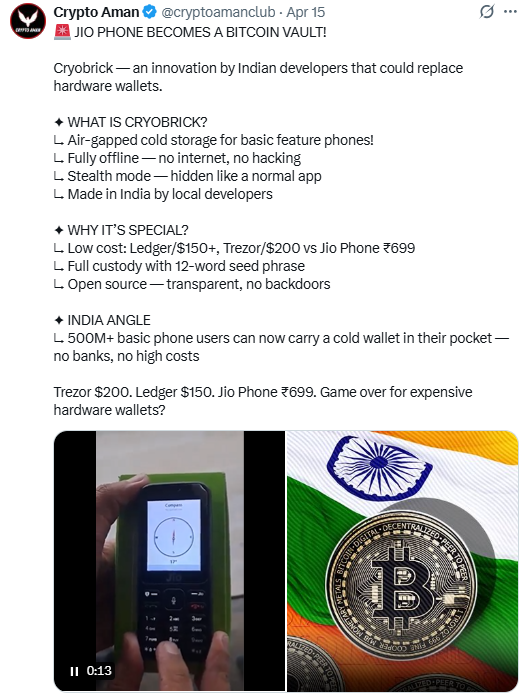
JIO phones becomes a BItcoin vault. | Credit: Crypto Aman X profile
An air gapped device is safer against many common online threats, but it is not automatically safe against all threats. Security depends heavily on what happened before the device became isolated and what happens during every interaction with it afterward.
If malicious software is introduced during setup, installation, or file transfer, the device may already be compromised before it ever becomes “offline.” In that case, the air gap provides less protection than people assume. It may stop some attacks, but it does not reverse a compromised starting point.
There is also the issue of workflow. Air gapped systems still need to exchange information somehow. That might happen through QR codes, microSD cards, USB transfers, or other manual steps. Every bridge between the offline device and the online world creates potential room for error or manipulation.
So the deeper point is this: air gapping reduces risk, but it does not eliminate risk. It is a security layer, not a security guarantee.
Feature Phones Are Not Secure Hardware Wallets
The image of a tough old Nokia style phone creates a sense of durability and trust. People associate those devices with reliability because they were physically sturdy and simple to use. But physical toughness is not the same as cryptographic security.
Dedicated hardware wallets are built specifically for protecting private keys. Many include components such as secure elements, controlled signing environments, and firmware designed around a narrow security purpose. Their whole reason for existing is to reduce the ways a key can leak or be misused.
A feature phone is different. Even when it can be repurposed for offline signing, it was not designed from the ground up as a security device.
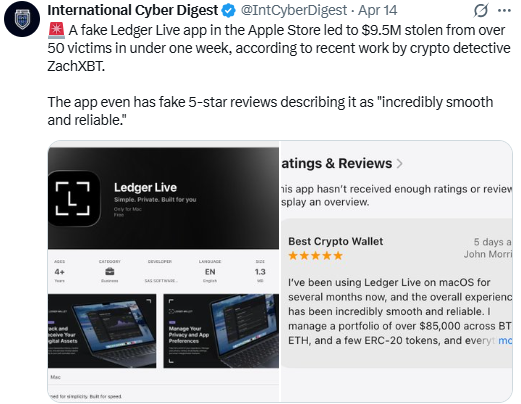
A fake Ledger Live app in the Apple Store led to $9.5M stolen from over 50 victims in under one week. | Credit: International Cyber Digest X profile
That creates several concerns:
● Most feature phones do not include secure elements for hardened key protection
● The hardware and software stack often has not been examined with Bitcoin custody as the main threat model
● Physical access protections may be weaker than users assume
This does not mean a feature phone setup is automatically unsafe. It means the user should not confuse improvisation with purpose built design. A device can be cleverly adapted for security, but that is not the same as being engineered for security from the beginning.
Software Is Often Experimental
Another part of the hype comes from treating these projects as if they were already mature wallet ecosystems. In practice, many of the tools that make feature phone Bitcoin storage possible are closer to experimental or enthusiast driven software than to mainstream financial infrastructure.
That matters because software maturity is a major part of Bitcoin security.
Established wallet ecosystems benefit from:
● Larger user bases
● More testing across real world conditions
● More developer scrutiny
● Better documentation
● Faster discovery of bugs and edge cases
Experimental tools often do not have those advantages yet. Some openly warn users that bugs may exist and that no safety guarantee should be assumed. That kind of honesty is useful, but it also means users should take the warning seriously.
The risk is not just that the code could fail in an obvious way. It is that small issues in randomness, signing, backup handling, transaction verification, or compatibility can have outsized consequences when private keys are involved.
With Bitcoin, “probably fine” is not the same as fine.
Human Error Becomes More Likely
This is where many otherwise clever Bitcoin storage ideas fall apart. The more manual and unusual the setup, the more pressure it puts on the user.
Cryobrick style workflows usually involve more steps than standard wallet usage. You may need to prepare a transaction on one device, transfer it to another, verify details on a smaller screen, sign it offline, then move it back for broadcast. You also have to manage seed phrase creation, backup storage, recovery planning, and device isolation practices.
Each one of those steps is manageable on its own. The problem is cumulative complexity.
More complexity means:
● More chances to skip a verification step
● More chances to misunderstand what the device is showing
● More chances to trust the wrong file, app, or transfer path
Most Bitcoin losses do not happen because the underlying cryptography breaks. They happen because users are phished, rushed, confused, or overconfident. A system that looks elegantly simple from the outside may actually create more room for dangerous mistakes on the inside.
That is why the biggest risk with Cryobrick is not that the idea is fake. The bigger risk is that people misunderstand it as being easier and safer than it really is.
Practical Ways to Store Bitcoin Securely
Cryobrick is only one option in a much broader landscape of Bitcoin storage methods. The right choice depends on how much Bitcoin you hold, how often you need access to it, how technically confident you are, and what kind of threats you are trying to defend against.
No storage method is perfect. Every approach involves trade offs between convenience, security, cost, and complexity.
Hardware Wallets
Hardware wallets are still the default recommendation for many users because they are purpose built for one job: protecting private keys and signing transactions without exposing those keys directly to an internet connected device.
Their biggest strengths are clarity and structure. They are designed around a specific security model, usually with clear recovery procedures, established interfaces, and stronger separation between key storage and everyday computing.
They are often the best fit for people who:
● Want strong security without building a DIY setup
● Hold meaningful amounts of Bitcoin
● Need a balance between safety and usability
That said, hardware wallets are not perfect. Their safety still depends on how they are purchased, set up, backed up, and used. A secure device can still be undermined by phishing, fake software, or poor seed phrase handling.
Software Wallets
Software wallets are the most convenient option. They live on phones, laptops, or desktops and make it easy to send, receive, and manage Bitcoin quickly.
That convenience comes with greater exposure. Because the device is internet connected, it has a larger attack surface. Malware, malicious extensions, fake apps, and compromised systems all become more relevant threats.
Software wallets are often a reasonable choice for:
● Smaller amounts
● Everyday spending
● Users who value accessibility over maximum isolation
The deeper rule here is simple: convenience usually lowers friction, but it also lowers security margins.
Paper or Metal Backups
A paper or metal backup is not really a wallet on its own. It is a backup of the seed phrase that allows recovery if the main device is lost or destroyed.
Its value is that it is offline and independent of software failure. If stored properly, it gives the user a path to recovery even if hardware fails.
Its weakness is physical vulnerability. Paper can burn, rot, or be lost. Metal is more durable, but can still be stolen or discovered. A seed phrase backup also introduces a critical risk: anyone who sees it can potentially take the funds.
This means backups are essential, but they must be protected with as much care as the wallet itself.
Multi Signature Setups
Multi signature, often shortened to multisig, requires more than one key to authorize a transaction. For example, a two of three setup might require any two out of three keys to move funds.
This can significantly improve security by reducing single points of failure. One stolen device, one damaged backup, or one compromised key is no longer enough on its own.
Multisig is powerful because it spreads trust across multiple keys, devices, or locations. It can be especially useful for:
● Users who want stronger protection against theft or accidental loss
The drawback is complexity. Recovery planning becomes more demanding. Setup is more involved. User mistakes can become harder to unwind.
Air Gapped Systems
Air gapped systems, including Cryobrick style setups, focus on isolation. They keep signing devices offline and separate from internet connected machines.
This can be very strong in the right hands. For technically confident users, air gapped storage provides an appealing security model that limits remote attack exposure.
But the strength of the model depends heavily on disciplined execution. It is not just about owning an offline device. It is about maintaining a trustworthy setup process, verifying transactions carefully, and understanding the risks of every transfer between offline and online environments.
Air gapped storage is often best seen as a specialist option rather than an automatic upgrade for everyone.
Risks Often Overlooked
Even well known solutions have faced real world issues, which helps put Cryobrick into perspective.
The Ledger data breach 2020 exposed personal information of customers. This led to phishing attacks and raised concerns about physical targeting. There was no leak or compromise of private keys, but the incident showed that security extends beyond the device itself.
There have also been repeated scams involving fake Ledger apps and phishing tools, often disguised as legitimate versions of Ledger Live. These attacks trick users into entering their seed phrases, completely bypassing hardware protections.
These examples highlight a key truth. Most Bitcoin losses do not come from breaking cryptography. They come from avoidable human and operational failures:
● Phishing
● Poor backups
● User mistakes
● Trusting the wrong software
Cryobrick does not remove these risks. In some cases, it may even increase them if users rely on unfamiliar tools without fully understanding how they work.
What Matters More Than the Device
At the end of the day, Bitcoin security is rarely determined by one gadget. It is shaped by the whole system around it.
A weaker tool used carefully can sometimes be safer than a stronger tool used carelessly. A clever setup can become dangerous if its owner does not fully understand it.
That is the most useful way to think about Cryobrick. It is not nonsense, and it is not magic. It is one possible method inside a much larger conversation about Bitcoin custody. Its value depends less on the novelty of the phone and more on whether the person using it truly understands the security model behind it.
Does Bitcoin actually get stored on a phone like a Nokia 3310?
No. Bitcoin is never stored on any device. What the phone stores are private keys or a seed phrase, which allow you to access and control your Bitcoin on the blockchain.
What is Cryobrick in simple terms?
Cryobrick is a method of storing and using Bitcoin keys on a device that stays offline (air-gapped), often using a basic feature phone instead of a traditional hardware wallet.
Is a Nokia 3310 really a secure Bitcoin wallet?
Not exactly. Older models cannot run Bitcoin software at all, and even newer feature phones are not designed for security like dedicated hardware wallets. They can be adapted, but they are not purpose-built for this use.
What does “air-gapped” mean and why is it important?
Air-gapped means the device never connects to the internet. This reduces the risk of remote hacking, but it does not make the device completely secure.
Disclaimer:
The information provided in this article is for informational purposes only. It is not intended to be, nor should it be construed as, financial advice. We do not make any warranties regarding the completeness, reliability, or accuracy of this information. All investments involve risk, and past performance does not guarantee future results. We recommend consulting a financial advisor before making any investment decisions.
Giuseppe Ciccomascolo began his career as an investigative journalist in Italy, where he contributed to both local and national newspapers, focusing on various financial sectors.
Upon relocating to London, he worked as an analyst for Fitch's CapitalStructure and later as a Senior Reporter for Alliance News. In 2017, Giuseppe transitioned to covering cryptocurrency-related news, producing documentaries and articles on Bitcoin and other emerging digital currencies. He also played a pivotal role in establishing the academy for a cryptocurrency exchange website. Crypto remained his primary area of interest throughout his tenure as a writer for ThirdFloor.


 Easy
Easy