How does the cost of an iPhone translate into BTC, ETH, and XRP from 2007 to 2025? | Credit: Jaap Arriens/NurPhoto via Getty Images
Share
Key Takeaways
Apple’s base iPhone pricing has hovered around $699–$799 since 2019, but an iPhone’s “crypto price” swings by orders of magnitude across cycles.
Whether iPhones feel “inflationary” depends on the yardstick.
A single year’s “phone in BTC” number is trivia while the multi-year series is the lesson as volatile numeraires distort inflation stories.
If you believe in long-run appreciation of an asset, spending vs. holding is the real decision.
When Steve Jobs pulled the first iPhone out of his jeans pocket in June 2007, the price tag was as revolutionary as the device itself: $499 to $599. It was an expensive gadget, but one that set the stage for Apple’s rise to trillion-dollar dominance.
Eighteen years later, Apple’s latest flagship, iPhone 17, arrives at a familiar-looking $799. On paper, the price hike is modest compared to the revolution under the hood: bigger displays, pro-grade cameras, AI chips, and more storage than entire PCs of the mid-2000s.
The real drama emerges when the familiar U.S. dollar is swapped for a very different yardstick: cryptocurrencies.
But what if iPhones were priced not only in dollars, but also in Bitcoin (BTC), Ether (ETH), and XRP at the time of each launch? Suddenly, the narrative takes an unexpected turn. In certain years, an iPhone would cost only a fraction of a cryptocurrency unit, while in fiat, it would demand an enormous amount.
That’s because you’re really watching two things move: Apple’s pricing strategy and each coin’s cycle of booms, busts, and everything between.
Try Our Recommended Crypto Exchanges
Sponsored
Disclosure
We sometimes use affiliate links in our content, when clicking on those we might receive a commission at no extra cost to you. By using this website you agree to our terms and conditions and privacy policy.
Before diving into the numbers, it’s worth asking: why does this exercise matter?
Perspective on volatility: Cryptocurrencies are famous for wild price swings. Pricing something stable, like an iPhone, in coins rather than dollars makes that volatility tangible.
Opportunity cost lessons: Looking back, “spending” BTC or ETH on consumer goods in early years feels like burning treasure. The first iPhone you bought with crypto could today be worth millions, or even billions, in foregone gains.
Inflation counterpoint: While headlines often talk about iPhone inflation, the real “inflation” often comes from the numéraire (the unit of account) you’re measuring it in.
iPhones Priced in USD, BTC, ETH and XRP At Launch
For launches with multiple models, this article used the standard (non-Pro) version and the official U.S. street release date (e.g., iPhone 13 on Sept. 24, 2021).
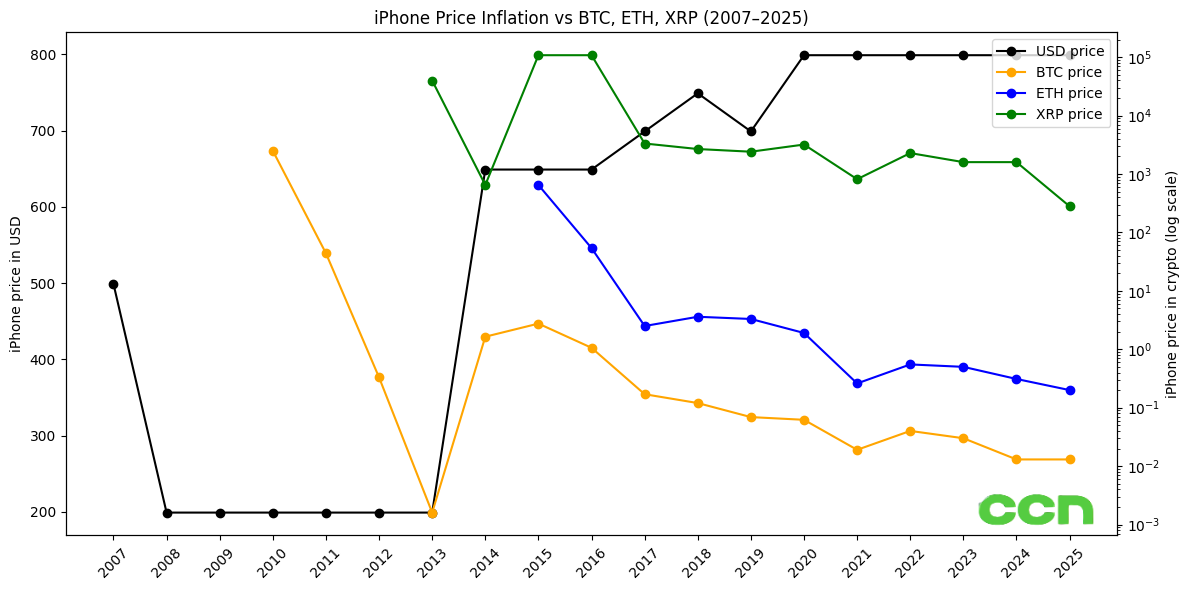
iPhone price inflation vs. BTC, ETH, XRP. | Credit: CCN.com
Crypto prices reflect approximate daily closing values for that date (or the nearest available trading day). “N/A” indicates the coin was not yet widely traded.
Year
iPhone model (U.S. release)
U.S. starting price ($)
BTC needed
ETH needed
XRP needed
2007
iPhone (2G) — 2007-06-29
$499
N/A
N/A
N/A
2008
iPhone 3G — 2008-07-11
$199
N/A
N/A
N/A
2009
iPhone 3GS — 2009-06-19
$199
N/A (BTC thin/early)
N/A
N/A
2010
iPhone 4 — 2010-06-24
$199
2,500+ BTC
N/A
N/A
2011
iPhone 4S — 2011-10-14
$199
44 BTC (BTC)
N/A
N/A
2012
iPhone 5 — 2012-09-21
$199
0.33 BTC (BTC = $600)
N/A
N/A
2013
iPhone 5s — 2013-09-20
$199
0.0016 BTC (BTC = $125)
N/A
39,800 XRP (XRP = $0.005)
2014
iPhone 6 — 2014-09-19
$649
1.64 BTC (BTC = $394.8)
N/A
649 XRP (XRP = $0.10)
2015
iPhone 6s — 2015-09-25
$649
2.75 BTC (BTC = $236)
649 ETH (ETH = $1.0)
108,167 XRP (XRP = $0.006)
2016
iPhone 7 — 2016-09-16
$649
1.06 BTC (BTC = $610)
54 ETH (ETH = $12)
108,167 XRP (XRP = $0.006)
2017
iPhone 8 — 2017-09-22
$699
0.17 BTC (BTC = $4,100)
2.5 ETH (ETH = $280)
3,330 XRP (XRP = $0.21)
2018
iPhone XR — 2018-10-26
$749
0.12 BTC (BTC = $6,300)
3.6 ETH (ETH = $210)
2,678 XRP (XRP = $0.28)
2019
iPhone 11 — 2019-09-20
$699
0.069 BTC (BTC = $10,182)
3.3 ETH (ETH = $210)
2,410 XRP (XRP = $0.29)
2020
iPhone 12 — 2020-10-23
$799
0.062 BTC (BTC = $12,944)
1.9 ETH (ETH = $415)
3,196 XRP (XRP = $0.25)
2021
iPhone 13 — 2021-09-24
$799
0.019 BTC (BTC = $42,840)
0.26 ETH (ETH = $3,100)
815 XRP (XRP = $0.98)
2022
iPhone 14 — 2022-09-16
$799
0.040 BTC (BTC = $19,700)
0.55 ETH (ETH = $1,450)
2,283 XRP (XRP = $0.35)
2023
iPhone 15 — 2023-09-22
$799
0.030 BTC (BTC = $26,600)
0.50 ETH (ETH = $1,590)
1,598 XRP (XRP = $0.50)
2024
iPhone 16 — 2024-09-20
$799
0.013 BTC (BTC = $63,000)
0.31 ETH (ETH = $2,600)
1,598 XRP (XRP = $0.50)
2025
iPhone 17 — 2025-09-19
$799
0.012–0.014 BTC
0.18–0.21 ETH (ETH = $3.8k–$4.4k in late Aug/Sept)
265–290 XRP (XRP = $2.75–$3.02 in Sept)
* 2008–2013 Apple heavily marketed $199 on a two-year contract. Unlocked pricing was significantly higher.
BTC had only just begun trading in 2010; the $199 “price” at a few cents per BTC yields thousands of coins, an illustration of illiquid, nascent-market pricing.
Apple’s advertised iPhone 12 base was $799, but the SIM-free price many buyers paid was $829; the $799 figure is the canonical launch headline.
What the Timeline Shows
Early 2010s: BTC was tiny; the iPhone’s “BTC cost” was enormous (thousands of BTC in 2010).
2013–2016: XRP appears (2013), ETH launches (2015). Their low early prices make the “coin cost” look huge compared with today.
2017 bull cycle: BTC/ETH soared; the BTC/ETH needed for an iPhone collapsed into fractions.
2022 bear market to 2024–2025 recovery: BTC and ETH rebounded strongly, pushing the coin amounts per iPhone even lower. XRP rose sharply into 2025 as well.
Bitcoin Pricing Highlights How Volatility Shapes Perceived Costs
BTC pricing exposes how volatility in crypto can dramatically reshape perceptions of cost, especially for something as familiar as an iPhone.
Bitcoin Cycles and Consumer Costs
Pricing iPhones in Bitcoin often reflects Bitcoin’s own cycles more than Apple’s pricing decisions. For example, the iPhone 6s “cost” almost 2.75 BTC in 2015, while the iPhone 13 was down to 0.019 BTC in 2021.
Apple hasn’t drastically reduced its prices, what changes is Bitcoin’s value, which swings the perceived “cost” of a $799 phone by an order of magnitude, depending on the month and year.
ETH and XRP Trends
Ethereum and XRP follow their own trajectories. Ethereum’s Merge-era dip in September 2022 meant the iPhone 14 “cost” 0.55 ETH, while 2021’s bull run brought the iPhone 13 to just 0.26 ETH.
XRP began with micro-prices, meaning early models cost thousands of tokens. Regulatory wins and market rallies in later years compressed the XRP needed to buy a new phone, creating striking visual contrast in crypto pricing charts.
Stable Dollar Prices Since 2019
In contrast, Apple’s dollar pricing for non-Pro iPhones has been stable since 2019. The main models have floated between $699 and $799, with the iPhone 11 at $699 and subsequent models at $799. In 2025, the base model doubled its storage to 256 GB, counteracting some effects of inflation when comparing specifications over time.
Carrier Subsidies and Crypto Conversion
Before 2014, advertised prices like $199 were subsidized by mobile carriers, bundling the true device cost into 24-month service contracts. For crypto comparisons, those years should be treated with caution, since direct conversion misrepresents the real out-of-pocket expense. It’s best to take 2008–2013 numbers as rough indicators, not direct analogs to the SIM-free era.
Framing iPhone pricing through the lens of Bitcoin, Ethereum, or XRP highlights how volatile assets can change the inflation story, making clear that perceived costs shift just as much from the asset’s fluctuations as from the manufacturer’s price tags.
The Early Years: iPhones vs. Early Bitcoin
When the iPhone 4 launched in June 2010, Bitcoin had only just begun trading. Its price hovered around $0.08. That means a $199 iPhone, still locked to a carrier contract, would have cost over 2,500 BTC.
The iPhone 4S in 2011 came just as BTC crept into single digits. At $4.50 per coin, the $199 subsidized phone was “only” 44 BTC. Again, hindsight makes this look like a tragic bargain.
Ethereum Enters the Picture
By 2015, Apple released the iPhone 6s for $649, and a new coin, Ethereum, had just launched. ETH was barely $1 at the time. That meant one iPhone 6s equaled 649 ETH.
If held, those 649 ETH would be worth nearly $2.5 million at 2025 prices. Instead, many early buyers might have shrugged off Ethereum as a novelty.
That same iPhone in BTC terms cost 2.75 BTC (Bitcoin at $236). XRP, still trading for fractions of a cent, priced the phone at over 100,000 XRP.
The First Crypto Bull Cycles Meet iPhones
The iPhone 8 in 2017 launched right as Bitcoin heated up toward $4,000. Suddenly, an iPhone cost just 0.17 BTC. For ETH holders, it was a mere 2.5 ETH. In XRP, it was about 3,330 coins at $0.21 each.
These numbers show the first taste of the “iPhone deflation” effect in crypto terms: as coins appreciated, the same phone looked drastically cheaper.
By 2019’s iPhone 11, Bitcoin was around $10k. The phone equated to only 0.069 BTC. ETH had sagged from its peak, so it cost a heavier 3.3 ETH, a reminder that not all coins move in sync. XRP, meanwhile, had cooled, so it was about 2,400 XRP.
The Pandemic Boom and iPhone 12–13
The iPhone 12 in 2020 came as crypto markets were recovering. BTC at $12,900 made the $799 phone equal to 0.062 BTC. ETH, climbing back past $400, made the phone about 1.9 ETH.
Then came the pandemic boom of 2021. By the time the iPhone 13 launched in September, BTC traded at $42,000 and ETH at $3,100.
That meant an iPhone cost only 0.019 BTC or 0.26 ETH, the cheapest yet in crypto terms. XRP, briefly buoyed near $1, priced the phone at about 815 XRP.
The Recent Years: iPhone 14–17
By 2022’s iPhone 14, crypto winter had returned. BTC slid under $20k, ETH around $1,450. The iPhone suddenly looked more expensive again: 0.040 BTC or 0.55 ETH. XRP, stuck near $0.35, priced the phone at 2,283 XRP.
In 2023, the iPhone 15 saw BTC rebounding to $26,000 and ETH to $1,600, so the phone cost 0.030 BTC or 0.50 ETH.
By 2024 and 2025, the numbers stabilized. The iPhone 16 and 17, both priced at $799, equated to just 0.013 BTC and 0.20 ETH as Bitcoin ranged between $58,000 and $68,000 and ETH pushed toward $4,000. XRP, trading near $3, priced the iPhone 17 at about 275 XRP.
Across 15 years, the amount of crypto required to buy an iPhone has fallen steeply, mirroring adoption and surging coin valuations. From thousands of BTC for a single device to less than a hundredth of a coin today, this story highlights the powerful shift crypto brings to traditional measures of value.
If held instead of spent, those early crypto payments would be life-changing fortunes, a lesson in appreciating, and understanding, the deflationary impact of digital currencies on consumer tech.
Which was the better investment: iPhones or Bitcoin?
As a financial asset, Bitcoin has dramatically outperformed any iPhone’s resale value. Even ETH and XRP, with different risk profiles, beat iPhones as “investments.” .
From a pure investment return perspective, Bitcoin, Ethereum, and XRP have vastly outperformed any monetary value retained by buying iPhones over the same timeframe. Cryptocurrencies offer potential for large capital gains (with higher risk), while iPhones, as consumer electronics, depreciate and do not generate financial returns.
Thus, for purely financial gain, investing in Bitcoin or Ethereum has been considerably better than purchasing iPhones, and XRP also offers strong growth potential, especially with recent price rallies and regulatory progress.
Conclusion
The iPhone has become more than a gadget—it’s a cultural icon and a convenient measuring stick. Pricing it in crypto highlights two very different stories: Apple’s steady pricing strategy versus the chaos and cycles of digital assets.
So the next time Apple announces another iPhone at $799, you can shrug at the dollar sticker—or ask the fun question: How many satoshis, gwei, or drops does that cost today?
The answer, as always, will depend less on Apple in Cupertino and more on the wild tides of global crypto markets.
What does “iPhone inflation in crypto” actually mean?
It’s a thought experiment: instead of USD, we price each iPhone at launch in BTC, ETH, and XRP using market prices from the phone’s release date. It shows how a relatively steady USD sticker becomes wildly volatile in crypto terms because the coins swing.
Why does 2010 look absurd (iPhone “costing” thousands of BTC)?
Bitcoin’s market was illiquid and nascent; a few cents per BTC makes any normal good look astronomically “expensive” in BTC terms. It’s the clearest demo of why volatile numeraires distort inflation stories.
Would CPI-adjusted dollars change the conclusion?
CPI-adjusting shows Apple’s base pricing has been remarkably steady (arguably better value per capability). The crypto picture would still be dominated by coin cycles, not Apple’s pricing.
Could on-chain transaction fees or exchange spreads change the numbers?
Slightly, yes. Fees/spreads, especially in earlier years, could add noise. For clarity, the table sticks to market reference prices rather than simulated checkout costs.
Disclaimer:
The information provided in this article is for informational purposes only. It is not intended to be, nor should it be construed as, financial advice. We do not make any warranties regarding the completeness, reliability, or accuracy of this information. All investments involve risk, and past performance does not guarantee future results. We recommend consulting a financial advisor before making any investment decisions.
Giuseppe Ciccomascolo began his career as an investigative journalist in Italy, where he contributed to both local and national newspapers, focusing on various financial sectors.
Upon relocating to London, he worked as an analyst for Fitch's CapitalStructure and later as a Senior Reporter for Alliance News. In 2017, Giuseppe transitioned to covering cryptocurrency-related news, producing documentaries and articles on Bitcoin and other emerging digital currencies. He also played a pivotal role in establishing the academy for a cryptocurrency exchange website. Crypto remained his primary area of interest throughout his tenure as a writer for ThirdFloor.


 Easy
Easy