Key Takeaways
- Abdul Rafay Gadit said the idea for ZIGChain emerged after realizing that most crypto-native yields rely on liquidity looping within the ecosystem.
- ZIGChain aims to bring real-world assets and institutional-grade financial products on-chain while ensuring retail investors can access the same opportunities, not just large institutions.
- Gadit described ZIGChain as an orchestration layer designed to abstract blockchain complexity.
- According to Gadit, trading will remain part of crypto, but long-term growth will depend on expanding investment options.
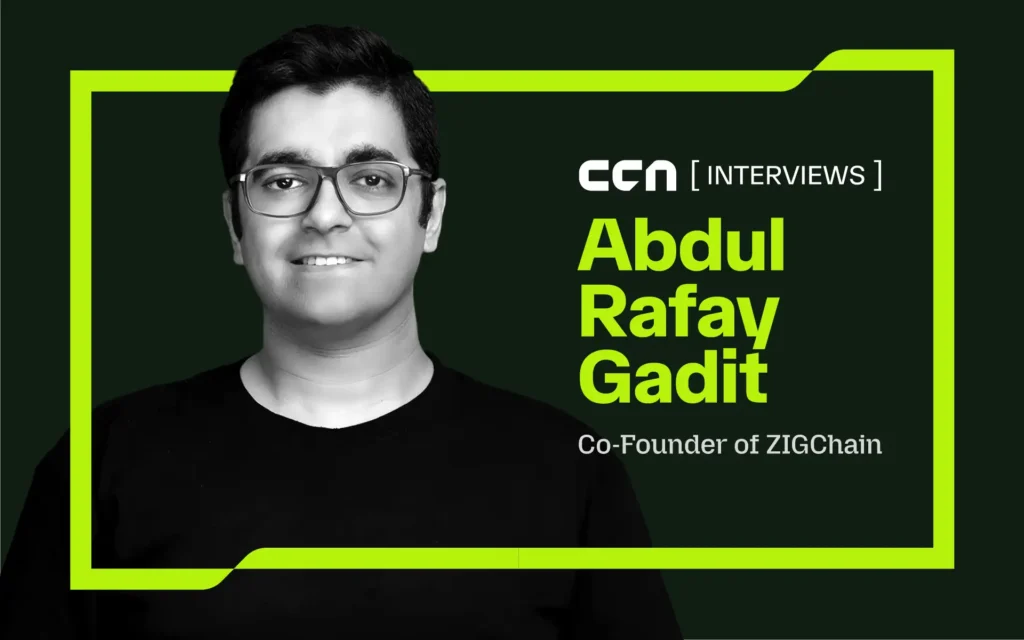
At EthCC in Cannes, Abdul Rafay Gadit, Co-Founder of ZIGChain, spoke with CCN about a shift he believes the cryptocurrency industry is slowly moving toward. After years of focusing on trading, yield farming, and speculation, Gadit argues that the next phase of crypto growth will depend on bringing real-world financial assets on-chain and making them accessible to both institutions and retail investors.
Gadit is no stranger to crypto infrastructure. Before launching ZIGChain, he helped build Zignaly, a crypto-native copy trading platform. But the experience of operating within the crypto ecosystem revealed a deeper issue: crypto yields and trading opportunities were limited, and most of the capital circulating within the space was simply being recycled.
“When we started with Zignaly, we were focused on copy trading. It worked well for crypto markets. But over time, we realized the yields in crypto were limited, and the scaling problem was real,” Gadit explained.
He pointed out that much of the yield generated in DeFi comes from looping liquidity within the ecosystem itself. While that can create short-term opportunities, it makes it difficult to attract fresh capital from outside crypto.
“Most of the money is still outside crypto. If you want real growth, you have to bring traditional finance on-chain.”
That realization became the foundation for ZIGChain.
Building a Financial Layer, Not Just Another Blockchain
Gadit described ZIGChain as an orchestration layer rather than a traditional blockchain focused on trading or technical performance. The goal is to remove complexity and create infrastructure that allows financial products to move on-chain more easily.
“We explain ZIGChain as an orchestration layer that abstracts away blockchain complexity. We provide compliant infrastructure so originators and distributors can interact without worrying about licensing or regulatory challenges.”
Instead of offering developers just a blockchain to build on, ZIGChain aims to provide a complete stack. That includes compliance infrastructure, licensing considerations, distribution mechanisms, and technical support. Gadit emphasized that this approach is closer to building a financial network than launching another blockchain.
“Most blockchains see themselves as technology. We see blockchain as a way of doing business.”
This distinction shapes how the team approaches partnerships and ecosystem growth. According to Gadit, projects building on ZIGChain are treated as clients rather than simply participants.
“When someone builds with us, we work with them closely. It’s not just ‘here’s a blockchain, go build.’ We provide the full infrastructure.”
Bridging TradFi and DeFi Without Friction
Crypto markets remain fragmented, and liquidity is often spread across different ecosystems. Gadit believes the next wave of adoption will depend on merging traditional finance and DeFi in a way that removes friction for users.
“The two worlds need to meet, but they need to meet in a way where users don’t even realize it.”
He pointed to one example from ZIGChain’s ecosystem, an AI-based intent layer called Oro. The goal is to simplify investing by allowing users to interact with blockchain-based products using natural language.
“A user could type something like ‘Buy the top five stocks from yesterday,’ and the system executes it on-chain. The user doesn’t need to understand whether it’s DeFi or TradFi.”
Gadit believes this type of experience is critical for attracting users outside crypto.
“When you remove friction, liquidity follows. When you make things interoperable, you bring TradFi money into DeFi.”
Limited Investment Options Remain a Problem
Another issue Gadit highlighted is the limited range of investment opportunities in crypto. While trading and volatility-driven strategies dominate, many investors are looking for diversification.
“If you hold stablecoins today, your options are limited. Most of the opportunities revolve around trading or volatility.”
He noted that institutional investors and high-net-worth individuals often look for exposure to different asset classes such as credit markets, fixed income, or real-world assets. Bringing those opportunities on-chain could expand crypto’s investment landscape significantly.
“The biggest hurdle for crypto for a long time was the lack of investment options.”
According to Gadit, tokenization is starting to fill that gap. By bringing traditional financial instruments on-chain, crypto platforms can expand beyond speculation and into broader capital markets.
Security Comes First
When discussing architecture and infrastructure, Gadit emphasized that security is the top priority.
“If a chain fails once, it’s very hard to recover from that.”
ZIGChain delayed its mainnet launch by three months to conduct additional audits and third-party testing. The team also requires projects launching on the chain to conduct security audits before receiving support.
“We require at least two audits for projects that want co-marketing from the chain.”
Gadit believes institutional capital will only enter crypto once trust improves.
“Big money cannot come without trust.”
Technology Is Becoming Commoditized
Gadit also shared a broader view on competition within crypto infrastructure. He believes technology alone is no longer enough to differentiate projects.
“Creating blockchain technology is becoming commoditized, especially with AI and rapid development tools.”
Instead, he sees competition shifting toward speed, partnerships, and access.
“It’s about how fast you can bring institutional-grade assets on-chain and how quickly you can give access to users.”
According to Gadit, the next winners in crypto infrastructure will focus less on technical specifications and more on adoption and accessibility.
How Crypto Trading Will Evolve
Gadit believes trading will always be part of crypto, but it will not define the industry’s future.
“There will always be trading. I trade myself. But it’s not something you allocate your entire portfolio to.”
He expects tokenized assets and credit markets to drive the next phase of growth. As crypto matures, diversification will become more important.
“If crypto wants to grow into trillions of dollars, tokenized assets will be a major factor.”
He also pointed out the scale difference between crypto and global capital markets. Crypto remains a small fraction of the global financial system, leaving significant room for expansion.
Memecoins, Speculation and Market Growth
Gadit does not see speculative trends such as meme coins as a threat to crypto’s long-term development.
“Memecoins and speculative assets will always exist. Human greed doesn’t disappear.”
However, he believes infrastructure and real-world adoption will ultimately determine long-term growth.
“You cannot build an industry on speculation alone.”
Instead, speculative cycles can help bring attention to crypto, which then creates opportunities for more serious financial infrastructure.
Fixing the Rails for the Next Phase of Crypto
Gadit concluded by emphasizing infrastructure as the key to crypto’s next stage of development. Once better rails are built, institutions and traditional investors can enter the market more easily.
“We need to fix the rails. Once the rails are ready, adoption follows.”
ZIGChain’s focus, he explained, is building infrastructure that connects traditional finance and blockchain while keeping access open to retail investors.
If that vision plays out, the next phase of crypto growth may come not from trading alone, but from integrating real financial markets into blockchain infrastructure.
The information provided in this article is for informational purposes only. It is not intended to be, nor should it be construed as, financial advice. We do not make any warranties regarding the completeness, reliability, or accuracy of this information. All investments involve risk, and past performance does not guarantee future results. We recommend consulting a financial advisor before making any investment decisions.

Onkar Singh has three years of experience as a digital finance content creator. Throughout his career, he has collaborated with various DeFi projects and crypto media outlets. In his leisure time, he enjoys fitness activities at the gym and watching movies across different genres. Balancing his professional and personal interests, Onkar continues to contribute to the digital finance landscape while pursuing his hobbies.

Giuseppe Ciccomascolo began his career as an investigative journalist in Italy, where he contributed to both local and national newspapers, focusing on various financial sectors.
Upon relocating to London, he worked as an analyst for Fitch's CapitalStructure and later as a Senior Reporter for Alliance News. In 2017, Giuseppe transitioned to covering cryptocurrency-related news, producing documentaries and articles on Bitcoin and other emerging digital currencies. He also played a pivotal role in establishing the academy for a cryptocurrency exchange website. Crypto remained his primary area of interest throughout his tenure as a writer for ThirdFloor.


 Easy
Easy