Quantum-safe Bitcoin is possible today, but it is costly.
The approach only protects newly created outputs and does not secure the majority of existing Bitcoin addresses.
Growing concern, fueled by Big Tech warnings, has driven innovation.
Bitcoin transactions could be made resistant to future quantum-computing attacks using existing network rules, according to a new research prototype from StarkWare. However, the approach may add tens to hundreds of dollars in computing costs per transfer.
The proposal, dubbed “Quantum Safe Bitcoin” (QSB), outlines a way to secure transactions against a hypothetical large-scale quantum computer without requiring changes to Bitcoin’s core protocol — a long-standing hurdle in adapting the network to emerging cryptographic threats.
Sponsored
Disclosure
We sometimes use affiliate links in our content, when clicking on those we might receive a commission at no extra cost to you. By using this website you agree to our terms and conditions and privacy policy.
The QSB scheme, presented by StarkWare Chief Product Officer Avihu Levy, replaces Bitcoin’s reliance on elliptic curve cryptography — specifically ECDSA signatures — with hash-based constructions that are resistant to quantum attacks.
Current Bitcoin transactions depend on the secp256k1 curve, which could be broken by a sufficiently powerful quantum computer using Shor’s algorithm to compute private keys from public ones.
QSB sidesteps this by anchoring security in hash pre-image resistance rather than discrete logarithms.
The system operates entirely within Bitcoin’s existing constraints, using legacy Script rules limited to 201 opcodes and 10,000 bytes, and does not require a soft fork or protocol upgrade.
Instead, it embeds a proof-of-work-style “hash-to-signature” puzzle into transaction validation, relying on a one-time signature scheme similar to HORS.
“This shows Bitcoin’s original design has more flexibility than previously understood,” the report said, describing the approach as a potential stopgap for protecting vulnerable coins, such as early pay-to-public-key (P2PK) outputs.
However, the method produces non-standard transactions that exceed default relay limits. As a result, users must submit them directly to miners rather than broadcast them across the network as usual.
High Computational Costs
While technically feasible, the approach comes with significant computational overhead.
Each QSB transaction requires users to solve multiple cryptographic puzzles through brute-force search, which they perform off-chain using GPUs.
StarkWare estimates this translates to approximately $75 to $150 in cloud computing costs per transaction under current hardware conditions.
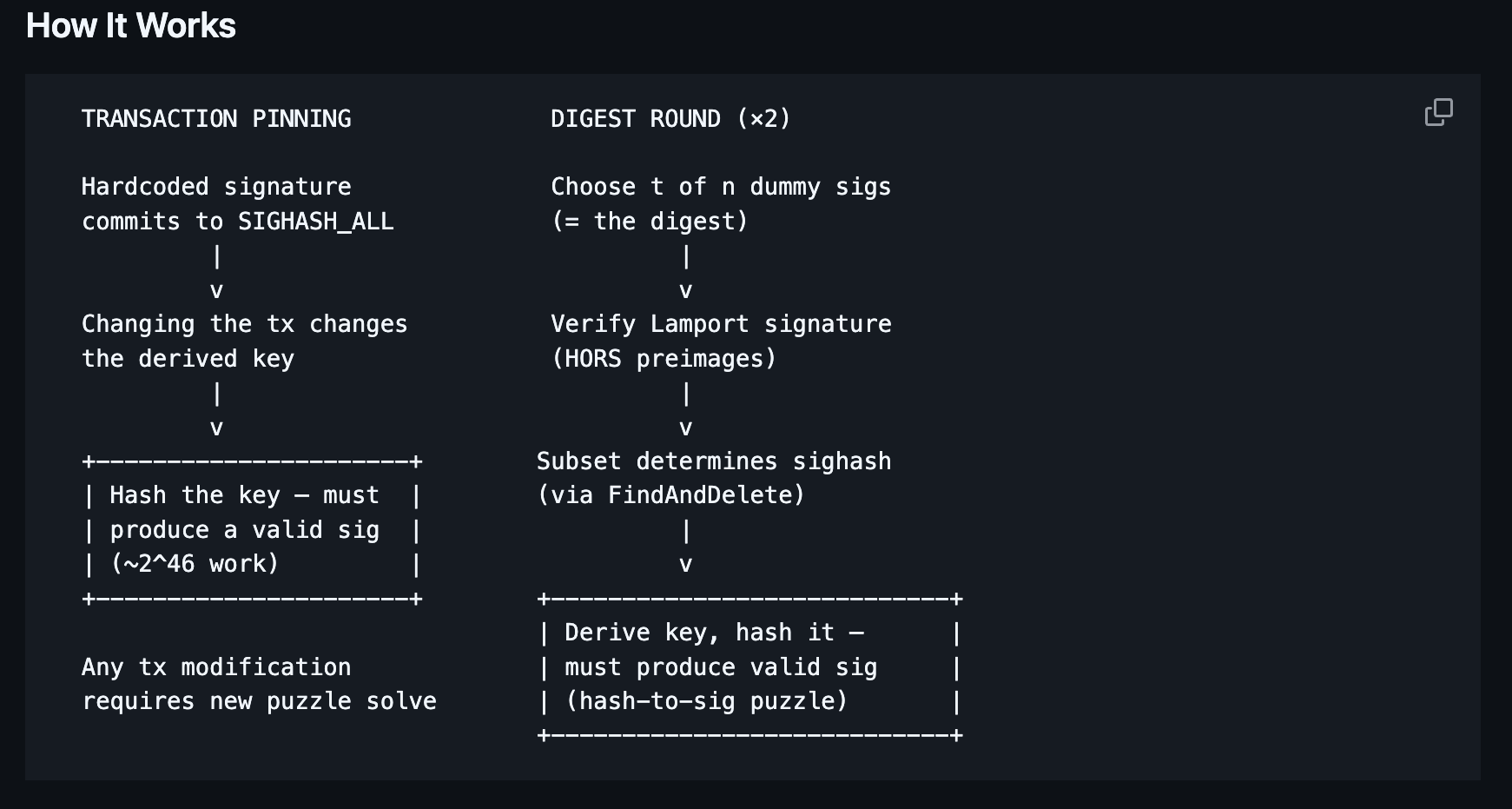
How does Quantum Safe Bitcoin (QSB) work? | Source: GitHub
The process involves three stages: “pinning” a transaction to specific parameters, followed by two “digest” rounds that determine valid subsets of signatures, each requiring independent search efforts.
Such costs make the scheme impractical for everyday payments, where transaction fees are typically a fraction of a dollar.
Instead, researchers consider it better suited to secure high-value or at-risk holdings if quantum threats become more immediate.
Partial Solution Still Draws Celebration
The prototype does not fully solve Bitcoin’s quantum vulnerability.
Most existing Bitcoin addresses, including widely used formats like P2PKH, still rely on ECDSA and would remain vulnerable if quantum computers become capable of breaking 256-bit elliptic-curve cryptography.
QSB only applies to newly created outputs using its custom scripting scheme.
Quantum conditions also reduce its effective security level. The design offers roughly 118-bit protection against classical attacks, but Grover’s algorithm reduces this to around 59 bits.
Despite these limitations, the research has drawn celebration across much of the crypto community.
JAN3 CEO Samson Mow said on X that “Bitcoin defenses against non-existent quantum computers were moving along at an incredibly fast pace.”
He has also pointed to similar efforts from Lightning Network contributors.
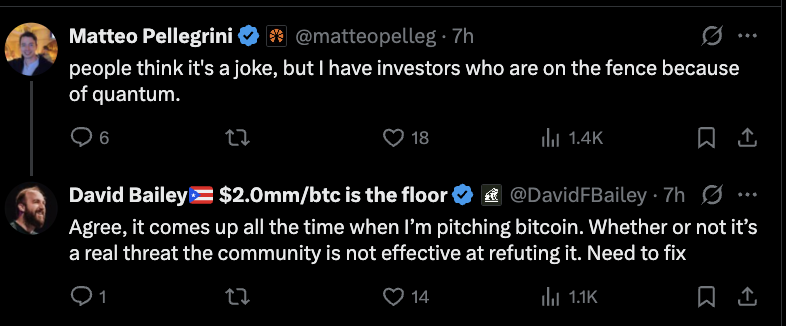
Matteo Pellegrini, Vibe CEO at Bitcoin platform Club Orange, said: “People think it’s a joke, but I have investors who are on the fence because of quantum.”
Claims of Satoshi Nakamoto’s “Built-In” Bitcoin Quantum Resistance
The proposal has also fueled speculation online that Bitcoin creator Satoshi Nakamoto may have inadvertently enabled quantum-resistant features from the network’s inception.
Some users have argued that legacy scripting behavior — particularly a mechanism known as “FindAndDelete,” which affects how transaction data is hashed — effectively allowed for quantum-safe constructions from the start.
So it turns out that when Satoshi tried to remove covenants from bitcoin, he left in some vestigial features which allow for limited tx introspection and quantum resistant signatures
Meaning bitcoin actually launched with quantum resistance back in 2009https://t.co/FExYx20Msz
However, many crypto holders have said this interpretation overstates the case.
The features leveraged by QSB are widely understood to be remnants of early design decisions, including the partial removal of more powerful scripting capabilities such as OP_CAT in 2010.
“There is no evidence Satoshi intentionally designed Bitcoin to be quantum resistant,” one analyst on X noted.
Instead, QSB exploits “vestigial” elements of the original scripting system that remained after those changes.
Bitcoin Quantum Fears Peak
The latest prototype comes as concerns over quantum computing have reached fever pitch across the crypto community.
Google said recently it is accelerating efforts to prepare for a post-quantum world, identifying 2029 as a key milestone for transitioning its systems to post-quantum cryptography (PQC).
The company cited rapid advances in quantum hardware and warned that future machines could eventually break widely used encryption and digital signature schemes.
It also flagged the growing risk of so-called “store now, decrypt later” attacks, in which malicious actors collect encrypted data today.
Many crypto-adjacent firms have moved to temper concerns, arguing the threat remains long-term.
Galaxy Research has described the risk as “real but unevenly distributed.”
The firm noted that most Bitcoin remains protected because public keys remain hidden until users transfer them.
It added that work on quantum-resistant solutions is already underway, including proposals such as BIP 360.
ARK Invest has reached similar conclusions, saying current quantum systems are far from capable of breaking Bitcoin’s encryption at scale.
While it estimates that a portion of Bitcoin could be exposed in a future scenario, it places the timeline for such capabilities in decades.
Kurt Robson is a London-based reporter at CCN, specialising in the fast-moving worlds of crypto and emerging technology. He began his career covering local news in Cornwall after graduating from Falmouth University with First Class Honours in Journalism. There, he cut his teeth on everything from council meetings to missing swans.
He quickly rose through the ranks to become a frontline journalist at several of the UK’s leading national newspapers. Over the years, he has interviewed musicians and celebrities, reported from courtrooms and crime scenes, and secured multiple front-page exclusives.
Following the upheaval of the COVID-19 pandemic, Kurt shifted his focus to technology journalism—just ahead of the AI boom. With a natural curiosity and a trained eye for emerging trends, he has found a new rhythm in reporting on innovation.
At CCN, Kurt's work focuses on the cutting edge of crypto, blockchain, AI, and the evolving digital world. Drawing on his background in people-first reporting and his deep interest in disruptive tech, Kurt delivers stories that are insightful, entertaining, and human-centric.