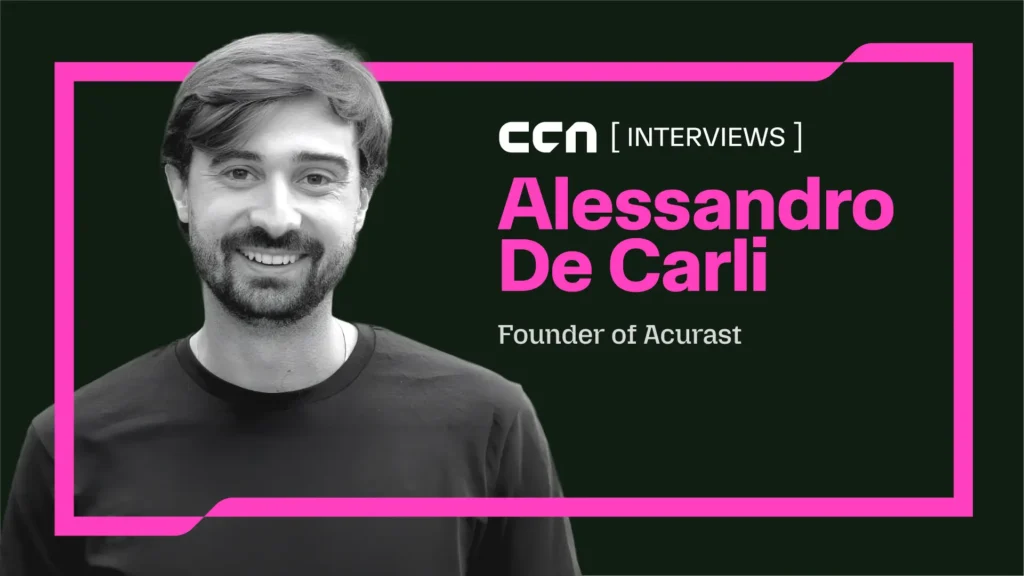
The shift toward running AI on devices already started. Di Carli believes that trend will accelerate. | Image source: CCN
Share
Global demand for computing power continues to rise as artificial intelligence, automation, and data-driven services expand across industries.
Traditional cloud providers still dominate this space, relying on centralized data centers that require large amounts of energy, capital, and infrastructure.
At the same time, billions of smartphones sit unused or underutilized, despite being some of the most advanced and efficient computing devices ever built.
Acurast aims to connect these two realities.
The project turns idle smartphones into a decentralized cloud network, allowing developers to run workloads across a global pool of consumer devices.
This approach raises important questions about efficiency, privacy, scalability, and control, especially as AI agents begin to operate more independently and interact with financial systems.
In this interview, Alessandro De Carli, founder of Acurast, explains how mobile devices can support AI workloads, how decentralized infrastructure works in practice, and what risks and opportunities emerge when combining AI agents, on-chain payments, and distributed compute.
Watch the full video here:
Turning Smartphones Into Decentralized Compute
Acurast builds a network where unused smartphones provide computing power. The idea sounds simple, but it challenges how cloud infrastructure works today.
De Carli explains that the system connects two sides. One side includes individuals with unused devices. The other includes developers who need compute resources.
“With Acurast, you can basically then monetize that compute and earn rewards and incentives by dedicating the compute to the network.”
Developers use this distributed network to run workloads in a decentralized way. Current use cases include web scraping, rendering, and secure automation tools.
Can Smartphones Handle AI Workloads?
The shift toward running AI on devices has already started. De Carli believes that trend will accelerate.
“In the future, a lot of the inference that today is being done in data centers will be done directly on the device that you own.”
Two factors drive this shift:
Hardware improvements: Smartphones now include specialized chips such as NPUs (Neural Processing Units).
Smaller models: Open-source communities continue to reduce AI model size and hardware requirements.
Large models still require data centers. However, lightweight models already run efficiently on mobile devices.
Battery Life and Performance Concerns
Running AI on smartphones raises concerns about battery usage. De Carli acknowledges the impact but highlights efficiency improvements.
“They still consume power, they still impact your battery life, but it will always be pushed down to do so less and less.”
Acurast avoids direct impact on active devices. Users typically connect spare phones to power sources when contributing compute.
“People that do that, they don’t let this run in the background… they’re always plugged in and are charging their phone.”
Turning Unused Smartphones Into Sustainable Decentralized Compute
Acurast also positions itself as a sustainability solution. Millions of devices become obsolete every year, despite still having strong hardware capabilities.
“Why would you go and produce more and more RAM and CPUs… when you can simply just upcycle what is already there?”
De Carli highlights the scale of engineering behind smartphones, especially iPhones, which receive billions in research and development funding.
These devices often sit unused after only a few years, despite their efficiency.
Securing Decentralized Compute: Trust, Hardware, and Staking Incentives
Security remains a major challenge when compute comes from unknown participants. Acurast relies on hardware-level protections built into smartphones.
“These devices are the most secure devices that a consumer owns.”
The system uses hardware security modules and device attestations to verify authenticity. If a device gets tampered with, it loses its trusted status.
To ensure reliability, Acurast introduces a staking model.
“There is a stake… that I will get slashed if I don’t do what I said I would.”
This mechanism encourages consistent uptime and honest participation across the network.
Ensuring Reliability Across Diverse Smartphone Devices
Smartphones differ widely in hardware and performance. Acurast addresses this through transparency and economic incentives.
The network tracks device capabilities, security levels, and uptime. Developers can choose which devices to trust based on these metrics.
If a device runs outdated or vulnerable software, developers can exclude it.
Decentralized infrastructure does not aim to replace all cloud services immediately. Instead, it focuses on specific use cases where it offers clear advantages.
“There are use cases that will be unbeatable to be run on a decentralized infrastructure.”
Web scraping stands out as one example. Distributed devices can bypass limitations that centralized servers face.
Mobile chips also offer strong efficiency in power-to-compute conversion. This creates potential for long-term cost advantages.
Still, De Carli remains cautious about broad claims.
“Will it be for everything? I don’t know yet.”
Global Accessibility and Emerging Markets
Smartphones exist almost everywhere, including regions with limited traditional infrastructure.
“Every household, every little village… has a mobile phone.”
This makes decentralized compute accessible across Africa, Asia, Latin America, Europe, and North America.
Acurast already sees global participation, not limited to developed markets.
Acurast supports AI agents that can automate tasks, including on-chain payments. This introduces new risks.
Large language models can still make mistakes or ‘hallucinate.’ This creates potential for unintended financial actions.
“The only way… is by specifying spending limits or requiring approval for certain actions.”
Users must define clear boundaries. Full autonomy still carries risk.
Who Takes Responsibility When Things Go Wrong?
In decentralized systems, responsibility shifts to users.
“It is ultimately the user who is responsible for whatever that agent is doing.”
Acurast provides infrastructure and transparency. It does not control how users deploy agents or configure automation.
Blockchain transparency helps track actions and identify issues, but accountability remains with the user.
Acurast presents a new model for cloud infrastructure, one that relies on devices already in users’ hands. The concept blends AI, blockchain, and decentralized systems into a network that prioritizes efficiency, privacy, and accessibility.
Smartphones may not replace data centers overnight. However, they already support specific workloads at scale. As hardware improves and AI models become lighter, decentralized compute could expand into more areas.
At the same time, risks around automation, security, and responsibility remain. The technology continues to evolve, but users must still define clear safeguards and limits.
Disclaimer:
The information provided in this article is for informational purposes only. It is not intended to be, nor should it be construed as, financial advice. We do not make any warranties regarding the completeness, reliability, or accuracy of this information. All investments involve risk, and past performance does not guarantee future results. We recommend consulting a financial advisor before making any investment decisions.
Dr. Lorena Nessi is an award-winning journalist and media technology expert with 15 years of experience in digital culture and communication. Based in Oxfordshire, UK, she combines academic insight with hands-on media practice.
She holds a PhD in Communication, Sociology, and Digital Cultures, and an MA in Globalization, Identity, and Technology.
Lorena has taught at Fairleigh Dickinson University, Nottingham Trent University, and the University of Oxford. She is a former producer for the BBC in London, with additional experience creating television content in Mexico and Japan.
Her research focuses on digital cultures, social media, technology, capitalism, and the societal impact of blockchain innovation.
She has written extensively on digital media and emerging technologies, with her work featured in both academic and media platforms. Her Web3 expertise explores how blockchain technologies shape culture, economics, and decentralized systems.
Outside of work, Lorena enjoys reading science fiction, playing strategic board games, traveling, and chasing adventures that get her heart racing. A perfect day ends with a relaxing spa and a good family meal.


 Easy
Easy